Delegates will elect the next California Republican Party chair on February 26. Before they do, they are owed answers about why the party officially endorsed Dena Maldonado over the top Republican vote-getter in CA-14.
Republican Forum | Opinion & Analysis
219
votes by which Wendy Huang finished ahead of Dena Maldonado in the certified June 16 special primary
~250
questions in the 27-page letter to party chairs. No public response.
2 years
the term delegates will decide when they elect the next California Republican Party chair
In both 2026 CA-14 primaries, Wendy Huang was the top Republican vote-getter. Dena Maldonado finished behind her both times. The California Republican Party and the Alameda County Republican Party officially endorsed Maldonado anyway. Chairwoman Corrin Rankin has not answered the questions that followed. Delegates should not be asked to choose the next chair while those questions remain unanswered.
What the votes show
Contest
Wendy Huang (R)
Dena Maldonado (R)
Huang’s margin
June 16 special primary (certified)
11,407 (9.22%)
11,188 (9.05%)
219 votes
June 2 regular primary (county’s June 12 update)
20,295 (13.16%)
18,732 (12.14%)
1,563 votes
Sources: Alameda County Registrar of Voters; California Secretary of State.
Neither Republican reached the top two. Democrats Aisha Wahab and Melissa Hernandez advanced in both contests. Wahab won the seat.
The official endorsement
Both the California Republican Party and the Alameda County Republican Party officially endorsed Dena Maldonado. Maldonado used that endorsement on her campaign materials. Alameda County Chair Jeanne Solnordal has said the county endorsing commission backed Maldonado by at least a two-thirds vote after a March meeting that Huang was invited to but did not attend.
That does not answer the central questions for the state party: Why did the CAGOP officially endorse the second-place Republican over the first-place Republican? What process produced that decision? Who made the final call?
The mailer
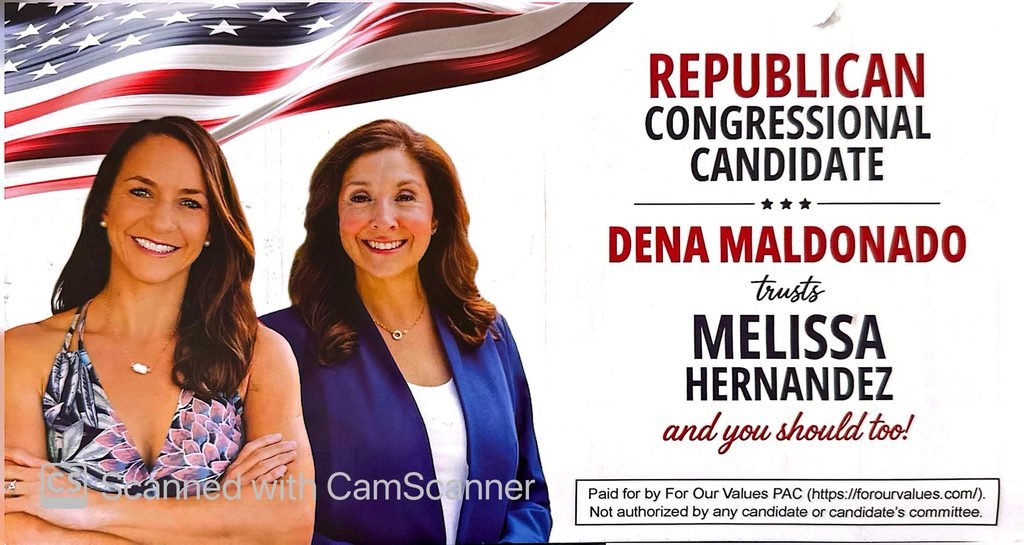
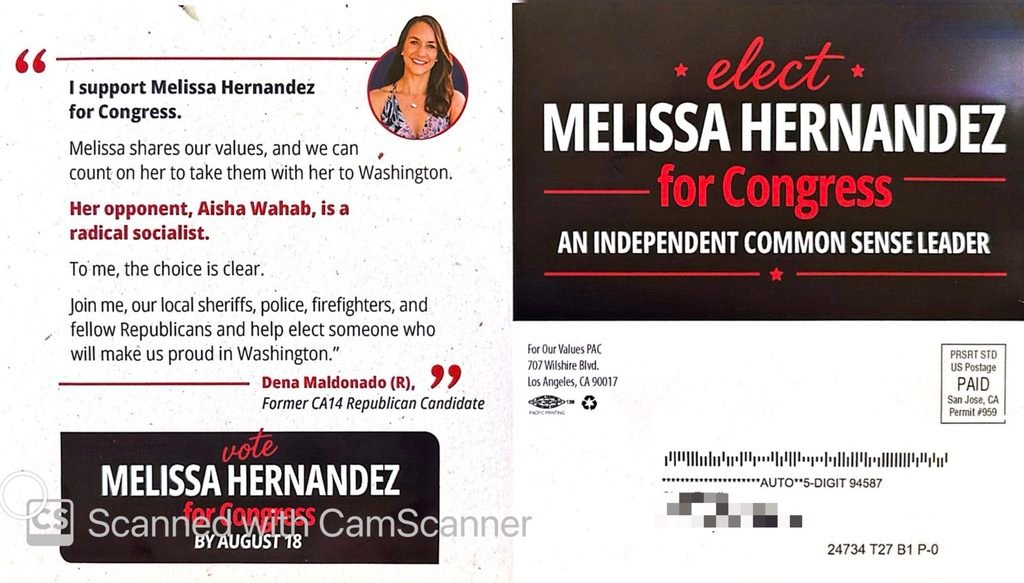
In August, a mailer paid for by For Our Values PAC featured Maldonado, labeled “Former CA14 Republican Candidate,” urging voters to elect Democrat Melissa Hernandez and calling Wahab a “radical socialist.”
Exhibit 1: Front of the mailer, paid for by For Our Values PACExhibit 2: Reverse and mailing panel (voter address removed)
Not authorized by any candidate or candidate’s committee.
Disclaimer printed on the For Our Values PAC mailer
Because of that disclaimer, it is not clear who wrote the quote or whether Maldonado approved it. Maldonado’s federal committee had reported no money raised or spent, and her campaign website was down by August.
A party that officially endorses a candidate owes its voters an answer when that candidate’s name is later used to elect a Democrat. Has the CAGOP asked Maldonado whether the mailer reflects her views? If it does, what is the party’s response?
Questions for Chairwoman Rankin
Why did the CAGOP officially endorse the second-place Republican over the first-place Republican?
What process produced that decision, and who made the final call?
Has the CAGOP asked Maldonado whether the mailer reflects her views?
If it does, what is the party’s response?
Delegates vote on February 26. They should have the answers first.
Part 5 of 5 — The 2027 Leadership Reset: a Republican Forum series on the RNC and the California GOP
The CAGOP Needs New Leadership. Time to Clean House.
Republican Forum | Opinion & Analysis
Over four installments we have argued that the party needs accountability at every level, from the RNC to the state to the county. This final installment names names. We believe California Republican Party Chairwoman Corrin Rankin, National Committeeman Shawn Steel and National Committeewoman Connie Conway should step aside, and that delegates should replace them if they do not. This is a judgment about results, not personalities.
The 2026 election cycle delivered another round of defeats for the California Republican Party, and for years the state’s conservative movement has been losing influence. Accountability has to start at the top of the party structure.
A record of stagnation
Shawn Steel has been a fixture of party politics in California for decades, and Connie Conway holds the other California seat on the RNC. Together they represent the permanent leadership class that grassroots conservatives have been trying to move past. National committee seats are meant to be positions demanding results, not lifetime appointments.
The questions we posed in Part 4 apply directly here. California has no voice among the RNC’s top ten officers. The party is losing ground to independents. And the people responsible for representing California Republicans nationally have little to show for their time in office.
Accountability inside our own ranks
The party’s handling of local controversies deserves scrutiny too. In California’s 14th Congressional District, Republican candidate Wendy Huang publicly questioned the party’s endorsement of fellow Republican Dena Maldonado, calling it deeply irregular and accusing Maldonado of being a “ghost candidate.” Maldonado has denied the claim. Huang’s campaign sent a 27-page letter with about 250 questions to the Alameda County and California Republican chairs. Whatever the truth of the allegation, voters are owed a transparent public accounting of how that endorsement was made.
When local disputes like this surface, state leaders cannot simply look the other way. Silence on party mismanagement erodes whatever trust remains with the grassroots base.
What the bylaws say
We do not have to wait for current leaders to step aside voluntarily. The Standing Rules and Bylaws of the California Republican Party (full text below) make clear where authority rests. Section 1.02 states: “The Committee consists of the delegate membership (or delegation) meeting in convention from time to time, the Executive Committee, and the executive direction of the elected officers and board of directors, as provided more particularly in these bylaws.”
The delegates decide who leads the party, and the bylaws set the calendar. Section 2.03.01(A) provides: “Elections for the office of Chairman… shall be held at the Spring election meeting in odd-numbered years and the officers so elected shall serve for the two-year term following the election meeting.” That puts the chairmanship on the ballot at the spring 2027 meeting.
The national committee seats follow a different schedule. Section 2.03.02(A)(4) provides: “For purposes of election of Republican National Committeeman and Republican National Committeewoman, the election shall be held at the Committee’s meeting immediately preceding the Republican National Convention.” That election is tied to the next national convention, so replacing Steel and Conway depends on that vote unless they choose to resign sooner.
If the chairmanship becomes vacant, Section 2.03.02(B)(1) provides the remedy: “If a vacancy occurs in the office of Chairman, by reason of resignation, death or otherwise, the State Vice Chairman shall succeed automatically to that office.”
What delegates and voters should do now
The first step is to read the bylaws. The second is to hold every candidate for chair, and every incumbent, to the standard set out in this series: measurable results, transparency, real representation and accountability to the grassroots. Republican voters should demand that their delegates use their authority to bring about real party reform, abandon a failed election strategy and rebuild the party’s infrastructure from the ground up.
The era of failing upward in the California Republican Party should end in 2027.
Part 4 of 5 — The 2027 Leadership Reset: a Republican Forum series on the RNC and the California GOP
2026 Exposed the Problem. 2027 Must Bring Real Change.
Republican Forum | Opinion & Analysis
Enough excuses. Enough insider politics. Enough business as usual. The Republican Party cannot ask for a bigger national coalition while refusing to confront the weaknesses in its own leadership.
Earlier in this series we asked who should lead the RNC, who should vote for its chairman, and why California Republicans are losing ground. This installment looks at who actually sits at the national leadership table, and then turns the same standard on California.
For too long, party leadership has been treated as an exclusive circle of relationships, alliances, fundraising networks and institutional insiders, while grassroots Republicans supply the money, volunteers, campaign workers and votes. When it comes to national influence, geographic representation and meaningful inclusion, serious questions remain, and the January 2026 leadership roster is a good place to ask them.
I. Who has a seat at the table?
The ten positions on the January 2026 national leadership roster are held by representatives of these states:
Florida
Kentucky
New York
Alabama
Mississippi
South Dakota
South Carolina
Louisiana
Montana
North Carolina
The list includes RNC Chairman Joe Gruters, Co-Chair KC Crosbie, Treasurer Jennifer Saul-Rich, Secretary Vicki Drummond and General Counsel Mike Hurst, along with congressional and other national party leadership positions.
California is not on it. California is the nation’s largest state, with millions of Republican voters, substantial fundraising potential, an established grassroots network and Republican communities across its urban, suburban and rural regions. Yet it has no representative among those ten positions. That should raise serious questions about how influence is distributed in the national party.
To be clear, California Republican Party Chairwoman Corrin Rankin does appear in the broader state-chair roster. The criticism here concerns California’s absence from the ten-position national leadership table, not from the RNC altogether. But the distinction does not answer the larger question: why isn’t California more prominently represented in national decision-making? California Republicans deserve more than an occasional acknowledgment when the national party needs their money, volunteers and votes. We deserve influence, access and a meaningful voice.
II. The representation question
The Republican Party often talks about expanding its coalition and attracting voters from every background. Those ambitions have to show up in leadership, not just in campaign speeches.
The roster identifies Senator Tim Scott of South Carolina as a prominent Black American leader, and Corrin Rankin is the first Black woman to lead the California Republican Party. Those accomplishments should be acknowledged. However, the ten-position national roster does not identify a clearly documented Hispanic American or Asian American among its listed leaders.
Where are Hispanic American and Asian American voices at the highest levels of national Republican leadership? These communities are not political accessories. They are part of America’s electorate and part of the Republican coalition. Representation is not about a photograph or a few names in a press release. It is about having a real voice where decisions are made.
III. The Democratic comparison
The Democratic National Committee’s January 2026 leadership roster offers a useful contrast:
Leader
Position
Documented representation
Malcolm Kenyatta
DNC Vice Chair
Black American
Artie Blanco
DNC Vice Chair
Latina
Joyce Beatty
DNC Associate Chair
Black American
Hakeem Jeffries
House Democratic Leader
Black American
Democrats also have two prominent Californians in congressional leadership: Pete Aguilar, Democratic Caucus Chair (Hispanic American), and Ted Lieu, Democratic Caucus Vice Chair (Asian American). Jeffries, Aguilar and Lieu hold congressional caucus positions rather than DNC officer posts, but they show California’s presence in Democratic leadership.
Category
Republican national roster
Democratic national roster
Black American representation
Tim Scott
Malcolm Kenyatta, Joyce Beatty, Hakeem Jeffries
Hispanic/Latino representation
None clearly documented in the ten-position roster
Artie Blanco
Asian American representation
None clearly documented in the ten-position roster
No clearly documented Asian American in the listed DNC officers
California congressional leadership
No California representative in the ten-position roster
Pete Aguilar and Ted Lieu
These are documented examples, not demographic censuses, and the two rosters contain different numbers and types of positions. But the comparison raises an uncomfortable question: if we want a genuinely nationwide coalition, why aren’t we doing more to make sure our national leadership reflects the breadth of our own electorate?
IV. Representation is not enough: results matter
This is bigger than demographics. It is about whether national and state leadership are delivering the organizational strength, grassroots engagement, fundraising, candidate development and electoral competitiveness that Republican voters expect.
A leadership position should never become a lifetime entitlement. A title is not an accomplishment, and a political connection is not a record of success. Republicans deserve to know what worked, what failed, where resources went and what measurable improvements leadership has delivered. If leadership cannot show results, it should not expect automatic loyalty.
V. Questions every candidate should answer
Part 1 listed the general reform questions for anyone seeking the RNC chairmanship. These are the ones that follow from the roster:
Why does California have no representative among the ten national positions listed in January 2026?
What concrete steps will increase Hispanic American and Asian American participation in national Republican leadership?
How will the national party give state and territorial organizations greater influence?
What measurable results has the current leadership delivered in grassroots development and candidate recruitment?
What will keep the RNC from becoming an institution controlled by a narrow circle of established relationships?
A candidate who cannot answer these questions should face serious scrutiny. No automatic endorsements, no entitlement to another term and no protection for insiders.
VI. California must apply the same standard at home
California cannot expect national recognition while avoiding its own organizational problems. We cannot demand change in Washington while refusing to demand it in Sacramento. These questions are not personal attacks. They are basic expectations of responsible leadership:
Where is the measurable growth in grassroots participation?
How are we developing the next generation of Republican candidates?
Are Hispanic American and Asian American Republican communities being meaningfully included in party decision-making?
Are county Republican organizations getting the support they need?
Are we building a sustainable organization that can compete across California, or repeating the same strategies and expecting different results?
The final word: California Republicans deserve better
Let’s stop pretending that preserving the same leadership structure is a strategy for rebuilding the party. Let’s stop confusing titles with accomplishments. Let’s stop treating grassroots Republicans as an election-season resource instead of the foundation of the party. And let’s stop making promises about inclusion and coalition-building without demanding results.
The 2027 California Republican Party chairmanship must be about a new direction, new leadership and a new standard of accountability. We need leaders who see Hispanic American, Asian American, Black and other Republican communities not as voters to be contacted at election time but as essential participants in shaping the party, and who will build relationships with county organizations, recruit candidates, develop young leaders, strengthen fundraising and build a sustainable statewide organization. Most of all, we need leaders willing to be held accountable.
The current national structure should be a warning, not a blueprint for California. New leadership. New accountability. Broader representation. A stronger California Republican Party. 2027 is the time for change.
In the final installment, Part 5, we say what that change should mean for the people now holding California’s top party posts.
Part 3 of 5 — The 2027 Leadership Reset: a Republican Forum series on the RNC and the California GOP
The California GOP’s Third-Party Problem, and the 2027 Reset
Republican Forum | Opinion & Analysis
Parts 1 and 2 looked at the national committee. This installment comes home to California, because the case for a leadership reset is strongest where the party has lost the most ground.
For generations, the California Republican Party was the cradle of conservative giants, a powerhouse that produced presidents and governors who shaped the nation. Standing in the wake of the 2026 elections, the reality facing the state’s conservative grassroots is stark. The party’s statewide defeats have left many loyal voters feeling alienated in their own home, and they are right to ask how a party with that history ended up pushed to the margins of political relevance.
What the numbers say, and what they do not
To be a Republican in California today is to know the isolating feeling of belonging to a third party. In terms of power, that is simply accurate: Democrats hold the overwhelming levers of legislative and executive authority, and Republicans have not won a statewide office in years.
In terms of voter registration, the picture is more precise. In the Secretary of State’s October 30, 2026 report, Democrats stood at 44.96%, Republicans at 24.69% and No Party Preference voters at 23.02%. Republicans still hold second place statewide, but only by about 1.7 points, and the independent share has been growing. Here in San Diego, where we are based, our reporting in the San Diego GOP Accountability Series finds Republicans trailing both Democrats and independents, which makes the county party a preview of where the state could be heading.
These unaffiliated voters now carry the outreach and electoral sway the GOP once wielded. For conservative Californians who still believe deeply in their core values, watching their party lose ground to independents feels like watching their voice fade in real time.
The crossroads: the 2027 chair election
That brings the party to a critical decision point. If the California GOP is to survive as a viable statewide force, and not merely a localized resistance, the 2027 election for state party chair cannot be business as usual. It must be a moment of reckoning.
The grassroots need visionary, unifying leadership that can break out of the echo chamber, win back estranged independents and rebuild a damaged infrastructure from the ground up. Time is a luxury the party no longer has. The 2027 election is not just about passing a gavel. It is about whether this movement gets rebuilt before it fades into the California sunset.
What would that leadership have to answer for? Part 4 sets out the questions.
Part 2 of 5 — The 2027 Leadership Reset: a Republican Forum series on the RNC and the California GOP
First, Let the 50 State GOP Parties Choose Their Own Leaders
Republican Forum | Opinion & Analysis
Part 1 argued that the RNC chairmanship should be an examination of leadership, not a coronation. This installment asks a question about timing: before the Republican National Committee selects its next national chairman, should every state Republican Party have the chance to elect and seat its own leadership?
Why should the RNC elect its next national chairman before the state parties have finished choosing their own leaders?
State party chairs serve different terms, operate under different bylaws and face different election schedules. Some states have leadership contests coming up, some have just elected a chair, and others may have vacancies or internal disputes. Yet the national election arrives in January 2027. That raises real questions about timing, representation and the relationship between the national committee and the states.
1. The states should have a meaningful voice in the national debate
The Republican Party is not simply an organization headquartered in Washington, DC. It is a network of state and territorial parties, county committees, local clubs, elected officials, volunteers and voters. State parties do much of the work that national leadership depends on: they organize locally, recruit candidates, develop volunteers, build relationships with voters and coordinate election efforts.
Their leadership matters. A newly elected state chair should be able to take part in the national discussion as the representative of the organization he or she was chosen to lead.
2. A proposal: finish the state process before the national election
One proposal deserving serious consideration is a sequence in which state party leadership elections are completed, newly elected chairs are formally seated, and only then does the national committee hold its leadership election. Under this approach, the RNC would first establish the status of each state party’s leadership, identify vacancies and resolve questions about representation.
This would not force any state to replace its chair. Some chairs would be reelected, some would step aside, and some states would choose new leaders. The point is that each state should complete its own process under its own rules before the national vote.
3. Why new state leadership could change the conversation
A new generation of state chairs could bring different priorities and different expectations of the national committee. Some may emphasize stronger county organizations. Others may focus on fundraising, candidate recruitment, voter outreach, election operations or financial transparency. Some may want a more direct relationship with the RNC and a bigger role in decisions that affect their parties.
New leadership should not be assumed to mean better leadership. Returning chairs and newly elected chairs alike should be judged by their records, their proposals and their accountability to their own state organizations.
4. This is bigger than Gruters versus Crosbie
The national conversation has revolved around two people. But the question is whether the national committee’s process adequately reflects the interests of the state organizations it serves. Gruters, Crosbie and any other candidate should explain how they would work with state parties, respect their autonomy and support county and grassroots organizations. The national chairman should not be seen as the owner of the party’s state organizations.
5. The practical questions must be answered
The RNC’s voting membership and leadership election are governed by the RNC’s own rules, while state chair elections are governed by each state party’s constitution and bylaws. A proposal to delay the national election until state processes are complete would have to be tested against the RNC’s governing rules. It would also need answers to several questions:
Which states have chair elections scheduled before January 2027?
Which states have chairs whose terms run past that date?
Which states have vacancies or unresolved leadership disputes?
How would newly elected state chairs be formally recognized?
What authority would be required to change the timing of the RNC election?
How would a delay affect the committee’s operations and election responsibilities?
These are not minor administrative details. They determine whether the proposal could be implemented at all, and what would have to change for it to work.
6. The national party should not overlook its state organizations
A national party cannot function without strong state parties. State chairs should have real opportunities to explain what their organizations need, how national resources are being used and what they believe must change. The leadership election is a natural moment to examine that relationship, including whether the RNC should be more transparent about its communications with state parties, its allocation of resources and the ways state organizations can raise concerns.
The question for January 2027
Should the RNC hold its January election on the existing schedule, or should it let the states finish choosing and seating their leaders first? There are procedural, practical and representational considerations on both sides, and the RNC’s rules and the state bylaws will matter. But the Republican Party is bigger than its national headquarters, and any discussion of national leadership should take the 50 state parties seriously.
California is the largest of those state parties, and its own leadership election is coming in 2027. Part 3 turns to the state of the California GOP.
Part 1 of 5 — The 2027 Leadership Reset: a Republican Forum series on the RNC and the California GOP
It Needs a Complete Leadership Reset
Republican Forum | Opinion & Analysis
The Republican National Committee’s January 2027 chairmanship election should be about accountability, transparency and reform, not about which insider gets the next promotion.
RNC Chairman Joe Gruters has President Trump’s public endorsement for another term. RNC Co-Chair KC Crosbie, whom Trump also backed for her current post, has announced that she will challenge him at the committee’s January meeting. The headlines frame this as a dramatic fight over the party’s future. The more important question is one that gets far too little attention:
Why should Republicans accept another chairman from the same leadership structure without first demanding an accounting of its performance?
The 2026 midterms left Republicans without control of Congress. After a result like that, a change of name on the chairman’s door is not an answer. At Republican Forum, we believe the RNC needs a hard look at how it operates, who makes its decisions, how it spends its money and whether its leaders answer to the Republican voters and committee members they serve.
1. No one on the current leadership team deserves an automatic promotion
The next chairman should not be chosen simply because he or she already holds a senior title. Gruters should explain the committee’s record under his chairmanship. Crosbie should explain her own record as co-chair and her earlier service as RNC treasurer. The same standard applies to every other officer.
Republicans deserve answers about election strategy, candidate support, fundraising priorities, state-party relationships, voter outreach and internal decision-making. They deserve to know what worked, what failed and who was responsible.
A presidential endorsement is a major political development. It is not a substitute for accountability. And a challenger should not be exempt from scrutiny simply because she promises change.
The January vote should not be a coronation. It should be an examination.
2. The succession question, and what we do not know
There is another part of this story that deserves attention. Our editorial opinion is that the public contest between Gruters and Crosbie leaves open a fair question: could Crosbie, a Trump-aligned Republican, ultimately prove an acceptable succession choice within the president’s political orbit?
We offer that as a question, not a finding. We have no evidence of a private arrangement, and early reporting cuts the other way: Axios reported that the White House was blindsided and angered by Crosbie’s announcement. What the public record actually shows is Trump endorsing Gruters and Crosbie, a former treasurer and current co-chair, announcing her challenge.
The press should look past personalities and headlines to the actual proposals, relationships, records and decisions behind the succession debate. And we have a warning for both sides of the contest: even if Crosbie becomes the next chair, that alone is not reform. She must say what she would change, how she would change it and how her record informs her plan. Replacing one insider with another is not the same as changing the institution.
3. The party needs reformers beyond the RNC establishment
Why is the discussion so narrowly focused on people who already hold positions inside the national committee? Republicans should be willing to hear a much wider range of voices.
Figures such as Thomas Massie, Marjorie Taylor Greene and Joe Kent have each been part of public debates about party priorities and the direction of the conservative movement. Their records and positions differ, and none should be assumed to be a declared candidate for RNC chairman. But their presence in the broader conversation raises a fair question: why should the party’s future be discussed only among those who already control its national organization?
The party should also hear from state-party leaders, county chairs, grassroots activists and people who have built political organizations outside Washington. The next generation of leadership should be determined by experience, proposals and accountability to Republican voters, not by proximity to the national establishment.
4. What real RNC reform should look like
Anyone seeking the chairmanship should be ready to answer these questions publicly:
Financial transparency: How is the RNC spending its money, and what measurable results is that spending producing?
State and county support: Are local Republican organizations getting the resources, training and help they need?
Candidate development: What is the committee doing to recruit and prepare competitive candidates?
Grassroots participation: Do the RNC’s 168 voting members have real influence over major decisions?
Election strategy: How will the party evaluate its performance and respond when its strategies fail?
Leadership recruitment: Is the committee developing talent beyond its existing circle of national insiders?
Representation: Do people from every community in the Republican coalition have a meaningful path into party leadership?
These are not unreasonable demands. They are basic questions about the responsibilities of a national political organization. We take up the representation question in detail in Part 4.
5. January 2027 must be an open contest, not an establishment coronation
The RNC’s 168 voting members carry an important responsibility when the committee meets. They should not treat the vote as routine. They should demand answers from current leadership, weigh competing reform proposals and consider candidates from outside the existing leadership circle. Gruters should explain why he deserves another term. Crosbie should explain why her leadership would produce change. Any additional candidate should meet the same standard.
No one should be handed the chairmanship because of a personal relationship, an endorsement, an existing title or a promise to do better. The decision should rest on transparent discussion and clearly stated plans. Next in this series, Part 2 asks a question about the vote itself: should the states get to finish choosing their own leaders first?
6. The party belongs to its voters, not its management
The RNC serves the Republican Party. It does not own the party, its voters or the conservative movement. Its officers are temporary stewards who answer to the organization and the people it represents.
Crosbie may become the next chair. Gruters may keep the job. Another candidate may enter the race. None of that should stop Republicans from asking whether the existing structure is delivering what the party needs. The issue is bigger than Gruters, bigger than Crosbie and bigger than the White House: it is whether the party is willing to open its doors to new leadership, examine its failures, give grassroots members a real voice and hold its national organization accountable.
No automatic promotions. No unquestioned insiders. No blank checks. The 2027 RNC election should begin a serious conversation about the future of the institution, not simply decide who gets to run it next.
Sources
Reporting on Crosbie’s challenge and Trump’s endorsement of Gruters: Axios and Just the News. Current RNC officers are listed on the RNC leadership page.