Category: Commentary and Endorsements

  • Our Republican Party Is Running Out of Second Chances

    Editorial opinion. This piece reflects the analysis and opinion of Republican Forum rather than straight news reporting.

    The 2026 Election Review | Chapter 4 of 4
    ← Previously: California Republicans, the 2026 Losses Happened on Their Watch. 2027 Must Be a Reckoning.
    Why California Republican leaders should face a real review in 2027.

    JANUARY 2027 MAY BE ITS LAST OPPORTUNITY TO REGAIN THE TRUST OF ITS VOTERS

    Thomas Massie, Marjorie Taylor Greene, and Joe Kent represent the kind of alternative leadership now being discussed by disillusioned Republicans. Another revolving door of career RNC insiders may deepen an already serious crisis of confidence.

    Our Republican Party is approaching a defining moment, and the clock is ticking.

    In January 2027, the Republican National Committee will hold its leadership elections at its scheduled meeting in Scottsdale, Arizona. Its 168 voting members will decide who leads the organization into the next election cycle.

    This is not simply another internal party election. It is an opportunity to confront a growing crisis of confidence among Republican voters who increasingly believe that the party’s established leadership has become disconnected from the people it claims to represent.

    The November 2026 elections should have made that message unmistakable. Republicans suffered major losses, and Democrats secured control of both chambers of Congress. The results demand serious questions about the party’s leadership, priorities, strategy, and relationship with its own voters.

    But what happens next?

    Will Republican leadership acknowledge the depth of the dissatisfaction, or will it simply rearrange the same familiar faces and expect voters to accept another round of business as usual?

    For millions of Americans who supported the Republican Party because they wanted something different from Washington’s political establishment, that distinction matters enormously.

    The Republican Party cannot afford another leadership decision that ignores the reasons its own voters are losing faith.

    THE PROBLEM IS BIGGER THAN JOE GRUTERS OR KC CROSBIE

    Joe Gruters has President Donald Trump’s endorsement for another term as RNC chairperson. KC Crosbie, the current RNC co-chair, has announced her intention to challenge him.

    Both are established figures within the Republican National Committee.

    But that raises a much larger question: Is a contest between established RNC insiders really the kind of change dissatisfied Republican voters are looking for?

    Changing the person occupying the chairperson’s office does not necessarily change the institutional culture, priorities, or decision-making that contributed to the party’s current predicament.

    Gruters has the support of Trump, while Crosbie has argued that the party needs to examine what went wrong and make changes following the election losses.

    Those are important developments. But Republican voters deserve more than competing promises from people who are already part of the existing leadership structure.

    They deserve an honest discussion about whether that structure itself needs reform.

    For years, grassroots Republicans have complained about political consultants, establishment fundraising networks, donor influence, career politicians, and party officials who appear more concerned with protecting their positions than listening to voters.

    These frustrations did not suddenly appear in November 2026.

    They have been building for years.

    THREE NAMES THAT DESERVE SERIOUS CONSIDERATION: MASSIE, GREENE, AND KENT

    Three individuals frequently mentioned in discussions about alternatives to conventional Republican leadership are Thomas Massie, Marjorie Taylor Greene, and Joe Kent.

    Each brings a different political background, perspective, and relationship with the Republican establishment.

    THOMAS MASSIE: THE CASE FOR ACCOUNTABILITY AND CONSTITUTIONAL PRINCIPLES

    Thomas Massie has developed a national reputation for challenging Republican leadership, questioning government spending, defending constitutional principles, and resisting pressure to simply follow the party line.

    His political identity is closely associated with fiscal restraint and skepticism toward Washington’s expanding political and financial machinery.

    For Republicans who believe the party has abandoned too many of its commitments to limited government and accountability, Massie represents an important voice in the debate over its future.

    MARJORIE TAYLOR GREENE: THE CASE FOR GRASSROOTS POPULISM

    Marjorie Taylor Greene has built a substantial national profile among populist-conservative voters.

    Her appeal has been rooted in direct communication, opposition to entrenched political interests, and a willingness to challenge established Republican leadership.

    Her political trajectory and differences with other Republican figures also demonstrate that the conservative movement is not a single, unified constituency.

    For voters who believe the Republican Party needs to reconnect with its populist base, Greene is a figure whose potential role in a leadership discussion deserves examination.

    JOE KENT: THE CASE FOR A DIFFERENT NATIONAL SECURITY PERSPECTIVE

    Joe Kent brings a different background to the conversation.

    His experience in national security, military service, and Republican politics gives him a perspective distinct from traditional party operatives.

    His political career has also illustrated the tensions that can emerge when grassroots expectations, national security priorities, and established political leadership collide.

    For Republicans seeking a reassessment of the party’s priorities and institutional relationships, Kent is another name worth considering.

    None of these three has announced a campaign for RNC chairperson. Their potential candidacies remain hypothetical.

    Nevertheless, their inclusion in the conversation reflects a broader question: Should the Republican Party consider leadership from outside its established national committee structure?

    THE GROWING ANGER TOWARD THE “EPSTEIN CLASS”

    There is another development Republican leadership should not underestimate.

    The phrase “Epstein Class” has become an increasingly recognizable expression of public resentment toward powerful political, financial, and social circles that critics believe operate under different standards of accountability from ordinary Americans.

    For many dissatisfied conservatives, the Epstein controversy has come to symbolize something larger than the criminal case itself: a perceived system in which powerful people enjoy access, influence, and protection that ordinary citizens do not.

    The demand for transparency surrounding the Epstein files, the treatment of powerful individuals, and the accountability of public institutions has become part of a much broader conversation about political trust.

    These concerns should not be dismissed as internet rhetoric or partisan theatrics.

    Nor should unsubstantiated allegations about particular individuals be treated as proven facts.

    The underlying demand is straightforward: Americans want transparency, equal treatment under the law, and accountability regardless of wealth, political affiliation, or connections.

    Republican leaders who fail to understand the intensity of these concerns risk further alienating voters who believe the party has become too comfortable with the same establishment it once promised to challenge.

    THE TUCKER CARLSON FACTOR: WHAT HAPPENS IF REPUBLICANS WALK AWAY?

    Perhaps one of the most consequential questions facing the Republican Party is whether dissatisfied conservatives will eventually decide that reforming the GOP is no longer worth the effort.

    Tucker Carlson has become an influential voice in the broader debate over the future of American conservatism. His public criticism of the Republican Party and his June 2026 statement that he would no longer support it have added to speculation about what might come next.

    There has been discussion about the possibility of a new political organization or third party associated with Carlson and other disillusioned conservatives.

    As of November 6, 2026, however, a formally established Tucker Carlson-backed political party has not been confirmed.

    But the possibility itself raises an important question for Republican leadership:

    What happens when voters who once considered themselves loyal Republicans conclude that their priorities are no longer represented by the party?

    A third-party movement would face significant organizational, financial, ballot-access, and electoral challenges. But the underlying dissatisfaction should not be ignored simply because creating a new party would be difficult.

    Political loyalty is not permanent.

    It is earned through representation, accountability, and results.

    If Republicans who feel ignored increasingly look toward alternative political movements, the RNC should recognize that as a serious challenge to the party’s future.

    JANUARY 2027: THE CLOCK IS TICKING

    The RNC’s January 2027 leadership election in Scottsdale is the immediate decision point.

    The committee’s 168 voting members will determine who leads the organization. Under Republican Party rules, national officers are elected in January of odd-numbered years.

    Gruters has Trump’s endorsement. Crosbie has announced her challenge. Other candidates could still emerge.

    But the larger issue should not get lost in the personalities or political maneuvering surrounding the contest.

    Republican voters deserve to know whether the next chairperson will pursue meaningful institutional reform, take responsibility for the 2026 results, and address the concerns of the grassroots.

    Massie, Greene, and Kent are three potential names in a broader discussion about alternative leadership. Their willingness to run and their ability to build support among RNC members remain unknown.

    What is clear is that the party’s leadership decision is approaching, and the opportunity to shape that decision exists now, before the January meeting.

    The RNC should not mistake Trump’s endorsement of a candidate for a resolution of the broader crisis of confidence facing the party.

    The question is not simply who has the president’s support. It is whether the organization can demonstrate that it understands the concerns of the people whose support sustains it.

    THIS IS ABOUT THE FUTURE OF THE REPUBLICAN PARTY

    The Republican Party was built on a coalition of Americans with different priorities, backgrounds, and political philosophies.

    Its future depends on maintaining a meaningful relationship with those voters.

    That requires more than campaign slogans, fundraising appeals, television appearances, and promises made during election season.

    It requires transparency, accountability, open debate, and a willingness to acknowledge mistakes.

    The 2026 election results have made the need for that conversation more urgent.

    Republicans who are dissatisfied with the party’s direction should not have their concerns dismissed. Those who believe the RNC needs fundamental reform deserve a serious hearing. And those considering alternatives outside the Republican Party should be understood as part of a broader debate about political representation in America.

    The January 2027 RNC election is an opportunity to examine those issues.

    Massie, Greene, and Kent represent three different perspectives that could contribute to that conversation. Whether any of them ultimately seeks the chairperson position remains to be seen.

    But one thing should be clear to everyone inside the Republican National Committee:

    The loyalty of Republican voters cannot be taken for granted.

    The party cannot expect people to remain indefinitely committed to an organization they believe no longer listens to them.

    It cannot continue to dismiss demands for accountability while expecting grassroots supporters to provide endless loyalty, donations, volunteer hours, and votes.

    And it cannot assume that dissatisfied conservatives will never consider another political home.

    The next RNC chairperson will inherit a party at a crossroads.

    The January 2027 decision will help determine whether the Republican National Committee confronts the concerns raised by its voters or continues with its established approach.

    Furthermore, we predict Massie, Greene, and Kent in 2027 will be the catalyst and leading candidates for a new Tucker Carlson inspired political party that competes directly with Republican voters. Our RNC ignores Massie, Greene, and Kent at their own peril.

    The clock is ticking. The voters are watching. And the future of the Republican Party is at stake.


    Summary

    Our Republican Party doesn’t need another Washington DC insider to fix its systemic issues—it needs a tested, local leader who has actually lived them.

    The disconnect between D.C. power brokers and everyday voters has never been clearer. We are looking for a new RNC Chair who operates entirely outside the establishment machine. Crucially, we need someone who has been in the trenches—a grassroots leader who knows from first-hand experience exactly what is broken within our RNC and our local, county, and state GOP organizations.

    Imagine an RNC led by someone who actually listens to the grassroots because they are the grassroots. By elevating a local conservative who has personally navigated the real-world frustrations of party bureaucracy, we can finally dismantle the status quo. A Chair with genuine community ties and a clear-eyed view of our party’s internal problems will ensure that our national strategy, funding, and focus return to the everyday Americans who actually drive our victories.

    If you know a dedicated Republican in your county who intimately understands the failures of the current GOP system and has the outsider perspective required to lead as RNC Chair, reply to this message right now with their name and background—or forward this directly to them so they can enter the arena today.

    Related: the San Diego GOP Accountability Series and the CA-14 Special Report.

  • California Republicans, the 2026 Losses Happened on Their Watch. 2027 Must Be a Reckoning.

    The 2026 Election Review | Chapter 3 of 4
    ← Previously: Our Prediction and the Results: What We Got Right, What We Still Need to Learn
    Democrats won both chambers. What the results confirm, and what still needs evidence.

    California Republicans, the 2026 Losses Happened on Their Watch. 2027 Must Be a Reckoning.

    Republican Forum | Opinion & Analysis

    Let’s stop pretending California Republicans can continue doing the same things, with the same leadership, the same internal politics, the same organizational structure, and the same excuses—and somehow expect different election results.

    The 2026 election should be a wake-up call.

    Republicans suffered significant losses in California while the current state and county party leadership teams were in office. Democrats swept California’s statewide down-ballot races, flipped multiple Republican-held congressional seats, and defeated Republican Congressman David Valadao in the 22nd Congressional District.

    Nationally, Democrats took control of both chambers of Congress.

    These are not hypothetical problems. They are election results.

    And they happened on the watch of the people responsible for leading, organizing, fundraising, recruiting candidates, supporting local organizations, and building the Republican Party in California.

    2027 cannot be another year of business as usual.

    It must be a serious examination of leadership at every level of the California Republican Party.

    1. The 2026 Results Demand Accountability

    California Republicans need to confront the results honestly.

    Democrats swept the state’s major down-ballot contests. Republican congressional candidates lost seats. The party’s statewide political influence remains severely limited.

    The Central Valley, traditionally important to California Republican politics, saw Republican Congressman David Valadao defeated by Democrat Randy Villegas. Democrats also won other competitive California congressional contests.

    The national political environment was difficult for Republicans. President Trump’s policies, economic concerns, the Iran war, redistricting, candidate decisions, and national voter sentiment all played roles in the broader election environment.

    But those circumstances do not eliminate the responsibility of state and county party organizations to prepare, organize, recruit, communicate, and compete.

    Leadership cannot take credit when things go well and blame everyone else when they go badly.

    The question is straightforward:

    What did California Republican leadership accomplish, what failed, and what is going to change?

    2. The State Chair and Vice Chair Must Face a Real Leadership Contest

    The 2027 California Republican Party leadership election should not be treated as a coronation.

    The Chair and State Vice Chair positions carry responsibilities that directly affect the direction and operation of the state party.

    Those seeking another term should be prepared to answer difficult questions.

    • What measurable progress has been made in strengthening county organizations?
    • How many competitive candidates were recruited and supported?
    • What happened to fundraising and voter outreach?
    • What specific strategies were implemented to expand the Republican coalition?
    • What went wrong in the 2026 election cycle?
    • What lessons have been learned?
    • What will be done differently?
    • What measurable goals will leadership commit to for 2028?

    And perhaps the most important question:

    Why should delegates assume that continuing the same leadership structure will produce a different result?

    Incumbency is not an accomplishment. Holding a position is not proof of effective leadership.

    Candidates for Chair and Vice Chair should have to earn support by presenting a credible plan, explaining their records, and accepting accountability.

    There should be no automatic endorsements, no unquestioned continuation, and no expectation that delegates will simply fall in line.

    3. County Republican Party Chairs Must Also Be Held Accountable

    The conversation cannot stop at Sacramento.

    County Republican organizations are where much of the party’s grassroots work is supposed to happen.

    County chairs and their leadership teams are responsible for building local organizations, engaging volunteers, supporting candidates, communicating with voters, and maintaining relationships with their communities.

    Yet the question must be asked:

    How many county Republican organizations are actually growing, recruiting volunteers, developing candidates, and making a measurable difference in their communities?

    A county chair should be able to explain:

    • How many active volunteers are involved?
    • Is membership and participation growing?
    • Are local fundraising efforts producing results?
    • Are candidates receiving meaningful organizational support?
    • Is the county party communicating regularly with Republican voters?
    • Are local Republicans being encouraged to participate?
    • Is the organization building relationships beyond its existing political circle?
    • What did the county accomplish during the 2026 election cycle?

    A county organization should not exist simply to hold meetings, distribute endorsements, maintain titles, and repeat familiar talking points.

    It should exist to organize Republicans and compete in elections.

    Every County Chair Should Face an Honest Performance Review

    The 2027 period should be an opportunity for county Republican organizations to conduct serious leadership reviews.

    Where governing rules provide for elections, members should have meaningful opportunities to challenge incumbents and present alternative leadership.

    Where leadership elections are scheduled, they should be competitive and transparent.

    Where performance has been poor, members should demand explanations and a credible improvement plan.

    County chairs should not assume that their positions are guaranteed simply because they have held them for years.

    The same standard must apply to everyone: state officers, county chairs, executive committees, and other party leaders.

    No position should be treated as a permanent political entitlement.

    4. The Problem Is Bigger Than One Election

    It would be convenient to blame everything on the national political environment.

    It would also be convenient to blame redistricting, fundraising, candidates, media coverage, or voter turnout.

    Those factors matter. California’s new congressional maps affected several Republican-held seats, and the national election environment was unfavorable to Republicans.

    But a serious organization examines what it can control.

    Could the state party have done more to support vulnerable candidates like Wendy Huang’s in California Congressional District 14 and others?

    Could county organizations have built stronger volunteer networks?

    Could state and county GOP organizations have been reprimanded or held accountable for endorsing Republican candidates that endorsed Democratic candidates? For example, CAGOP and Alameda County GOP endorsed Dena Maldonado, who then endorsed Democratic candidate Melissa Hernandez in 2026.

    Could fundraising and voter outreach have been better coordinated?

    Could candidate recruitment have started earlier?

    Could the party have communicated more effectively with voters who feel disconnected from Republican leadership?

    Could local organizations have developed stronger relationships with independent voters and communities outside their traditional base?

    These are legitimate questions. They deserve answers backed by records and results.

    The party cannot control every election outcome. It can control whether it learns from defeat.

    5. Stop Protecting Positions. Start Evaluating Performance.

    One of the biggest dangers facing any political organization is the development of an internal culture where holding a title becomes more important than accomplishing the mission.

    When leadership positions become insulated from criticism, accountability disappears.

    When questioning leadership is treated as disloyalty, problems remain hidden.

    When internal relationships matter more than organizational performance, volunteers lose confidence.

    And when members feel that decisions are already made before they arrive at a convention, participation becomes meaningless.

    That is not how a grassroots political organization should operate.

    Republicans should be able to disagree with their own leadership without being treated as enemies.

    County delegates should be able to challenge county chairs.

    State delegates should be able to challenge state officers.

    Members should be able to demand transparency without having to worry about whether asking questions will damage their standing within the organization.

    The party should welcome competition, not fear it.

    6. What a New Standard of Leadership Should Look Like

    The next generation of California Republican leadership should be judged by results, not rhetoric.

    We need an organization that prioritizes:

    Grassroots development: Rebuild active county organizations with real volunteer participation.

    Candidate recruitment: Identify and develop credible candidates well before election season.

    Fundraising accountability: Establish clear priorities and communicate how resources are being used.

    County support: Give local organizations practical assistance, training, communications, and meaningful coordination.

    Voter outreach: Develop strategies that reach independents, younger voters, working families, and communities that have become less receptive to Republican candidates.

    Transparency: Provide members with meaningful information about party operations, priorities, and progress.

    Leadership accountability: Establish measurable objectives and require leaders to report on whether they have achieved them.

    These should not be empty campaign promises. Candidates should explain how they will implement each priority and how members will measure progress.

    7. 2027: Put Every Leadership Position Under the Microscope

    The next state party leadership election should be a genuine contest for the Chair and State Vice Chair.

    County Republican organizations should also examine their leadership, their performance, and their plans for the future.

    That means more than replacing one personality with another. It means asking whether the organization itself is working.

    A new name on the door will not automatically fix a broken strategy.

    But neither should a familiar name receive another term without answering for the organization’s performance.

    The 2026 election results provide a legitimate reason for delegates and county committee members to demand a thorough review.

    Every incumbent should be prepared to defend a record.

    Every challenger should be prepared to present a realistic alternative.

    Every delegate should have the opportunity to make an informed decision.

    8. This Is Not About Personalities. It Is About Survival as a Competitive Political Organization.

    California Republicans cannot afford another cycle of internal complacency.

    The state is too large. The challenges are too significant. The opportunities are too important.

    Republicans need a statewide organization that can compete, county organizations that can organize, candidates who are prepared to run serious campaigns, and leadership that understands accountability.

    The party must stop confusing internal political activity with actual political progress.

    Holding conventions is not the same as building a grassroots movement.

    Issuing statements is not the same as communicating with voters.

    Holding titles is not the same as delivering results.

    And winning internal party politics is not the same as winning elections.

    The measure of leadership should ultimately be whether the organization is becoming stronger, more effective, more transparent, and more capable of competing.

    9. The Message to State and County Delegates

    To the delegates who will participate in the next leadership decisions:

    Do not vote out of habit.

    Do not vote simply because someone is familiar.

    Do not confuse personal relationships with organizational performance.

    Ask for the numbers. Ask for the plans. Ask what went wrong in 2026. Ask what will change in 2027 and 2028.

    Demand a genuine discussion about the future of the party.

    And do not allow anyone to suggest that questioning leadership is somehow disloyal to Republican principles.

    Accountability is not disloyalty.

    It is a responsibility.

    10. The Nuclear Option: Change the Standard, Not Just the Names

    Going nuclear should mean ending the assumption that party leadership is entitled to continue without a serious examination of its record.

    It should mean putting every leadership position under scrutiny.

    It should mean demanding competitive elections, transparent processes, measurable commitments, and consequences when promises are not fulfilled.

    It should mean giving county Republican organizations the opportunity to examine their own leadership and decide whether their current direction is producing results.

    It should mean challenging complacency wherever it exists.

    And it should mean refusing to accept another cycle of excuses without a credible plan for improvement.

    The 2026 election losses happened on the watch of the people currently leading these organizations. That fact cannot be erased, ignored, or explained away.

    It does not establish that every incumbent caused every defeat. But it absolutely establishes that their performance deserves examination.

    The state Chair. The State Vice Chair. County Republican chairs. Executive leadership. The entire organizational structure. Everyone should be prepared to answer for the results.

    California Republicans need an organization that is accountable to its members, connected to its communities, and capable of competing for the future.

    2027 is the time to demand that standard.

    GOD. FAMILY. COUNTRY.

    Those words should represent principles worth defending—not a shield against accountability.

    The 2026 results are on the record. The 2027 leadership decisions should be about what happens next.

    No more automatic confidence. No more unquestioned positions. No more business as usual.

    Next: Our Republican Party Is Running Out of Second Chances →

    Disclosure: Republican Forum has endorsed Wendy Huang in the CA-14 race. Republican Forum is independent of all campaigns, with no coordination with, funding from, or direction from any campaign.

  • Adopt These 10 Values Now or Step Aside: A Warning to County GOP Chairs

    Editorial opinion. This piece reflects the analysis and opinion of Republican Forum rather than straight news reporting.

    A Warning to Every County GOP Chair & Central Committee

    America is facing unprecedented, existential threats—from the looming specter of nuclear war to the unchecked and deeply concerning rise of artificial intelligence. Yet, our political and social systems are completely paralyzed. Why? Because our leadership has entirely lost its focus on serving the public, leading to a catastrophic decline in our national stability and prosperity.

    The hard truth is that on the issues that matter most—foreign policy, the federal budget, and the tax code—the two major political parties have become virtually identical. They share the same agenda and have effectively colluded against the American population, working to enrich and protect themselves rather than the citizens they were elected to represent.

    The Republican base is fully awake to this betrayal, and the clock is ticking.

    Millions of Republican voters are exhausted by “business as usual” and are actively looking for a third-party alternative. They will not wait until 2028. However, fracturing the conservative vote only hands a permanent victory to the establishment Left. The solution is not to abandon the party, but to completely overhaul it from the grassroots up.

    Recently, in August 2026, Tucker Carlson laid out a blueprint to restore America and ensure its future viability. These are not radical ideas; they are the foundational, common-sense Conservative values that must define our platform.

    Every County GOP Central Committee and Chairperson must adopt these 10 goals immediately. If you will not champion these principles, you must step aside and let someone lead who will.

    The 10 Foundational Goals to Restore America

    1. Fairness

    We must restore a justice system where every single person is held to the exact same standards, ending the two-tiered system of justice.

    2. Sovereignty

    America must act independently, completely free from outside globalist influence and disastrous, excessive foreign entanglements.

    3. Productivity

    Our economy must re-center on creating tangible, high-quality, and useful goods, rather than relying on hollow finance and surveillance tech.

    4. Beauty

    We must prioritize aesthetic quality in our architecture and public spaces to elevate societal well-being and national pride.

    5. Health

    We must champion physical and spiritual well-being through better food, sobriety, and unapologetic self-respect.

    6. Honesty

    We demand absolute transparency from all government institutions and the immediate end to systemic, bureaucratic secrecy.

    7. Optimism

    We must foster a future-oriented mindset that fiercely protects the family unit and ensures our national continuity.

    8. Wisdom

    Our focus must shift back to teaching universal truths and human nature, rejecting the empty, technical credentialing of the modern education system.

    9. Decency

    We must maintain our moral standards and rigorously defend the interests and dignity of the American population.

    10. Unity

    We must establish true national cohesion, which strictly requires a shared language and a hard stop to mass, rapid migration.

    The Time for Excuses is Over

    The current trajectory of this country is entirely unsustainable, but our nation is absolutely fixable if we choose to prioritize these principles for the next generation.

    To every County GOP Chair and committee member: consider this your notice. The Republican Forum and millions of grassroots voters are demanding action. The base is energized, angry, and ready to move. Adopt these common-sense values, fight for the people, and help us take our party back—or get out of the way.

  • The CA-14 Vote Split and the June 16 Special Primary (Archive)

    Republican Forum endorsement. This is editorial opinion, not news reporting. Republican Forum is independent of all campaigns.

    Archived: written June 2026, between the June 2 primary and the June 16 special primary and kept for the record. The June 16 special primary has passed. Aisha Wahab and Melissa Hernandez advanced to the August 18 special runoff.

    The CA-14 Vote Split and the June 16 Special Primary

    Wendy Huang finished 6,184 votes short of the November runoff in the June 2 primary. Dena Maldonado, the candidate endorsed by the California and Alameda County Republican Parties, received 18,732 votes. We argued then, and argue here, that the split of the Republican vote cost the district its Republican option for November, and that voters had one more chance on June 16 to change the outcome of the special primary.

    What the numbers show

    The June 2 results below come from the Alameda County Registrar of Voters, posted June 12, 2026. The second chart is a hypothetical: it asks what the result would have been if the votes cast for Huang and Maldonado had gone to a single Republican candidate.

    CA-14 Primary Election Results

    Hypothetical Scenario: If Dena Maldonado Did Not Run

    Consolidating the Unified Republican Vote Under Wendy Huang

    The hypothetical is arithmetic, not a prediction. It assumes every Maldonado voter would have chosen Huang, which no one can know, and it doesn’t show whether voters who chose Maldonado did so by mistake or deliberately. We have raised questions about the Maldonado campaign’s finances and endorsements (see the CA-14 Special Report), and those are before the FEC as MUR 8508. The vote totals are a reason to take those questions seriously.

    Our endorsement

    We endorsed Wendy Huang for the June 16 special primary. She holds the endorsements of the Howard Jarvis Taxpayers Association, Reform California, the Republican National Hispanic Assembly of San Diego, Moms for Liberty, and others. On June 16, the special primary produced a different outcome: Aisha Wahab and Melissa Hernandez advanced, and no Republican reached the runoff. See Where Things Stand.

  • Archive: This Is the Moment, Four Days to the CA-14 Special Primary

    Republican Forum endorsement. This is editorial opinion, not news reporting. Republican Forum is independent of all campaigns.

    Archived: written four days before the June 16 special primary and kept for the record. The June 16 special primary has passed. Aisha Wahab and Melissa Hernandez advanced to the August 18 special runoff.

    This Is the Moment: Four Days to the CA-14 Special Primary

    Four days remain to do something that rarely happens in American politics: cast a vote that scares the people in power. Our endorsement goes to Wendy Huang.

    The bill she wrote and carried to a congressional office

    Wendy Huang, a grassroots candidate from the East Bay, stood outside the office of a sitting member of Congress holding a fully drafted piece of federal legislation she wrote herself, and asked that it be acknowledged. The EASJA Act of 2026 would create an independent commission with subpoena power and a forensic panel, and require full, unredacted disclosure of covered federal records connected to the Jeffrey Epstein network. She didn’t announce it as a talking point. She wrote it, printed it, and walked it in.

    Why it matters

    Over decades, through Democratic and Republican majorities alike, no one powerful connected to the Epstein network has faced a real day of accountability, and the circumstances of his death in federal custody have never been coherently explained. That is not a partisan complaint. The flight logs and client lists don’t sort by party registration, and a divided public is one that never looks up long enough to ask the question.

    We think every other candidate on the ballot has had months to say one honest sentence about it, and we haven’t seen them do it. That is part of why we are endorsing Wendy Huang.

    This is bigger than one race

    If you believe no one is above the law, and that the American people are owed the truth about who was involved, then you already agree with what the EASJA Act is trying to do, whatever party you belong to. A vote on June 16 sends a message that this accountability can no longer be deferred. Vote Wendy Huang.

  • Archive: The Union-Funded Mailer and the CA-14 Endorsement Question

    Republican Forum endorsement. This is editorial opinion, not news reporting. Republican Forum is independent of all campaigns.

    Archived: written four days before the June 16 special primary and kept for the record. The primary has passed. See Where Things Stand.

    The Union-Funded Mailer and the CA-14 Endorsement Question

    In our earlier investigation, Roommates with the Political Enemy, we reported that the California Republican Party shares a Sacramento building at 1001 K Street with the California Labor Federation. A few days before the June 16 special primary, a mailer arrived from a committee called “Committee for Working Families, Sponsored by Labor Organizations,” at 555 Capitol Mall, Sacramento, a short drive from that building.

    What the mailer says

    The mailer has a red banner, a photo of Republican candidate Dena Maldonado, and a headline calling her “too extreme.” It tells voters to “Reject Republican Dena Maldonado.” But the policies it lists are conservative positions: backing a border agenda, opposing abortion rights, supporting concealed carry across state lines, and promoting parental choice in education. It also states that she is “the only candidate endorsed by the California Republican Party.”

    The mailer was addressed to Republican and No Party Preference voters. We don’t know the committee’s purpose. A political committee that publicizes a Republican candidate’s conservative positions to Republican voters is doing something that could help her or hurt her, and we are not in a position to say which. We note only that the strongest display of her Republican credentials we found in the race was on a mailer from a labor-sponsored committee.

    Questions this raises

    • Who paid for the mailer, and what is the committee’s relationship, if any, to the candidates?
    • Why would a labor-sponsored committee mail a Republican candidate’s conservative platform to Republican voters?
    • Why has no elected Republican endorsed Maldonado? Her endorsements, as far as we have found, come from the party organizations.

    The contrast we drew

    Our endorsement is Wendy Huang. She holds endorsements from the Howard Jarvis Taxpayers Association, Reform California, Moms for Liberty, and the Republican National Hispanic Assembly of San Diego. She has also drafted federal legislation (the EASJA Act of 2026) on the Epstein investigation, and she opposes reinstating a military draft and expanded overseas conflict. Maldonado, by contrast, had published no comparable policy positions, and federal filings showed no reported campaign receipts or spending.

    Evidence: mailer from Committee for Working Families, Sponsored by Labor Organizations, 555 Capitol Mall, Ste. 400, Sacramento; Alameda County Republican Party endorsement records; FEC filings; Alameda County Superior Court Case No. 24CV060851.

  • Subsidizing the Shadows: How California’s Conservative Base Funds Its Own Party Problems

    Editorial opinion. This piece reflects the analysis and opinion of Republican Forum rather than straight news reporting.

    INSTITUTIONAL TREASON: How California’s Conservative Base Financially Subsidizes Its Own Execution

    The most damning indictment of California’s center-right political ecosystem is not that its party bosses run covert operations, hide governing documents, or target reform-minded candidates.

    It is that “We the People”—the grassroots voters and high-dollar donors—willingly fund, validate, and enable the degenerate machine that engineers these defeats cycle after cycle.

    The complete collapse of the center-right infrastructure in California’s 14th Congressional District primary is not an accident of geography or demographics. It is a crime of operational treason. Following the high-profile April 2026 resignation of incumbent Representative Eric Swalwell under the weight of federal ethics and criminal investigations, an open congressional seat capable of deciding control of the U.S. House of Representatives was handed to center-right voters on a silver platter.

    Instead of deploying a weaponized, elite campaign apparatus to seize power, the establishment chose to detonate its own coalition.

    But let us be unsparingly clear: the career party bosses didn’t steal their positions. The donor class and the base abdicated their oversight, acting as passive financial marks for a leadership tier that treats political power as a private patronage racket. If the conservative base expects to survive the upcoming November general election, the time for polite dialogue is over. Every single County Central Committee across California must execute the nuclear option this summer: invoke the bylaws, strip the executive titles, fire the architects of defeat, and purge the party tier from top to bottom.

    I. THE ANATOMY OF A PSYCHOLOGICAL SPOILER: THE CARDBOARD CAMPAIGN

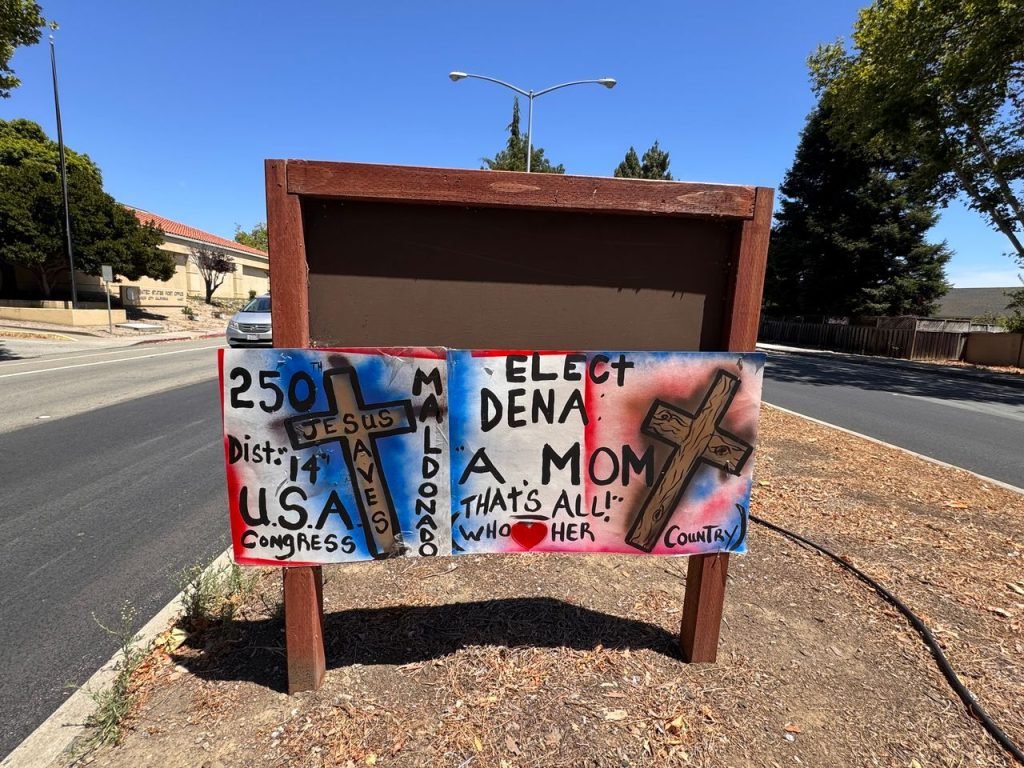
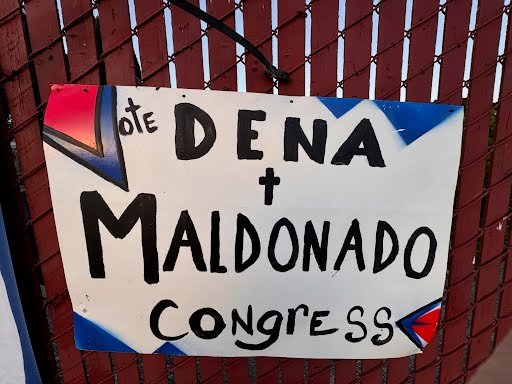
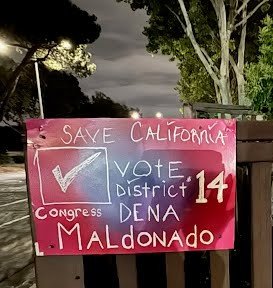
    Investigative field documentation has exposed the raw mechanics of how local party leadership manufactures artificial candidacies to sabotage their own wins. The campaign signage appearing across Alameda County under the name of Dena Maldonado—the candidate officially endorsed by the Alameda County Republican Party (ACRP) and blessed by the state apparatus—resembles a coordinated psychological operation designed to repel voters rather than attract them.

    A forensic look at the physical evidence on the ground reveals the true depth of the deception:

    • The Grocery Store Substrate: Maldonado’s campaign signs are not printed by any political vendor. They are not vinyl or corrugated plastic. They are made of raw cardboard—the kind scavenged from behind grocery store dumpsters—hastily cut with scissors and assembled like a yard sale poster.
    • The Opposition Caricature: The slogans slathered across this cardboard in crude, dripping spray paint read: “MAGA,” “JESUS SAVES,” and “ELECT DENA A MOM THAT’S ALL!” This is not a policy platform meant to compete in a suburban district; it is a caricature of what a Democratic opposition researcher imagines a conservative sounds like. It is broad, culturally maximalist, and explicitly designed to drive away independent voters.
    • Calculated Geographic Displacement: Most damning of all, these crude cardboard signs are completely missing from the Tri-Valley suburban and exurban residential corridors where actual CA-14 voters live and feel the cost-of-living crisis. Instead, they are being deployed deep within Alameda County’s urban core. They are placed where they will be seen by left-aligned voters who cannot vote in the district, ensuring the maximum possible damage to the center-right brand by projecting an image of operational incompetence and extremism.

    This “ghost campaign” was engineered to achieve a highly specific outcome: fracture the center-right coalition and siphoning away just enough votes to destroy a legitimate grassroots challenger. In the regular primary, authentic conservative reformer Wendy Huang—a retired technology CEO, Taiwanese immigrant, and elected Central Committee member—missed the critical second-place runoff position by fewer than 100 votes.

    In a margin that razor-thin, a fake candidate running an out-of-district apartment address on Fall Creek Road who reports $0 raised and $0 spent to the FEC is not an accidental underdog. It is a guided missile aimed directly at real grassroots reform.

    II. THE COURT LEDGER OF CORRUPTION: PERJURY AND PERVERSION OF THE BYLAWS

    Donors continue to write blind checks to legacy county committees under the emotional delusion of supporting local infrastructure. While they do, the executives they fund are being dragged through courtrooms, exposing a leadership tier defined by perjury, intimidation, and illegal power grabs.

    A forensic analysis of the public legal record in Alameda County Superior Court Case No. 24CV060851 (Huang v. Solnordal et al.) lays bare the true face of the party elite:

    • Judicial Sanctions for Deception: On November 7, 2024, Superior Court Judge Elizabeth Riles slapped ACRP Chairwoman Jeanne Solnordal with $6,550 in personal monetary sanctions. The court explicitly ruled that Solnordal’s attempts to hide meeting records and obstruct subpoenas were “frivolous and disingenuous.”
    • Perjury Under Sworn Oath: Judge Riles went further, characterizing the sworn courtroom assertions of party leadership regarding an internal October 18, 2023 session as a “baldfaced lie” and “frankly, perjury to the court.”
    • Pleading the Fifth Over Physical Violence: Former ACRP Chairman David Chan invoked his Fifth Amendment right against self-incrimination when questioned under oath about internal threats of physical violence—specifically, discussions regarding the literal “strangling” of an elected female member of his own committee.
    • Retaliatory Purges of Elected Representatives: Rather than correcting course, leadership weaponized an illegal “litigation bylaw” to execute an administrative purge. In letters dated December 30, 2024, they unilaterally stripped six voter-elected Central Committee members—Wendy Huang, Tom Wong, Jennifer Kavouniaris, Joe Grcar, John Guerrero, and Alison Hayden—of the seats given to them by thousands of primary voters. The court formally designated these purges as “compelling evidence of retaliation.”

    When you fund a county party committee that commits perjury to judges and pleads the Fifth over physical threats to its own members, you are not supporting a political party—you are financing a protection syndicate for career failures.

    III. THE FINANCIAL GRIFT AND THE SHADOW TECH STACK

    While grassroots volunteers are told there is “no budget” for field infrastructure, minority media outreach, or voter registration, your donations are actively siphoned into out-of-state vendor networks and platforms designed to enrich the political opposition.

    • The Encrypted “Shadow” Office: To intentionally evade transparent, discoverable public archives and public accountability, County Election Integrity Officer Mark Zulim uses a private, encrypted email account rather than an official party address.
    • Out-of-State Wealth Transfers: Financial disclosures reveal that local operations systematically export tens of thousands of donor dollars out of California—including a $20,000 disbursement to a text-messaging software vendor (Prompt.io) based in Seattle, Washington, alongside a massive $27,813.70 single transfer to a faceless firm (Pacific Political, Inc.) whose web domain features zero team details, no phone number, and a blank digital footprint.
    • The Multilingual Investment Blackout: While cash flows to out-of-state entities, the local party logs exactly $0 for sustained Spanish-language media outreach, $0 for Tagalog voter education, $0 for Chinese-American press engagement, and $0 for Vietnamese localized field operations.

    The resulting “infrastructure gap” is a deliberate choice. While the opposition executes a relentless field operation—logging 175 public community deployment events over a six-month window—our current county leadership managed a pathetic 5 events over the exact same period, completely abandoning the voter base.

    IV. THE STATEWIDE SYSTEMIC ROT AND CO-HABITATION

    Voters who believe this decay is isolated to a single northern county are blind to the broader reality. This is an interconnected, state-level crisis where legacy chairpersons operate county parties as personal fiefdoms while completely retreating from the electorate:

    • The Insulated San Diego Executive Tier: Officers like Chairwoman Paula Whitsell, 1st Vice Chair Alana Sorensen, 2nd Vice Chair Kristie Bruce-Lane, Treasurer William Exeter, and Secretary Dan Bickford remain firmly insulated from ballot failures, planning expensive fundraising dinners to celebrate their own mediocrity while candidates are left to fend for themselves. They sat silently as the 2024 52nd Congressional District race saw 87,501 Republicans vote for a placeholder nominee (Jason Lee) who had zero debates, no interviews, no website, no expenditures, and no public photographs against Democrat Juan Vargas.
    • The War on Working Professionals: To block modern, reform-minded outsiders from taking over, county bylaws explicitly enforce a strict, archaic ban on remote or electronic participation for full committee voting sessions. This deliberate rule privileges retirees and entrenched political insiders while locking out working parents, military service members, and younger activists who cannot attend physical meetings.
    • Roommates with the Enemy: The state party infrastructure is so deeply integrated with the ruling opposition that the official California Republican Party (CAGOP) headquarters rents office space on the 4th Floor of 1001 K Street in Sacramento—literally sharing an elevator, lobby, and building security with the California Labor Federation on the 2nd Floor. They are entirely comfortable coexisting with the machine that defeats them, while the California Democratic Party operates out of its own modern, standalone fortress at 1830 9th Street.

    V. THE CARTEL OF SILENCE AND COMPLICITY

    The absolute apex of this institutional betrayal is not found merely within the borders of Alameda County. It is found in the deafening, calculated silence of every other County GOP organization from Shasta to San Diego.

    When the Alameda County Republican Party executive tier overrode the certified will of thousands of primary voters and weaponized synthetic bylaws to purge six duly elected Central Committee members, it was a direct declaration of war on the concept of representative governance. It proved that to these career party bosses, a voter’s ballot is an administrative suggestion, easily erased the moment it threatens the insider cartel.

    Yet, as these six elected representatives were stripped of their seats for demanding financial transparency and accountability, the leadership of neighboring county parties stood by and did absolutely nothing. They issued no public statements. They demanded no state party audits. They held no emergency interventions.

    This silence is not neutrality. It is active, systemic complicity.

    By remaining silent, other County GOP chairpersons and executive boards have exposed the true nature of their operations: they are not part of a unified political movement hungry to win; they are a cross-county cartel of mutual protection. They look the other way when a neighboring chair logs courtroom perjury or uses a backroom maneuver to execute an administrative execution because they want the exact same impunity preserved for themselves. They protect the corporate solidarity of the boss class over the foundational rights of the grassroots base that funds them.

    If a County GOP chairperson will not stand up against the blatant, court-sanctioned corruption of an executive committee just one county over, they have forfeited any moral right to lead their own. Their silence signals to the opposition that the center-right apparatus is entirely fractured, morally bankrupt, and entirely house-broken. It tells the donors that their capital is being used to build walls to protect party bosses rather than bridges to reach voters.

    VI. THE SUMMER PURGE MANDATE

    If voters and donors continue to leave the current crop of county chairpersons in place through the warm months, the upcoming November general election is dead on arrival. California elections are decided the moment mail-in ballots hit mailboxes in early autumn. Waiting for election night to fix a broken party infrastructure is a suicide pact.

    The governing bylaws provide the exact mechanism required to decapitate this failed leadership class, but it requires the grassroots to stop begging and start commanding.

    Every County Central Committee in California must convene an emergency session this summer to elect entirely new County GOP chairpersons.

    • Bypassing the Chair: Sitting county chairs—such as Paula Whitsell or Jeanne Solnordal—will naturally refuse to call for their own removal. The rules explicitly permit elected Central Committee members to bypass the chairperson and independently compel an emergency session via a signed written petition.
    • The Leverage of the Checkbook: Donors must immediately execute a total freeze on all political capital. No more automatic donations, no more event sponsorships, and no more compliance with digital fundraising solicitations until your regional committee representatives sign the petition to force the summer session.
    • Installing the Vanguard: The summer session must be used to declare all executive board seats vacant and elect a professionalized tier of leadership. The new chairs must be committed to direct candidate defense, open digital transparency, and a dedicated, multilingual field operation that matches the demographic reality of modern California.

    Print the formal voter mandate below. Deliver it directly to your elected Central Committee members. If they refuse to sign the petition to fire the architects of defeat, then stop blaming the opposition for being effective. A serious political movement measures its legitimacy exclusively by victories, not legacy titles. Clean house this summer, or accept total responsibility for the losses in November.

    Clean our house this summer, or face the consequences from the base that funds you.

  • What a Real Candidate Looks Like: Wendy Huang vs. the Ghost Candidate

    Republican Forum endorsement. This is editorial opinion, not news reporting. Republican Forum is independent of all campaigns.

    Wendy Huang and the Ghost Candidate Contrast

    Dena Maldonado claims transparency. Wendy Huang demonstrates it. The difference is not subtle.


    The nine-point comparison table at the end of this article makes the contrast impossible to dismiss — but the evidence behind it is worth reading in full first.

    Maldonado’s defenders cannot claim that running as a Republican in CA-14 structurally requires hiding your party affiliation. Wendy Huang — a retired tech CEO, immigrant, mother, elected member of the Alameda County Republican Central Committee, and former CAGOP Delegate running in the same June 16, 2026 special primary — proves it does not.

    Like Maldonado, Huang is a Republican candidate in the same race with CAGOP backing. Like Maldonado, she faces an electorate that includes independents, skeptics, and voters who don’t reliably pull a party lever. Everything Maldonado hides, Huang discloses. That is what makes the contrast definitive.

    The similarities between them end at party registration. Everything else is the difference between a genuine candidate and a phantom.


    Two Republican Candidates. One Real Campaign.

    The argument throughout this series has not been that Maldonado’s opacity is somehow explained by the pressures of running as a Republican in a competitive Tri-Valley district. That argument would fail — because Wendy Huang is running the same kind of race and doing the opposite of everything Maldonado does.

    Both candidates are Republicans. Both are seeking votes in CA-14. Both face an electorate that includes independents, skeptics, and voters who don’t reliably pull a party lever. If the strategic case for hiding your Republican affiliation were sound, Huang would have every reason to do what Maldonado does.

    She doesn’t. And that choice is worth examining in detail.


    The Transparency Checklist

    Below is a side-by-side comparison based entirely on publicly available campaign materials — Maldonado’s at denamaldonado.com and Huang’s at voteforwendy.com. The Huang data is drawn from her WordPress site export (voteforwendy.com, exported June 1, 2026), which documents twelve published posts dating from May 14 through May 28, 2026.

    Party Affiliation

    Maldonado: No mention of the Republican Party, the GOP, the CAGOP, or any party affiliation anywhere on her campaign website.

    Huang: Identifies herself openly and repeatedly as a Republican candidate. In a post directed specifically at independent voters, she writes without equivocation: “I am an elected member of the Alameda County Republican Central Committee and a former CAGOP Delegate. I carry a party label.” She goes further — she acknowledges the political complexity of that label and makes the affirmative case for why independent and even Democratic voters should consider supporting her anyway. That is the behavior of a candidate who trusts voters with the truth.

    Residency and Community Connection

    Maldonado: Campaign mailing address in Dublin, a city split between congressional districts. No named address, neighborhood, school, church, or community organization within the district. No explanation of how long she has lived there or what connects her to the district’s communities.

    Huang: Names specific communities she seeks to represent — Fremont, Hayward, Pleasanton, Livermore, and Union City — throughout her posts. In her First 100 Days piece, she commits to holding post-Congress public town halls in each of those cities by name. She describes watching the I-580 traffic from her own car. These are not abstract references; they are the markers of a candidate embedded in the communities she wants to represent.

    Huang’s campaign is based in Alameda County, and this is not a disqualifying disconnect — it is an alignment. CA-14’s special election district includes portions of Alameda County, specifically the Tri-Valley and southern Alameda communities of Fremont, Hayward, Pleasanton, Livermore, and Union City. Her address places her within the district she is seeking to represent, which is the opposite of Maldonado’s situation.

    Business and Professional Identity

    Maldonado: Describes herself as running “my own small floral business.” Provides no business name, location, years of operation, employees, or any verifiable detail.

    Huang: Identifies herself specifically as a “retired tech CEO” and “retired Silicon Valley tech executive.” Her professional identity is the foundation of her signature policy proposal — a Cabinet-level Department of Technology — and she explains the connection explicitly: “As a tech executive, I spent my career understanding systems: how they fail, why they fail, and what it actually takes to fix them.” Her biography is a causal chain, not a credential list. Voters can evaluate the claim because the claim is specific.

    Policy Platform

    Maldonado: Identical template on every issues page — short paragraph, four vague bullet points. No named legislation. No specific regulations. No dollar figures. No position on healthcare, Social Security, wildfire preparedness, water rights, or trade.

    Huang: Has published a drafted bill — the Department of Technology Establishment and Democratic Accountability Act — with a public framework at www.department.technology. She has published a companion K-12 bill proposal (the K-12 AI Access and Student Safety Act) with specific statutory targets: modernizing COPPA and FERPA, establishing federal AI certification standards, and creating a competitive grant program. She has named specific dollar figures (the $537 million HSR closed-session settlement, the $750 million minimum from SB 1031). She has named specific legislation she supports or opposes (AB 1608). She commits to specific timelines: legislation on Day One, hearings in days 31–60, a bipartisan caucus by day 90, public town halls by day 100.

    This is what a policy platform looks like. Maldonado’s platform is the absence of one in a costume.

    Personal Biography

    Maldonado: No family mentioned. No named personal relationships. No community organizations. Nothing that anchors her in any specific place.

    Huang: Her biography is woven through everything she publishes. She came to the United States from Taiwan at thirteen years old. She has two sons in college. She describes watching her community from the driver’s seat of a car on I-580. She references her political organizing history — fighting vaccine mandates at California community colleges, pushing back mask mandates in Alameda County — as a lived record, not a resume line. She is a specific person doing specific things in a specific place.

    Transparency About Endorsements and Party Infrastructure

    Maldonado: Both the CAGOP and Alameda County Republican Party have formally endorsed her. Neither endorsement appears anywhere on her campaign materials.

    Huang: Discloses her party roles openly. Acknowledges she has party backing and explains what that means and doesn’t mean. In her post to independent voters, she neither hides her Republican affiliation nor pretends it is irrelevant — she addresses it directly, explains her record of cross-partisan action, and asks voters to make an informed choice based on full information. That is the opposite of cloaking.

    Campaign Timeline and Infrastructure

    Maldonado: Domain registered February 3, 2026 — months before the election. Website built quickly, consistent with a campaign stood up for electoral purposes.

    Huang: Site export records show published posts beginning May 14, 2026 — but the site content reflects months of substantive policy development. A drafted bill, a companion framework website (department.technology), a documented record of local political activity, and a twelve-post body of campaign writing all indicate a candidate who has been building toward this run, not one who was placed on a ballot.


    The Electoral Harm Is Measurable

    Here is why the Huang comparison is more than rhetorical. In CA-14’s special primary, this is a top-two race — every vote cast for any candidate is a vote not cast for another. Huang’s own campaign writing addresses this math directly and transparently.

    In her post to independent voters (published May 15, 2026), Huang lays out the district’s registration numbers plainly: Democrats hold 57.7% of registered voters, Republicans 12%, and No Party Preference voters nearly 25% — approximately 241,000 people. She explains that in a split field, a ghost candidate drawing even a fraction of those votes could determine whether any Republican advances to the August runoff.

    The point is not that Huang makes this argument (she does, as a genuine candidate making a genuine strategic case). The point is that she is correct on the arithmetic — and that every vote Maldonado draws from that same cross-partisan pool is a vote that does not go to Huang or any other genuine candidate.

    Ghost candidates do not need to draw large numbers of votes to affect an outcome. They need only draw enough — from the right slice of the electorate, at the right margin. In a race where Huang calculates that the NPP coalition is “not a footnote — it is a deciding factor,” even a few thousand votes peeled away by a nonpartisan-presenting phantom could determine whether a real candidate advances.

    That is real electoral harm. It is not theoretical. It is arithmetic.


    What the Contrast Proves

    The existence of Wendy Huang’s campaign dismantles the most charitable defense of Maldonado’s opacity — that running as a Republican in this district structurally requires hiding your affiliation.

    It does not. Huang proves it does not.

    A candidate can be a Republican, carry a CAGOP affiliation, base her campaign in Alameda County, and still identify openly, campaign transparently, name her community connections, publish detailed policy with specific legislation attached, explain her biography with verifiable specifics, and ask independent voters to support her on the merits of a real argument.

    That is what Huang does. That is what every genuine candidate does.

    Maldonado’s campaign does none of it — not because it is strategically impossible, but because the campaign was apparently not designed for that purpose.


    A Note on Fairness

    This article is not an endorsement of Wendy Huang or any candidate in the CA-14 special primary. Our interest here is not in which candidate wins — it is in whether the candidates on the ballot are genuine.

    Huang’s positions, her record, her policy proposals, and her fitness for office are for voters to evaluate. She may win. She may lose. Those outcomes belong to the voters of District 14.

    What is not for voters alone to decide is whether they have been given accurate information about who is actually running against them. That is a question of electoral integrity, and it is the question this series has been asking from the beginning.

    Wendy Huang answers it — by existing, by being specific, by being transparent — in a way Dena Maldonado simply does not.


    Summary: The Ghost Candidate Contrast in One Table

    CriterionWendy Huang (voteforwendy.com)Dena Maldonado (denamaldonado.com)
    Party affiliation disclosed✅ Openly Republican, CAGOP Delegate❌ No party mentioned anywhere
    Party endorsements displayed✅ Acknowledges party role throughout❌ Both CAGOP and Alameda GOP endorsements hidden
    Named community connections in district✅ Fremont, Hayward, Pleasanton, Livermore, Union City❌ None — no named District 14 location
    Verifiable professional identity✅ Retired tech Exectutive, Silicon Valley career❌ “Small floral business” — no name, location, or detail
    Specific legislation named✅ Drafted DoT Act, K-12 AI Access Act, named bills❌ No legislation named on any issues page
    Personal biography with named details✅ Immigrated from Taiwan, two sons, specific organizing history❌ No family, no organizations, no personal anchors
    Policy positions on district-specific issues✅ HSR, AB 1608, transit funding, housing supply❌ No position on healthcare, water rights, wildfire, trade
    Campaign depth vs. ballot-placement pattern✅ 12 substantive posts, drafted legislation, policy framework❌ Template website, domain registered 4 months before election
    Residency alignment with district✅ Alameda County communities within CA-14 special election scope❌ Dublin (split between districts); no stated tie to the district

    Sources: Wendy Huang campaign website (voteforwendy.com), WordPress export of voteforwendy.com dated June 1, 2026; Dena Maldonado campaign website (denamaldonado.com); FEC filing #C00942136; California Republican Party endorsements (cagop.org); Alameda County Republican Party voter guide (alamedagop.org). This article draws exclusively on publicly available campaign materials. No legal conclusions are expressed. The appropriate authorities — the FEC and DOJ — are the proper bodies to determine whether violations of federal law have occurred.

  • Archive: What Happens If a Ghost Candidacy Is Proven in CA-14?

    Republican Forum endorsement. This is editorial opinion, not news reporting. Republican Forum is independent of all campaigns.

    Archived: written four days before the June 16 special primary and kept for the record. The primary has passed. See Where Things Stand.

    What Happens If a Ghost Candidacy Is Proven in CA-14?

    Elections can be distorted through careful design and not only through loud failures. In California’s 14th District, with the seat open after a high-profile vacancy, we have asked whether a candidate on the ballot was a real contender or a placeholder. This post describes what the consequences would be if that were ever established. It does not claim it has been.

    The Florida precedent

    In 2020, in Florida Senate District 37, a candidate who shared the Democratic incumbent’s surname and never campaigned drew 6,382 votes in a race decided by 32. A consultant, Frank Artiles, was later convicted on three felony counts: excessive contributions, conspiracy, and false swearing. The case shows what investigators look for: payments, false filings, and concealed coordination. A candidate on a ballot with no campaign is not, by itself, a crime.

    What would follow here

    • An FEC finding. The complaint in MUR 8508 would have to find reason to believe a violation occurred and then follow an enforcement process that can take years.
    • Scrutiny of party endorsements. If funds or coordination were shown, the California and Alameda County Republican Parties would face questions about how they handled the endorsement.
    • Pressure for internal accountability. Party members who have already called for transparency, including those removed by the Alameda County party, would have standing to ask for a leadership review.

    None of that happens on speculation. It happens if evidence is established and the proper authorities act on it. We have documented the questions and the record, and we have said what we don’t know.

    Our endorsement

    Voters did not have to wait for any inquiry. We endorsed Wendy Huang, who holds the endorsements of taxpayer, reform, and parents’ organizations and has a published platform, and encouraged voters to choose a candidate with a visible campaign.

  • The Authenticity Choice: Why Aisha Wahab and Wendy Huang Are CA-14’s Clear Options

    Republican Forum endorsement. This is editorial opinion, not news reporting. Republican Forum is independent of all campaigns.

    The Authenticity Choice: Why Aisha Wahab and Wendy Huang Are CA-14’s Clear Options

    This Memorial Day weekend, with the June 2 primary and June 16 special primary ahead, voters deserve more than polished marketing. They deserve to know where candidates stand and to trust that what they say matches what they have done.

    Whether you lean left or right, real representation requires candidates who don’t hide who they are. By that standard, we think Aisha Wahab and Wendy Huang give voters the clearest choices on the ballot. You can agree or disagree with their policies, but both have been direct about what they believe.

    For liberal voters: Aisha Wahab

    As a State Senator, Aisha Wahab has a public record of progressive legislation and positions that matches her campaign rhetoric. Whether she is working on civil rights, community safety, or protections for working families, voters know what they are getting: a consistent, openly progressive philosophy.

    For conservative voters: Wendy Huang

    Wendy Huang has lived in the East Bay for decades, built a career as a high-tech executive, and raised two college-aged sons in the district. Her platform is specific:

    • Taxpayer defense. She is endorsed by the Howard Jarvis Taxpayers Association (HJTA PAC) and Carl DeMaio’s Reform California.
    • Local wallets. Her priority is defending Proposition 13 and cutting the hidden regulatory fees that drive up the cost of living.
    • Foreign policy grounded in cost. She opposes expensive overseas conflicts that fuel domestic inflation and favors diplomacy.

    The verdict

    In California’s top-two primary, voters can’t afford to split their support among campaigns that haven’t shown voters who they are. If you are a Democratic voter, go ahead and vote for Aisha Wahab. If you are a Republican, vote for Wendy Huang. It’s not complicated.

  • Representation Over Special Interests: Why Wendy Huang Is Our Choice in CA-14

    Republican Forum endorsement. This is editorial opinion, not news reporting. Republican Forum is independent of all campaigns.

    Representation Over Special Interests: Why Wendy Huang Is Our Choice in CA-14

    This Memorial Day weekend, as we honor those who gave their lives for the principle of self-government, voters in California’s 14th Congressional District have a responsibility that comes with that principle: to choose a representative who answers to the people who elect them. Representative democracy depends on it.

    What that standard looks like

    • A transparent campaign. Voters should be able to find a candidate’s positions, contact information, and funding.
    • Independence from outside interests. Wendy Huang runs on the endorsement of taxpayer watchdogs, the Howard Jarvis Taxpayers Association (HJTA PAC) and Reform California, not on special-interest funding.
    • A focus on local costs. Her priorities are defending Proposition 13, cutting hidden government fees, and bringing down the cost of living for East Bay families.
    • Diplomacy before escalation. As a retired tech executive, she favors diplomacy over open-ended overseas conflicts that raise inflation and energy prices at home.

    The case

    Wendy Huang came to this country at 13 speaking no English and built a career in technology. She has lived and raised her family in the East Bay for decades. She has done the work of earning endorsements from organizations that require written commitments, and she has said plainly where she stands. Voters who want a representative who answers to them, not to donors or national factions, have a clear choice.

    Vote on June 2 and June 16

    We urge CA-14 voters to support Wendy Huang in both primaries. Representation should stay in the hands of the people it serves.

  • Stop Splitting the Vote: The Case for Wendy Huang in CA-14

    Republican Forum endorsement. This is editorial opinion, not news reporting. Republican Forum is independent of all campaigns.

    Stop Splitting the Vote: The Case for Wendy Huang in CA-14

    California’s 14th Congressional District faces two primaries, June 2 and June 16. If conservative, independent, and reform-minded voters want to break the hold of East Bay establishment politics, they have to be strategic. In California’s top-two system, only two candidates advance, and a divided vote can lock out the district’s conservative voice entirely. Our endorsement goes to Wendy Huang.

    Local roots and a record of work

    Wendy Huang came to this country at 13 speaking no English and worked her way up to a career as a high-tech executive. She has lived in the East Bay for decades and raised her two sons here. The inflation hitting East Bay families, from groceries to utility bills to tuition, is an everyday concern for her, not an abstract statistic.

    Endorsements

    • Howard Jarvis Taxpayers Association (HJTA PAC), which endorsed her after she signed the pledge to defend Proposition 13.
    • Reform California and Carl DeMaio.
    • Republican National Hispanic Assembly of San Diego, which endorsed her on May 5, 2026.
    • Moms for Liberty, on parental rights.
    • A grade of “A” from the California Rifle and Pistol Association.

    Where she stands

    • Defending Proposition 13 and cutting hidden government fees that raise the cost of living
    • Diplomacy over open-ended overseas conflicts, including proposals such as a virtual U.S.-Iran embassy, to ease inflation and energy prices
    • Full transparency on the Epstein files

    The other Republican candidates

    According to state candidate filings, Jack Wu listed no campaign website or phone number, Dena Maldonado left her campaign phone number blank on her declaration forms, and Tom Wong has not shown the fundraising or grassroots network a Bay Area federal race requires. We raise these points because voters deserve to know what a campaign looks like before they spend their vote on it, not because of who these candidates are. Our reporting on the Maldonado campaign appears in the CA-14 Special Report.

    The verdict

    Every vote for a candidate without visible infrastructure or a path to the general election makes it more likely the district’s conservative voice will be shut out. Wendy Huang has the endorsements, the record, and the campaign to compete. Vote Wendy Huang on June 2 and June 16.

  • Memorial Day 2026: Foreign Influence and the AIPAC Act

    Editorial opinion. This piece reflects the analysis and opinion of Republican Forum rather than straight news reporting.

    Memorial Day, Foreign Influence, and Why Americans Across Party Lines Should Support the AIPAC Act

    Every Memorial Day weekend, Americans pause to honor the men and women who gave their lives defending this country.

    They did not die for Democrats.
    They did not die for Republicans.
    They did not die for lobbyists, foreign governments, or political machines.

    They died for the United States of America — for the principle that American citizens should govern themselves.

    That principle is exactly why the Americans Insist on Political Agent Clarity Act — better known as the AIPAC Act introduced by Thomas Massie — deserves broad bipartisan support from Democrats, Republicans, Independents, elected officials, candidates, and voters alike.

    This should not be a partisan issue.
    It should be an American issue.

    What the AIPAC Act Actually Does

    Despite the emotionally charged reactions surrounding it, the bill itself is straightforward in principle.

    The legislation would strengthen and modernize the Foreign Agents Registration Act (FARA), requiring organizations lobbying on behalf of foreign governments or foreign political interests to disclose those relationships more transparently.

    That is not censorship.
    It is not a ban on speech.
    It is not an attack on any religion, ethnicity, or nation.

    It is a transparency law.

    Americans already expect transparency in campaign finance, public disclosures, ethics reporting, and lobbying. Foreign influence should not be exempt from scrutiny simply because discussing it makes political elites uncomfortable.

    If an organization is substantially advancing the interests of a foreign government, the American people have a right to know.

    That standard should apply equally whether the foreign country is Israel, China, Russia, Saudi Arabia, Qatar, Ukraine, India, or any other nation.

    No exceptions.
    No favored countries.
    No politically protected classes of lobbying.

    Why This Matters on Memorial Day Weekend

    Memorial Day is not merely a holiday.
    It is a national reminder that self-government comes with a cost.

    Thousands of Americans died in wars fought under the American flag. Many believed they were defending democratic accountability, constitutional government, and the sovereignty of the American people.

    Yet today, Americans across the political spectrum increasingly believe major national decisions are influenced by powerful donor networks, lobbying organizations, intelligence relationships, defense contractors, and foreign-policy pressure groups operating far beyond ordinary voters’ reach.

    Whether those fears are fully justified or not, the distrust itself is real.

    And transparency is how democracies rebuild trust.

    The AIPAC Act represents a simple democratic principle:
    Americans should know who is influencing American policy.

    That should not frighten honest organizations.
    It should strengthen public confidence.

    This Should Unite Democrats, Republicans, and Independents

    Democrats often argue that “dark money” threatens democracy.

    Republicans often argue that unelected bureaucracies and powerful interest groups manipulate public policy.

    Independents increasingly believe both parties are captured by donors and insiders.

    The AIPAC Act speaks to all three concerns.

    Democrats Should Support It

    Democrats routinely call for campaign-finance reform, lobbying disclosure, and protections against foreign interference in elections.

    If transparency matters when discussing Russia, corporate PACs, or billionaire donors, then consistency demands transparency regarding all foreign-aligned lobbying operations as well.

    Transparency cannot be selective.

    Republicans Should Support It

    Republicans traditionally champion national sovereignty, America First policies, and limits on foreign influence over domestic affairs.

    Supporting stronger FARA enforcement aligns directly with those values.

    A nation cannot fully control its own foreign policy if lobbying networks tied to foreign interests operate without robust public disclosure.

    Conservatives who believe in constitutional self-government should see transparency as essential — not threatening.

    Independents Should Support It

    Independent voters are exhausted by political hypocrisy.

    They are tired of rules being applied differently depending on who holds power or which interest group is involved.

    The AIPAC Act offers something increasingly rare in modern politics:
    a universal standard.

    No special treatment.
    No immunity from scrutiny.
    No political sacred cows.

    Just disclosure.

    Why Elected Officials and Candidates Should Support It

    Many politicians privately acknowledge what few openly say:
    the pressure surrounding foreign-policy issues in Washington can be immense.

    Lobbying organizations matter.
    Major donors matter.
    Political retaliation matters.

    That is precisely why transparency protections are necessary.

    Public trust erodes when voters believe elected officials are more accountable to donor coalitions or foreign-policy pressure groups than to constituents back home.

    Supporting the AIPAC Act is an opportunity for candidates and officeholders to demonstrate independence, courage, and loyalty to democratic accountability itself.

    Even those who oppose the bill should at least be willing to debate it publicly.

    Silence only deepens suspicion.

    Transparency Is Not Extremism

    Critics will inevitably attempt to frame the issue in the most inflammatory terms possible.

    But transparency laws are not extremist.
    Disclosure requirements are not authoritarian.
    Knowing who influences government is not “dangerous.”

    In fact, transparency is one of the core safeguards that separates democracies from corrupt systems dominated by hidden power.

    Americans are capable of hearing information and making their own decisions.

    That is what free citizens do.

    The Real Question

    The real question is simple:

    If an organization is lobbying American officials in ways that materially advance the interests of a foreign government, why should Americans not know about it?

    Why should disclosure be controversial?

    Why should transparency be feared?

    On Memorial Day weekend especially, those questions matter.

    Because the soldiers we honor did not sacrifice their lives so Americans would become afraid of open debate, public accountability, or democratic transparency.

    They fought so citizens — not hidden power structures — would remain sovereign.

    Honor the Fallen by Defending Self-Government

    Americans do not need to agree on every foreign-policy issue.

    They do not need to agree on Israel, Ukraine, China, NATO, the Middle East, or military spending.

    But Americans should be able to agree on one foundational principle:

    The American people deserve transparency about who is shaping American policy.

    That is not radical.
    That is democracy.

    And this Memorial Day weekend, supporting transparency in government is one meaningful way to honor the Americans who gave everything to preserve it.

  • Part 2: The Fighter Alameda County Needs in Congress (Profile of Wendy Huang)

    Republican Forum endorsement. This is editorial opinion, not news reporting. Republican Forum is independent of all campaigns.

    ← Previously in this series:
    Part 1: The Stolen Seat

    They Threatened Her. They Lied Under Oath. They Purged Six Voter-Elected Members. She Never Backed Down.

    Why Wendy Huang Is the Fighter Alameda County Needs in Congress.


    You elected them. They tried to erase every single one of them.

    That is the story of Wendy Huang — immigrant, wife, mother, retired tech executive, lifelong Union City resident, community advocate, elected Central Committee Member of the Alameda County Republican Party, and now candidate for California’s 14th Congressional District. But it is also the story of five other Alameda County voters whose democratic choices were thrown in a trash can by the same political machine.

    It is a story about what happens when ordinary citizens win fair elections, stand up to powerful insiders, and refuse to be silenced — no matter the cost.

    The Court Record, in Brief

    The full timeline is documented in Part 1 of this series. The essential facts: in the March 2024 primary, 4,049 Alameda County Republicans elected Wendy Huang to the Central Committee. Party leadership subsequently barred her from taking her seat, using a bylaw inserted the same day they sent the removal letter. Along the way, a judge sanctioned ACRP Chairwoman Jeanne Solnordal $6,550 for “frivolous and disingenuous” discovery obstruction, heard sworn testimony that Solnordal had said she wanted to “punch Wendy in the face” up to a dozen times, and described the December 30, 2024 removal letter as “compelling evidence of retaliation” against a constitutionally protected act.

    That is what Wendy Huang walked through before she announced she was running for Congress. Here is who she is.

    Behind Every Court Document Is a Person

    Wendy Huang is a proud immigrant from Taiwan who came to the United States in pursuit of the promise this country makes to those willing to work for it. She arrived at age 13. She spoke no English. She had no political connections, no family wealth, and no institutional backing.

    What she had was the kind of determination that the American story was built on — a mother’s values, an immigrant’s work ethic, and an engineer’s approach to solving problems.

    She built a career in Silicon Valley. She married and raised two sons in Union City, California — the same community she has fought for in every civic role she has taken on. She became a United States citizen and registered as a Republican because she believes in the founding principles of this country: that your effort, your character, and your integrity determine how far you can go.

    She ran for Union City City Council because she believed her neighbors deserved a stronger voice at the local level. She ran for the Republican Central Committee because she believed the party’s voters deserved honest, accountable representation. And now she is running for Congress because she has seen firsthand — in the most personal and documented way possible — what happens when the people holding power stop answering to the people who gave it to them.

    Why Congress. Why Now.

    An immigrant who built a life here. A mother who wants a better community for her children. A tech leader who understands the economy shaping Alameda County’s future. A fighter who has already proven, on the public record, that she will not be bought, managed, or bullied into silence.

    In Congress, she will bring that same documented, uncompromising commitment to the issues that matter to every Alameda County family: the cost of housing, the safety of our neighborhoods, access to opportunity for immigrants and working families, and a government that actually works for the people paying for it — not the insiders running it.

    She is running for U.S. Congress in California’s 14th Congressional District. She is the candidate the establishment doesn’t want. She is the candidate the voters chose. And she is asking for your support — Republican, Democrat, and Independent alike — because the fight she has been waging for Alameda County voters does not end at a party registration card.

    Vote Wendy Huang for Congress — California’s 14th Congressional District.


    The legal case for why these actions warrant federal investigation is documented in Part 3: The Vote That the Party Refused to Honor.

  • Election Integrity Is Worth Fighting For

    Editorial opinion. This piece reflects the analysis and opinion of Republican Forum rather than straight news reporting.


    And Why Performative Conservatism Isn’t Leadership

    California’s elections sit at the intersection of two uncomfortable truths:
    First, public confidence matters, even when fraud is rare.
    Second, good ideas die fast when leaders treat them like branding exercises instead of governing priorities.

    That’s why Californians should sign the California Voter ID initiative — and why we should be honest about the legal roadblocks ahead and the hollow support coming from some local party leadership.


    Why Voter ID Is Worth Supporting

    Election integrity is not a fringe issue. It’s foundational.

    Requiring government-issued identification to vote, maintaining clean voter rolls, and conducting routine audits are normal expectations in everyday civic life — from boarding a plane to opening a bank account. Voters are not unreasonable for expecting similar safeguards in elections.

    The California Voter ID Initiative, supported by leaders such as Carl DeMaio and Tony Strickland, proposes straightforward standards:

    • ID for in-person voting
    • Verified ID information for vote-by-mail ballots
    • Regular voter-roll audits
    • Free voter ID for anyone who needs one

    At its core, the measure isn’t about exclusion — it’s about uniformity, accountability, and trust.

    Even critics often admit the same thing supporters argue, fraud may be rare, but confidence is fragile. And confidence, once lost, is difficult to restore. We believe voters are right to ask for stronger verification, and that confidence in elections matters even when documented fraud is rare.

    That alone makes this initiative worth signing.


    The Hard Truth: This Will Face Serious Legal Resistance

    Supporting election integrity does not require pretending the courts will roll over.

    If this initiative qualifies and passes, litigation is guaranteed — and delay is likely. Courts will scrutinize:

    • Vote-by-mail ID requirements
    • Proof-of-citizenship provisions
    • Potential disparate impacts on certain voters
    • Implementation timelines close to elections

    In California especially, state constitutional protections are interpreted aggressively. Portions of the measure could be paused, narrowed, or struck down. Full implementation could take years — or never arrive exactly as written.

    Voters deserve honesty about this.

    But here’s the key point critics ignore:
    Legal resistance is not proof the idea is wrong. It’s proof the idea threatens entrenched systems that benefit from ambiguity and administrative discretion.

    Signing the petition doesn’t guarantee victory — but not signing guarantees surrender.


    The Real Problem: Performative Support from Local Party Leadership

    Which brings us to the most frustrating part of this entire common-sense election integrity effort.

    Our Republican Party of San Diego County Leadership wants credit for “joining the fight,” but what they’re offering looks less like leadership and more like optics management.

    Handwritten letters. Photo ops. Press releases. Carefully worded support.

    What’s missing?

    • No sustained legal war chest
    • No serious voter-education infrastructure
    • No statewide coordination muscle
    • No preparation for the inevitable court battles
    • No serious outreach for Democratic, Independent, and third-party voters to join the fight

    This is checkbox conservatism — just enough noise to appear aligned, not enough commitment to actually win.

    If election integrity is truly an existential issue, why is the effort being treated like a mail campaign instead of a multi-year legal and organizational battle?

    Grassroots volunteers are giving time, energy, and belief. They deserve more than symbolic gestures designed to pad résumés and placate donors.

    Leadership means planning for the hard parts, not just celebrating the easy optics.


    You Should Still Sign — But Demand Better

    Despite all of this, Californians should sign the Voter ID petition.

    Not because it’s guaranteed to succeed.
    Not because courts will be friendly.
    Not because party leadership has earned your trust.

    But because:

    • Election integrity is worth defending
    • Clear standards beat vague assurances
    • And surrendering before the fight begins is how confidence truly dies

    At the same time, voters should demand more from the people claiming to lead this effort:

    • Real legal strategy
    • Real funding commitments
    • Real statewide coordination
    • Real accountability

    Election integrity cannot survive on symbolism alone.

    If leaders want to be taken seriously, they need to stop acting conservative for the cameras — and start governing like the outcome actually matters.


    Sign the petition. Support the principle. And don’t let anyone confuse performative activism with real leadership.

  • Stand Your Ground: San Diego Needs Your Conservative Voice

    Editorial opinion. This piece reflects the analysis and opinion of Republican Forum rather than straight news reporting.

    Why San Diego Needs Your Conservative Voice

    You took an oath to support and defend our United States Constitution. But if you are stationed in San Diego and sitting out the local elections, you are leaving your values at the door.

    San Diego County is a critical hub for the military, but the political landscape here is shifting. Policies are being made every day that affect your cost of living, the safety of the streets your family walks on, and the quality of the schools your children attend.

    Too many service members think, “I’m in California, my vote doesn’t count,” or “I’ll just vote back home.” That is exactly what the opposition hopes you will do.

    The reality? Your vote is a weapon for liberty, fiscal responsibility, and law and order. It’s time to use it.

    Why Registering as a Republican Here Matters

    California may be a “blue state” on the national map, but San Diego County is a battleground for common sense. When you register and vote Republican here, you are fighting for:

    • Military Funding: Safeguarding our way of life for you and our veterans.
    • Election Integrity: Ensuring our elections are secure and transparent.
    • Public Safety: Supporting District Attorneys and Sheriffs who enforce the law and back the blue, rather than those who prioritize criminals over victims.
    • Economic Freedom: Fighting back against skyrocketing gas taxes and housing regulations that make life unaffordable for military families.
    • Parental Rights: Ensuring local school boards respect the role of parents in their children’s education.

    The Mission: Registering the Right Way

    Integrity is a core military value. We win by following the rules.
    You can legally register in California IF you choose to make this your primary legal residence (domicile).

    • Who is eligible: U.S. Citizens, 18+, stationed here, who intend to make CA their home for voting purposes.
    • Barracks/Base Housing: These are generally accepted as residence addresses for registration if the base is where you live. Check with your county elections office if you are unsure.
    • Warning: You cannot be registered in two states. If you register here, you are moving your political “Home of Record” to California.

    Why Register “Republican”?

    In California, party registration determines which primary ballots you receive for certain central committee party elections like our San Diego GOP.


    How Party Registration Affects Your Ability to Vote for Candidates in California

    1. San Diego GOP Central Committee Elections

    To vote in the Republican Party Central Committee elections, California election law requires that you be registered with the Republican Party. These committee seats are considered party-nominated offices, and only voters registered with that party can vote for its committee candidates on the primary ballot.

    In other words:
    If you want to vote for Republican Party nominees in these internal party elections, you must be registered as a Republican on your voter registration.


    2. Presidential Primary Elections

    California has a semi-closed system for presidential primaries:

    • For President, political parties decide whether voters without a party preference (No Party Preference, or NPP) can vote in their presidential primary. Under current rules, a NPP voter only receives a ballot with presidential candidates if the party authorizes crossover voting or if the voter re-registers with that party.
    • If a party does not allow NPP crossover voting, then NPP voters will get a ballot without any presidential candidates on it.

    Thus:
    If you wish to vote in the Republican presidential primary, you generally must be registered as a Republican (or re-register as one before the deadline), because many parties do not allow NPP crossover voting to their presidential contests.

    This reflects current California practice, which is consistent with the state’s approach of letting political parties control access to their presidential nominations.


    3. Congressional, State Legislative, and Other “Top Two” Primaries

    California’s Top Two Open Primary system (from Proposition 14) applies to most federal and state races other than president and party committee elections. This means:

    • All voters, regardless of party registration or no party preference, may vote for any candidate in these contests in the primary election.
    • The top two vote-getters, regardless of party, advance to the general election.

    So:
    In U.S. House, State Senate, State Assembly, and similar races, it doesn’t matter whether you are Republican, Democrat, or NPP — you can vote for any candidate in the primary.


    Key Points

    Office TypeCan NPP Vote for Party Candidate Without Party Registration?Relevant Rule
    GOP Central CommitteeNo — must be RepublicanParty-nominated office rule
    Presidential PrimaryDepends on party rule; usually Parties decide crossover; NPP ballot excludes presidential unless crossover approved
    Congressional/State — Top TwoYes — any voterTop Two Open Primary Act

    How to execute

    1. Online Registration (California Residents)
    Use your CA Driver’s License or ID (or the last 4 of your SSN). Remember, a California driver’s license or ID is helpful but not mandatory for registration. Voters may instead provide the last four digits of a Social Security number.

    • Action: Go to the California Secretary of State website.
    • Selection: Choose Republican Party to ensure full voting rights in the primaries.

    2. Federal Post Card Application (FPCA)
    If you are likely to deploy, use the FPCA. It registers you and requests your absentee ballot in one step, ensuring you can vote from anywhere in the world.

    Final Orders

    Don’t let San Diego drift further left without a fight. The local community needs the disciplined, patriotic perspective that only service members can provide.

    Approximately 110,000–117,000 active-duty service members are based in San Diego County across U.S. Navy, Marine Corps, and Coast Guard units. Most of these are Navy and Marine Corps personnel, with San Diego hosting large installations such as Naval Base San Diego, Marine Corps Base Camp Pendleton, Marine Corps Air Station Miramar, and others.

    Regardless of the political party you choose, or no political party, we at Republican Forum thank each and every service member in United States Armed Forces for your dedication, commitment, and sacrifices.

    Register Republican. Vote your values. Defend your community.

    God Bless America!

  • To Our Democratic, Independent, and Third-Party Voters and Friends

    Editorial opinion. This piece reflects the analysis and opinion of Republican Forum rather than straight news reporting.

    Archived: written ahead of the June 2, 2026 primary and kept for the record.


    A Message to Voters Looking Toward 2026

    As the 2026 election approaches, one thing will become increasingly clear: your vote will shape the direction of San Diego County and our nation. Families, workers, and communities will be deciding what kind of leadership they want—and what kind of future they expect.

    By June 2, 2026, voters will have the opportunity to choose leaders who listen, act responsibly, and put communities first.


    Why More Voters Will Be Reconsidering Their Choices

    In the months ahead, voters from all backgrounds—Republican, Democratic, Independent, No-Party-Preference, and third-party—will be taking a closer look at the direction of their communities.

    You will likely be asking familiar questions:

    • Can I afford to live and raise a family here?
    • Are my schools and neighborhood and schools safe?
    • Are elected officials accountable and transparent?
    • Is government focused on real solutions instead of politics?

    More voters will be looking beyond labels and toward results, and those conversations will matter more than ever.


    Why We Will Be Asking for Your Vote in 2026

    As we move toward the 2026 election, Republican candidates will continue working to earn your trust—not assume it. We will be asking for your vote because we believe in leadership that focuses on:

    • Public safety, safer schools, and strong communities
    • Affordability and cost-of-living relief
    • Parental rights, involvement and educational excellence
    • Fairness, accountability, and transparency in government

    This will not be about partisan loyalty.
    It will be about shared priorities and practical solutions.

    These are not “Republican issues.”
    These are San Diego issues.
    These are your issues.


    We Will Be Asking for Your Vote—On or Before June 2, 2026

    When ballots are cast in 2026, we will be asking for your vote so that together we can build safer neighborhoods, a stronger local economy, and a more accountable government.

    By June 2, 2026, your vote will help:

    • Support leaders who listen and act
    • Strengthen communities at the local, state, and federal levels
    • Move San Diego County forward in a positive direction

    We look forward to earning your trust, your engagement, and—when the time comes—your vote.

    Vote Republican in 2026, and help shape the future we all deserve.

  • Thank You, María Corina Machado

    Editorial opinion. This piece reflects the analysis and opinion of Republican Forum rather than straight news reporting.

    A Thank You for a Powerful Gesture of Gratitude — and a Historic Echo

    In moments of global uncertainty, symbolism matters. Acts that cross borders and generations can remind the world that peace, courage, and moral clarity are not abstract ideals—but lived commitments.

    All of America extend a sincere thank you to María Corina Machado for a gesture that resonated far beyond a single meeting: the presentation of her Nobel Peace Prize medal to Donald Trump as a symbol of gratitude for support she believes advanced the cause of freedom and democratic change in Venezuela.

    This act was not about transferring a prize—whose honor remains inseparable from its laureate—but about recognition. Recognition that leadership, resolve, and international pressure can matter to people fighting peacefully for their future.

    A Powerful Historical Parallel

    Machado’s gesture also echoes a lesser-known but striking historical tradition.

    Simón Bolívar, the Liberator of much of South America, was once gifted a medal by Gilbert du Motier, Marquis de Lafayette, the legendary French hero of the American and French Revolutions. Lafayette, a symbol of transatlantic liberty, honored Bolívar in recognition of their shared devotion to independence, republican ideals, and resistance to tyranny.

    Bolívar did not hide this honor. He reportedly wore the medal proudly, understanding that such symbols were not vanity, but visible affirmations of legitimacy, solidarity, and shared struggle. In an era when revolutions depended as much on moral authority as military strength, medals and honors served as public testimony that a cause was just—and recognized beyond national borders.

    Symbolism That Still Matters

    In this light, Machado’s gesture fits squarely within a long historical lineage. From Bolívar and Lafayette to modern defenders of democracy, the exchange of symbolic honors has often marked moments when ideas, not armies, took center stage.

    By offering her Nobel medal, Machado reminded the world that peaceful resistance is sustained not only by sacrifice, but by acknowledgment—that moral support from beyond one’s borders can strengthen resolve at home.

    We thank María Corina Machado for her courage, her historical awareness, and her willingness to use symbolism as a force for unity and hope. May this moment—like Bolívar’s before it—stand as a reminder that the fight for liberty is rarely solitary, and that gestures of recognition can echo across centuries.

    Donald J. Trump is our George Washington of our times and an enduring symbol of freedom for all!

  • Win Parents Across Party Lines in 2026

    Editorial opinion. This piece reflects the analysis and opinion of Republican Forum rather than straight news reporting.

    Why our San Diego GOP Must Lead on This Issue to Win Parents Across Party Lines in 2026

    There is one issue quietly reshaping politics in San Diego County—and it does not break cleanly along party lines.

    It is not taxes.
    It is not immigration.
    It is not national politics.

    It is parents’ concern about fairness, privacy, and common sense in schools.

    Across San Diego County, parents from every political affiliation—Democrats, Independents, Libertarians, and Republicans—are voicing discomfort with California’s current policies governing girls’ sports and locker room access. Many of these parents are not ideological activists. They are not partisan warriors. They are families who simply believe that biological differences matter in athletics and that privacy for children should not be dismissed as bigotry.

    And yet, their concerns are routinely ignored.

    This Is Not a “Republican Issue” — It’s a Commonsense Parent Issue

    The biggest mistake our Republican Party of San Diego County could make is treating this as a niche culture-war talking point. It isn’t.

    Talk to parents privately—at school events, sports fields, PTA meetings—and a different picture emerges:

    • Democratic parents who quietly pulled their daughters out of sports
    • Independent parents confused by school policies they were never consulted on
    • Third-party and non-aligned voters frustrated that asking questions gets them labeled

    These parents may still vote Democratic and identify as Democratic out of habit. But their trust has been shaken.

    And shaken trust is political opportunity.

    Why Democrats Are Vulnerable on This Issue

    California’s one-size-fits-all approach leaves no room for nuance, no room for parental input, and no room for compromise. Parents are told to accept policies without debate—and to stay silent if they disagree.

    That approach alienates people who otherwise support public education, inclusion, and fairness.

    Many parents who are Democrats, Independents, Libertarians, and Republicans are asking reasonable questions:

    • Why should girls lose competitive opportunities without discussion?
    • Why is privacy treated as prejudice?
    • Why are parents excluded from policy decisions affecting their children?

    They are not hearing reasonable answers.

    This Is Where Republicans Can Win — If They Show Up Like Adults

    Republicans will not win these voters by yelling slogans or attacking people personally. They will win by offering something Democrats refuse to offer: balance, honesty, and parental respect.

    That means our San Diego GOP must be willing to say, clearly and calmly:

    • Girls deserve fair competition based on biology
    • Children deserve privacy in intimate spaces
    • Parents deserve a voice in school policy
    • Compassion and common sense are not opposites

    This framing resonates far beyond our Republican base.

    Independent, Democratic, and Moderate Voters Are Waiting for Leadership

    Independent voters are not looking for extremes. They are looking for someone willing to acknowledge reality without cruelty.

    When Republicans articulate this issue as:

    • protecting girls’ sports,
    • respecting all students,
    • and restoring parental involvement,

    they stop sounding partisan—and start sounding reasonable.

    That is how trust is rebuilt.

    Why This Issue Can Move Votes in 2026

    Parents vote.
    Parents talk.
    Parents remember who listened—and who dismissed them.

    In close races, even a small shift among parents who feel unheard can change outcomes. Democrats are betting those voters will stay silent or stay loyal.

    Republicans should bet otherwise.

    The Choice Facing the San Diego GOP

    Our San Diego GOP can either:

    • continue to stay silent and let Democrats define the issue, or
    • lead with clarity and invite a broad coalition of parents into the conversation

    Winning in 2026 will not come from preaching to Republicans alone in an echo chamber. It will come from earning the confidence of parents who are ready to cross party lines for their children.

    This issue is not about ideology.
    It is about commonsense, fairness, privacy, and trust.

    And if Republicans are willing to stand there—calmly, firmly, and unapologetically—they will find far more allies than they’ve been told to expect.

  • We Follow the Facts, Even When They’re Uncomfortable

    Editorial opinion. This piece reflects the analysis and opinion of Republican Forum rather than straight news reporting.

    San Diego GOP investigation: Evidence Files | Chapter 1 of 21
    New to this series? Start with Part 2: Why the San Diego GOP Is a Third-Place Party, or see the San Diego GOP Accountability Series hub.

    We Follow the Facts, Even When They’re Uncomfortable

    At Republican Forum, we don’t traffic in rumors or personality disputes. We document patterns, compare rules to outcomes, and follow incentives to results. After months of reporting, one conclusion is hard to avoid: Republican candidates and voters in San Diego County are being undermined by actions taken inside their own party apparatus. We are not alleging crimes. We are stating facts and drawing reasonable conclusions from them.

    The record

    Across election cycles, we have documented a consistent set of behaviors by Republican Party of San Diego County leadership that predictably weaken Republican campaigns:

    1. Late or absent pre-primary endorsements

    Documented in: A Party That Endorses Without Responsibility: How the San Diego GOP Bylaws Shift Risk to Candidates; How “No Early Endorsements” Hurts San Diego Republicans

    2. Failure to schedule or sponsor debates

    Documented in: Part 11: How the Democratic Calendar Keeps Volunteers Engaged; The Calendar Doesn’t Lie: A Candidate Training Class Too Little, Too Late

    3. Obstacles to voter data access for candidates

    Documented in: Part 8: Candidates Denied Voter Data While the San Diego GOP Stays Silent

    4. Opaque processes and undocumented decisions

    Documented in: Part 5: How the San Diego GOP Bylaws Engineer Defeat; Our 2026 Survival Kit: Seven Bylaw Amendments the San Diego GOP Needs Now

    5. Digital and legal lapses that harm donor trust

    Documented in: A Tale of Two County Parties: How the San Diego GOP Website Hurts Candidates; The Privacy Policy That Names the Wrong Website

    6. Bylaws that favor insider continuity over coalition growth

    Documented in: Part 5: How the San Diego GOP Bylaws Engineer Defeat; Two Rulebooks, Two Outcomes: Democratic and Republican Bylaws in San Diego

    7. Abandonment of Hispanic, Asian, Black, and minority voters

    Documented in: Erasing Spanish-Speaking Voters by Design; Part 17: Functionally Working for the Democrats? The Vietnamese American Voter Gap

    8. No outreach to independents or Democrats

    Documented in: Zero Clubs vs. a Living Democratic Machine

    9. Refusal to host debates for new Republican candidates

    Documented in: A Party That Endorses Without Responsibility: How the San Diego GOP Bylaws Shift Risk to Candidates; Part 8: Candidates Denied Voter Data While the San Diego GOP Stays Silent

    10. Hostility toward President Trump and the RNC platform

    Documented in: Roommates with the Political Enemy: The California GOP and the Labor Federation Share an Address

    11. Refusal to promote core conservative principles

    Documented in: Part 15: The San Diego GOP’s Values Vacuum; Part 16: Is the County GOP Leadership Pro-Choice? Absent from the Walk for Life

    12. Fundraising prioritized over voter engagement

    Documented in: Feeding the Consultants: Where San Diego GOP Donations Go; Part 10: Why Is the San Diego GOP Using an Out-of-State Fundraising Vendor?

    13. No public candidate hub

    Documented in: Part 1: The Missing Candidate Hub; Part 12: A Critique of San Diego GOP Leadership

    14. Collapse of the GOP club ecosystem

    Documented in: Zero Clubs vs. a Living Democratic Machine; One Club for Every Community: A Republican Counter-Club Plan for San Diego

    15. Silence on Democratic vulnerabilities

    Documented in: Silence Is Complicity: A Party That Manages Decline; Where Did the Billions Go? California’s Homelessness Spending and Republican Silence

    Each of these has been documented in a full article, forming a cumulative factual record that GOP leadership cannot dismiss as opinion. None of these outcomes hurt Democrats. Every one of them helps them.

    Follow the incentives

    Politics is not a mystery. When the same decisions repeatedly produce advantages for the opposition, reasonable observers ask whether those decisions are accidental or incentivized. We compared these practices with those of the San Diego County Democratic Party. Democrats consolidate early, schedule debates, elevate candidates, and mobilize coalitions before primaries. Republicans are often fragmented, quiet, and late. The result is not neutrality. It is asymmetry.

    The question of bad actors

    We don’t claim to know how many individuals inside the county GOP may be acting against Republican interests, and we don’t speculate on motives beyond what the facts support. But due diligence is not optional when donor money is collected from Republican voters, candidates rely on the party for access and infrastructure, and outcomes repeatedly favor the opposition. If even a small number of insiders are slowing campaigns, suppressing exposure, blocking resources, or tolerating dysfunction that advantages Democrats, leadership has a responsibility to investigate, document, and correct it. Ignoring the evidence isn’t unity. It is negligence.

    Facts don’t run away

    Leadership may avoid questions, meetings may stay undocumented, and promises may remain verbal. But facts persist, patterns accumulate, and outcomes compound. Republican Forum will keep documenting decisions and their effects, comparing rules to results, and asking the questions leadership refuses to answer. We do this not to divide Republicans but to defend the voters and candidates who deserve a party that fights to win. The facts are on the record. Running from them won’t change the outcome. Confronting them might.

    Next: Where Is the Patriotism? The San Diego GOP Website and Its Missing Military Imagery →

  • Parents, Your Kids, Your Voice: Why Cross-Party Families Should Consider Republicans in 2026

    Editorial opinion. This piece reflects the analysis and opinion of Republican Forum rather than straight news reporting.

    Why It’s Time for Democratic, Independent, and Third-Party Parents to Consider Republicans in 2026

    If you are a parent with kids in elementary, middle, or high school, you know the daily reality of the education system can be very different from the political rhetoric. Whether you have always voted Democratic, register as an independent, or support a third party, the 2026 election is not about party labels. It is about electing leaders who will put your family first in the classroom. We think the Republican education platform deserves a look from every parent, and it comes down to four areas.

    1. Choice: ending the one-size-fits-all system

    For too long, the quality of a child’s education has been set by zip code. Affluent families already have school choice: they can pay private tuition or move to a high-performing district. School choice initiatives aim to extend that option to every family.

    • School choice (vouchers and ESAs): Republican-led states are pursuing universal Education Savings Accounts, which give parents a portion of the public funding allocated for their child to spend on approved educational options.
    • Why it matters to every parent: if your child is struggling in a low-performing school, has learning needs that aren’t being met, or is exposed to content that conflicts with your family’s values, you shouldn’t have to wait for the system to change.

    2. Parents in charge: parental rights

    Many parents feel locked out of decisions about their children’s curriculum and well-being at school. The Republican push for parental rights is a call for transparency and partnership.

    • Curriculum transparency: proposed legislation such as the Parents Bill of Rights Act would guarantee parents the right to inspect curriculum and instructional materials.
    • Privacy and consent: Republican efforts seek to reinforce federal laws (FERPA and PPRA) so that schools can’t withhold information from parents, including a student’s preferred name or gender identity used at school, without their knowledge.

    3. Safe schools

    Every parent sends a child to school expecting that child to come home safe. Republican proposals often call for more funding flexibility for physical security, more School Resource Officers, and integrating community and faith-based mental health services, including crisis teams, into schools.

    4. Fairness and privacy: girls’ sports and private spaces

    For parents of daughters, the integrity of female sports and the privacy of female-only spaces are central concerns. Republicans frame their efforts as upholding Title IX.

    • Girls’ athletics: proposals to amend Title IX so that programs designated for women and girls are based on biological sex at birth, which supporters say preserves a level playing field.
    • Private spaces: bills to keep bathrooms and locker rooms separated by biological sex.

    The choice for your family

    Your vote is the most powerful tool you have to shape your child’s future. In 2026, consider moving past old party loyalties and weighing the priorities that matter most: your children. What are the biggest education concerns in your community? Tell us in the comments.

    What Democratic voters are saying

    I’ve been a registered Democrat for over 20 years, but in 2024 I voted Republican because I realized my children’s education and safety mattered more than party loyalty. I watched my local school board ignore parents, hide critical information, and make decisions that affected my kids without transparency. Republican candidates in my district were the only ones talking about restoring parental rights, improving school safety, and putting students, not politics, first. I didn’t leave my values behind. I voted to protect them. Maria, mother

    As a lifelong Democrat, I never imagined voting Republican. But by 2024, the rising prices, taxes, and housing costs were suffocating my family. I felt like no one in the Democratic leadership was listening. The Republican candidate I voted for talked about lowering the cost of living, supporting small businesses, and holding Sacramento accountable for reckless spending. For the first time, I felt someone actually understood what families like mine were going through. My vote wasn’t about switching sides. It was about survival. Jeremy, Democratic voter

  • Thank You to the Voters Who Crossed Party Lines in 2024

    Editorial opinion. This piece reflects the analysis and opinion of Republican Forum rather than straight news reporting.

    A Special Thank You to Our Democratic, Independent, & Third-Party Voters!

    A Special Thank You to the Voters Who Crossed Party Lines in 2024

    In an election year defined by division, uncertainty, and historic political tension, one message rose above the noise here in San Diego County: your vote still matters—and your voice still shapes the future.

    In 2024, thousands of Democratic, Independent, No-Party-Preference, and third-party voters made the thoughtful and courageous decision to support Republican candidates at the local, state, and federal levels. Whether motivated by concern for your children, frustration with the cost of living, worries about public safety, or a desire for real accountability, you helped bring balance and fresh perspective to our communities.

    Today, Republican Forum extends its sincere gratitude.


    Thank You—for Thinking Independently

    Your willingness to look beyond party labels, challenge the status quo, and evaluate candidates on their ideas rather than their political alignment is a testament to the strength of our democracy. We recognize the significance of your decision. We know it wasn’t automatic. And we know that your support must never be taken for granted.


    Thank You—for Trusting Republican Candidates with Your Vote

    We understand that trust is earned, not assumed. Many of you crossed party lines because you wanted leaders who would listen—leaders focused on practical solutions rather than empty promises.

    Your votes sent a message:
    San Diego deserves leaders who prioritize safety, affordability, parental rights, transparency, and fairness across all levels of government.

    And that message was heard.


    Looking Ahead to 2026: We Welcome Your Voice

    Republican Forum is committed to continuing the hard work that made your 2024 support possible. As a grassroots organization, we are powered by volunteers, neighbors, and everyday San Diegans who believe that real change begins at the local level.

    Between now and 2026, we will focus on the issues many of you told us matter most:

    These are not “Republican issues.”
    These are San Diego issues.
    These are your issues.


    We Will Continue to Earn Your Support

    The Republican Forum community knows that we must continue to listen—really listen—to Democratic, Independent, and third-party voters who took a chance on Republican candidates. Your input helps shape our priorities and strengthens the candidates we support.

    We welcome your:
    Comments
    Suggestions
    Questions
    Story ideas or community concerns

    Your perspective is invaluable, and your engagement helps our democracy function the way it should: with open dialogue and mutual respect.


    Together, Let’s Build a Better 2026

    Whether you changed your vote for the first time or have been evaluating each election independently for years, we thank you. Your support in 2024 mattered—and your continued involvement will help build a stronger, safer, and more prosperous San Diego County.

    We look forward to earning your trust, your partnership, and—when the time comes—your vote again in 2026.

    From all of us at
    Republican Forum
    Thank you for believing in a better way forward.