Tag: CA-14

  • Chairwoman Rankin, Delegates Deserve Answers Before the 2027 CAGOP Convention

    Open Letter | CAGOP Leadership

    Delegates will elect the next California Republican Party chair on February 26. Before they do, they are owed answers about why the party officially endorsed Dena Maldonado over the top Republican vote-getter in CA-14.

    Republican Forum | Opinion & Analysis

    219

    votes by which Wendy Huang finished ahead of Dena Maldonado in the certified June 16 special primary

    ~250

    questions in the 27-page letter to party chairs. No public response.

    2 years

    the term delegates will decide when they elect the next California Republican Party chair

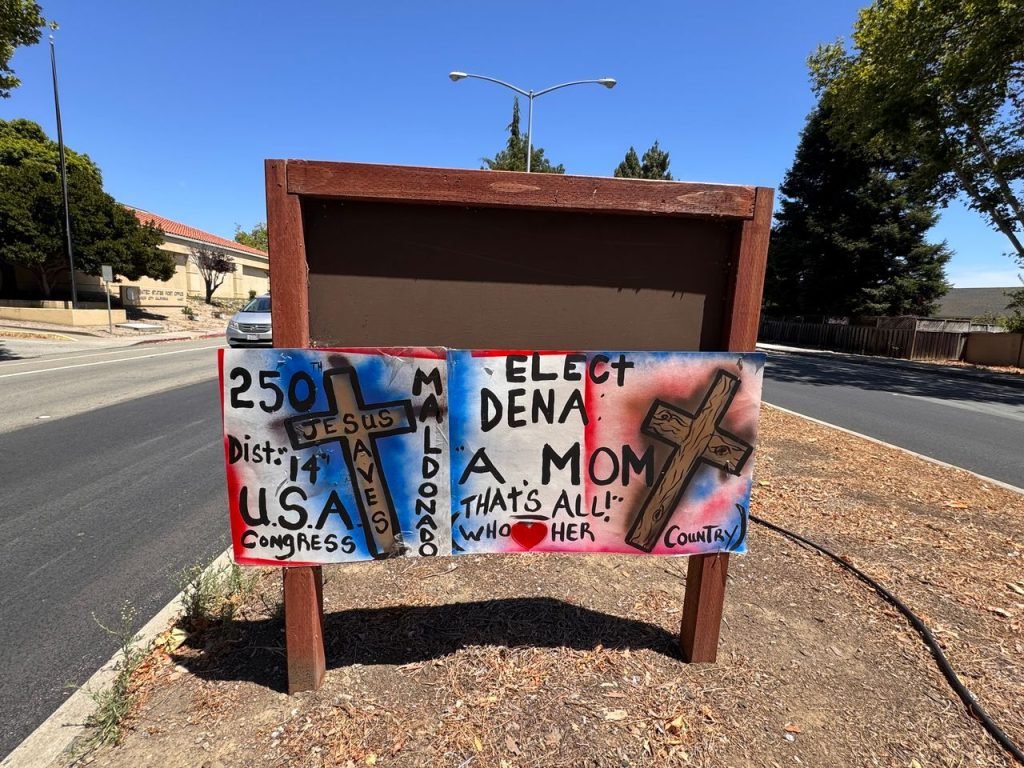
    In both 2026 CA-14 primaries, Wendy Huang was the top Republican vote-getter. Dena Maldonado finished behind her both times. The California Republican Party and the Alameda County Republican Party officially endorsed Maldonado anyway. Chairwoman Corrin Rankin has not answered the questions that followed. Delegates should not be asked to choose the next chair while those questions remain unanswered.

    What the votes show

    ContestWendy Huang (R)Dena Maldonado (R)Huang’s margin
    June 16 special primary (certified)11,407 (9.22%)11,188 (9.05%)219 votes
    June 2 regular primary (county’s June 12 update)20,295 (13.16%)18,732 (12.14%)1,563 votes
    Sources: Alameda County Registrar of Voters; California Secretary of State.

    Neither Republican reached the top two. Democrats Aisha Wahab and Melissa Hernandez advanced in both contests. Wahab won the seat.

    The official endorsement

    Both the California Republican Party and the Alameda County Republican Party officially endorsed Dena Maldonado. Maldonado used that endorsement on her campaign materials. Alameda County Chair Jeanne Solnordal has said the county endorsing commission backed Maldonado by at least a two-thirds vote after a March meeting that Huang was invited to but did not attend.

    That does not answer the central questions for the state party: Why did the CAGOP officially endorse the second-place Republican over the first-place Republican? What process produced that decision? Who made the final call?

    The mailer

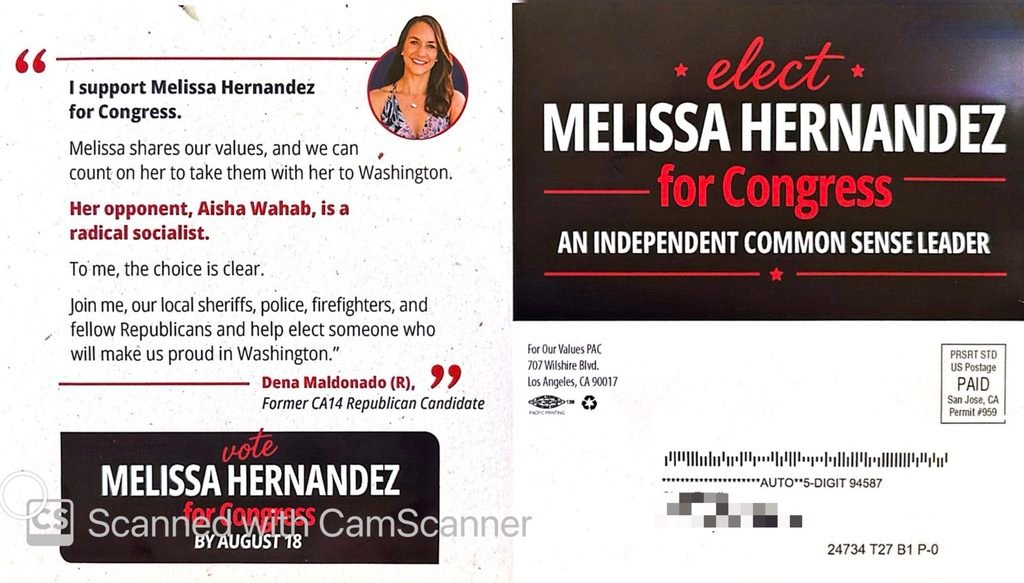
    In August, a mailer paid for by For Our Values PAC featured Maldonado, labeled “Former CA14 Republican Candidate,” urging voters to elect Democrat Melissa Hernandez and calling Wahab a “radical socialist.”

    Not authorized by any candidate or candidate’s committee.

    Disclaimer printed on the For Our Values PAC mailer

    Because of that disclaimer, it is not clear who wrote the quote or whether Maldonado approved it. Maldonado’s federal committee had reported no money raised or spent, and her campaign website was down by August.

    A party that officially endorses a candidate owes its voters an answer when that candidate’s name is later used to elect a Democrat. Has the CAGOP asked Maldonado whether the mailer reflects her views? If it does, what is the party’s response?

    Questions for Chairwoman Rankin

    1. Why did the CAGOP officially endorse the second-place Republican over the first-place Republican?
    2. What process produced that decision, and who made the final call?
    3. Has the CAGOP asked Maldonado whether the mailer reflects her views?
    4. If it does, what is the party’s response?

    Delegates vote on February 26. They should have the answers first.

  • Before the Oath: A Plea to the House to Find the Truth in CA-14

    Update, September 2026: Aisha Wahab was sworn in as the representative for California’s 14th District in September 2026. This letter is kept here as part of the record. See the CA-14 Special Report for where the questions stand.

    CA-14 investigation: After the Primary | Chapter 9 of 10
    New to this story? Start with Part 1: The Stolen Seat, or see the CA-14 Special Report hub.
    ← Previously: Dena Maldonado, If You Are Reading This: There Is Still a Path Forward
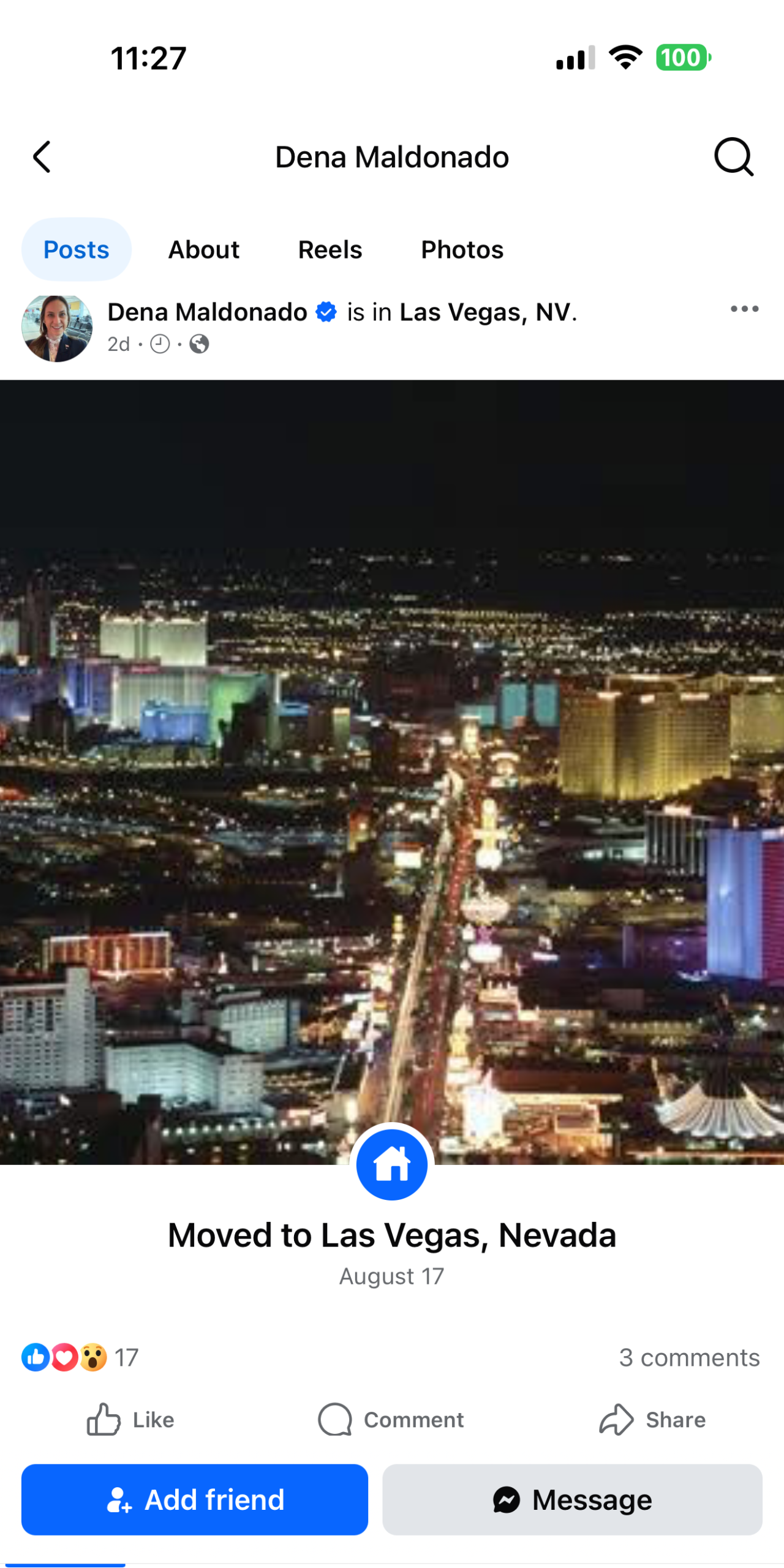
    Addressed directly to Dena Maldonado, this post says public records confirm her Republican candidacy and the federal complaint involving her campaign.

    To Speaker Mike Johnson, the House Committee on House Administration, and every Member of the United States House of Representatives:

    Please do not rush past the questions surrounding California’s 14th Congressional District.

    Investigate first. Seat later.

    This is not a demand that Congress declare Aisha Wahab guilty of anything. It is not a demand that the House overturn an election based on rumor, partisan disagreement, or disappointment with its outcome.

    It is something much more fundamental:

    We are asking Congress to find out what happened.

    On August 18, California voters chose Aisha Wahab to fill the remainder of the vacant CA-14 congressional seat. The certified results show Wahab receiving 53.09% of the vote against Melissa Hernandez’s 46.91%.

    That result deserves respect.

    But so does the integrity of the process that produced it.

    A note on where this concern originates

    Before going further, it’s worth being direct about the source of the underlying complaint. The federal campaign-finance matter discussed below, FEC MUR 8508, was filed by Wendy Huang — a retired tech-executive, duly elected Alameda County GOP committeewoman, wife, mother, immigrant, entrepreneur, twice CA14 2026 top Republican vote-getter, and Republican candidate who also ran in the CA-14 primary and competed directly against Dena Maldonado, a recent transplant from San Diego, and self-described swimwear designer and florist.

    That connection doesn’t answer the questions the complaint raises, but readers deserve to know it up front rather than discover it later. A complaint filed by an interested party can still identify real problems; it can also be wrong, or self-serving, or both. That’s exactly why the answer isn’t to accept or dismiss the allegations on the basis of who raised them — it’s to have them examined by an authority with no stake in the outcome.

    California’s Congressional District 14 carries more than its share of national significance

    Our CA-14 is not an ordinary suburban district. It is home to Lawrence Livermore National Laboratory, one of the two U.S. laboratories responsible for designing and maintaining the nation’s nuclear weapons stockpile, along with a satellite site of Sandia National Laboratories. In April 2026, Union City — also within the district — became home to the first U.S. facility dedicated to advanced AI chip packaging and assembly, a research and development center opened by the Japanese firm Resonac to support the chip supply chain behind AI servers and other next-generation hardware. The district also gained Forge 1, a nearly 289,000-square-foot advanced manufacturing campus opened by Velo3D in Livermore in July 2026 that produces mission-critical metal components for the defense, aerospace, and energy sectors.

    None of that changes the legal standard for whether Congress should investigate. But there is a reason this seat’s representation deserves particular care: whoever holds it will sit on committees, receive briefings, and cast votes that touch directly on nuclear security and the AI and advanced manufacturing supply chain. That is an argument for getting the process right, not for favoring one outcome over another.

    There is an unresolved question at the beginning of this election

    The controversy does not begin on August 18.

    It begins with the June special primary that determined which candidates would advance to the August runoff.

    One of those candidates was Dena Maldonado, who was officially endorsed by the Alameda County GOP and California’s Republican Party.

    On June 26, 2026, Wendy Huang filed a formal complaint with the Federal Election Commission alleging coordinated and unlawful campaign-finance conduct connected to Maldonado’s candidacy. The FEC acknowledged receipt of the complaint on July 2, 2026, and assigned it Matter Under Review (MUR) 8508. The named respondents include Dena Maldonado and her campaign committee, a labor-affiliated PAC called the Committee for Working Families, and the California and Alameda County Republican Parties.

    It’s important to be precise about what that acknowledgment letter does and does not establish. It confirms that a complaint was filed and logged, and that respondents would be notified. It is not a finding that anything alleged in the complaint is true, and the FEC has not announced that it has opened a formal investigation, found reason to believe a violation occurred, or reached any conclusion. MUR 8508 is, at this stage, an open, unresolved matter — nothing more, and nothing less.

    The complaint itself states facts combined with allegations of a specific pattern, which — again — is alleged, not proven:

    • That Maldonado’s campaign reported raising and spending $0.00 for the entire cycle while still securing ballot access and institutional endorsements;
    • That a $60,786 mailer campaign by a labor-affiliated PAC, run just before the special primary and nominally framed as an attack on Maldonado, instead amplified her conservative credentials to Republican and No Party Preference voters;
    • That the PAC’s mailers used a headshot matching Maldonado’s own campaign materials, which the complaint argues points to shared assets rather than independent activity;
    • That Dena Maldonado’s campaign relied on informal Form 99 filings rather than standard periodic financial disclosures, and that she later filed a sworn statement acknowledging amendments were needed without the public record being updated; and
    • That the combination of these factors allowed Dena Maldonado to draw roughly 18,732 votes (about 12.1%) in the June 2 primary — a share the complaint argues would not have gone to her absent the alleged coordination.

    None of this has been adjudicated. The allegations are disputed and should not be treated as proven facts unless and until the FEC or another appropriate authority establishes them.

    But that is precisely why an investigation matters.

    If the evidence ultimately shows that Dena Maldonado’s candidacy was an ordinary, legitimate candidacy, then the public deserves to know that.

    If the evidence shows that inside and outside political actors improperly coordinated with or engineered a candidacy for the purpose of manipulating the outcome of the primary, the public deserves to know that, too.

    And if the evidence shows that such conduct materially affected who appeared on the August 2026 ballot, Congress needs to understand the consequences before it acts on the resulting election.

    Those questions cannot be answered by pretending they do not exist — and they cannot be answered by an acknowledgment letter alone. Only a completed FEC review, or a House inquiry that draws on the same underlying records, can do that.

    This is bigger than one candidate

    The issue is not whether you personally support Aisha Wahab.

    It is not whether you support Wendy Huang.

    It is not whether you are a Democrat or Republican.

    It is not even ultimately about Dena Maldonado.

    It is about whether Americans can trust that a congressional election is what it appears to be.

    Imagine discovering after an election that a candidate had been placed into a primary not to win, not to represent a constituency, but allegedly to divert enough votes from another candidate to change who advanced.

    If that happened, voters would have been participating in an election whose apparent choices did not reflect the actual political contest.

    That would strike at something deeper than campaign strategy.

    It would strike at the voter’s right to make an informed choice.

    And if the allegations are false, the investigation is equally important — because innocent people deserve to have their names cleared by facts rather than left under a cloud of suspicion.

    Congress has a responsibility here

    The Constitution does not leave congressional elections entirely to political parties, campaigns, or even state election officials.

    Article I, Section 5 provides that each House is the judge of the “Elections, Returns and Qualifications” of its members. The House has procedures for examining contested elections and has exercised its authority to investigate disputed congressional elections.

    That constitutional responsibility exists for moments exactly like this:

    When there is a serious question about whether the process that produced a congressional election was legitimate.

    The House does not need to prejudge the answer.

    It needs to ask the questions. It can obtain documents. It can examine campaign-finance records. It can review communications and expenditures. It can hear from the relevant campaigns and organizations. It can coordinate, where appropriate, with the FEC on the status of MUR 8508 rather than duplicate that work from scratch. It can determine whether the allegations have merit. And then it can make a decision based on evidence rather than speculation.

    Please do not turn this into a partisan fight

    There is an easy way for Washington to mishandle this.

    Democrats can say: Wahab won. Move on.

    Republicans can say: This is simply an effort to overturn an election.

    Supporters of Huang can say: The election was stolen.

    Supporters of Wahab can say: These allegations are an excuse to deny the will of the voters — filed, after all, by the losing candidate’s own former opponent.

    Everyone can retreat into their political corners.

    And the facts can get lost.

    That would be a failure.

    The right response is neither “Wahab must be seated immediately” nor “Wahab must never be seated.”

    The right response is: show us what happened.

    To Speaker Johnson: use the power of your office responsibly

    Mr. Speaker, this is not a request that you personally decide who should represent CA-14.

    It is a request that you ensure the House does not close its eyes to a potentially consequential election-integrity question simply because the election has produced a winner — and simply because the complaint that raised it came from an interested party rather than a neutral one. The identity of the complainant is a reason for scrutiny, not a reason for dismissal.

    The House can investigate. The House can demand answers. The House can determine whether the allegations are supported by evidence. And, where the law and House procedures permit, the House can allow that process to occur before taking an irreversible step.

    Please don’t ask the American people to trust the outcome before Congress — or the FEC, through MUR 8508 — has examined the questions that have been formally raised about the process.

    To the House Committee on House Administration: investigate

    We are asking for a serious, bipartisan examination of the CA-14 special election.

    Not a political spectacle. Not a predetermined conclusion. An investigation.

    Determine:

    1. What was the purpose and origin of Dena Maldonado’s candidacy?
    2. Who encouraged, recruited, financed, or supported that candidacy?
    3. What communications existed among the relevant individuals, campaigns, committees, and outside organizations, including the Committee for Working Families PAC named in MUR 8508?
    4. Were any campaign-finance laws violated, as alleged in MUR 8508?
    5. Was there coordination that was not properly disclosed?
    6. Was the candidacy intended to influence the outcome of the June primary?
    7. Did any alleged conduct materially affect the result?
    8. Would the August runoff have occurred in its present form absent that conduct?
    9. What does the evidence mean for the legitimacy of the election now before the House?
    10. What is the current status of MUR 8508 within the FEC, and has the Commission made any determination on reason-to-believe or dismissal?

    Those are factual questions. Find the answers.

    We are not asking Congress to overturn an election by accusation

    We are asking Congress to protect the election by investigation.

    There is a profound difference.

    If the investigation establishes that everything was legitimate, then seat the winner and let the public move forward.

    If the investigation establishes serious misconduct, then Congress must confront what that means under the Constitution and federal election law.

    But neither outcome should be determined without first examining the evidence.

    Because once the oath is administered, the political pressure to simply move on becomes enormous. The opportunity for a careful investigation becomes harder. And the public is left wondering whether Congress ever really wanted to know the truth.

    Democracy requires more than counting votes

    Counting votes matters.

    But democracy is not merely the mechanical addition of ballots.

    It requires that voters be presented with legitimate choices. It requires that campaigns compete under the law. It requires transparency about who is financing political activity. And it requires institutions willing to investigate when credible questions arise — even, and especially, when the questions were first raised by someone with a personal stake in the answer.

    The people of CA-14 deserve that. Wendy Huang deserves that. Aisha Wahab deserves that. Dena Maldonado deserves that. And, most importantly, the voters deserve that.

    If the allegations are wrong, let the evidence demonstrate that. If they are right, let the evidence demonstrate that.

    But do not ask the American people to accept an answer before the questions have been investigated.

    Before the oath, find the facts.

    A congressional seat is not a trophy. It is not a prize for the campaign that wins the final count. It is a public trust. And when there is a serious unresolved question about whether the electoral process itself was manipulated, the responsible course is not to look away.

    It is to investigate.

    Speaker Johnson and Members of the House: please use the constitutional authority entrusted to you. Investigate MUR 8508 and the underlying allegations. Determine the facts. Determine whether the June primary — and therefore the August special election — was affected by unlawful or improper conduct. And until those questions can be responsibly answered, exercise caution before seating Aisha Wahab.

    Not because she has been proven to have done anything wrong. Not because her opponent should automatically receive the seat. But because the integrity of an election is more important than the convenience of moving on.

    The voters deserve the truth.

    Before the oath, find the facts.


    CA-14 voters: the election is over. The questions aren’t.

    Right now, a federal complaint is sitting open — FEC MUR 8508 — alleging a “ghost candidate” was engineered to siphon Republican votes and rig who advanced past the June primary. Nobody has proven it. Nobody has disproven it either. And once Congress seats the winner, the pressure to just move on becomes overwhelming.

    You don’t need to be a lawyer or an insider. You need five minutes.

    We’ve already written the words. Send the email. Make the call.

    Investigate first. Seat later. Do it now — before the window closes.

    Email Template

    How to use this: Copy the message below into an email. Fill in your name, city/county, and — if you know it — your congressional district. Send it to Speaker Johnson’s office (you can find a contact form at speaker.gov) and/or your own U.S. Representative, and to your county GOP chair if you’d like local party leadership to hear from you too. Sending it to more than one recipient is fine — just address or adjust the salutation for each.

    Subject: Please support an investigation into the CA-14 election

    Dear Speaker Johnson / [County GOP Chair],

    I am writing as a voter who cares deeply about the integrity of our elections.

    I am asking you to support a thorough, bipartisan investigation into the circumstances surrounding the CA-14 special election, including the allegations raised in FEC MUR 8508 concerning Dena Maldonado’s candidacy. That complaint was filed by Wendy Huang, CA14’s two-time Republican top vote getter, and two-time primary candidate — I’m noting that upfront because I think the questions it raises deserve to be evaluated on the evidence, not dismissed or accepted based on who filed it.

    I am not asking you to prejudge the outcome or declare that anyone has done anything wrong. I am asking for the facts to be established.

    There are serious questions about whether Maldonado’s candidacy may have been used to influence the June special primary and, consequently, which candidates advanced to the August election. The FEC has acknowledged the complaint and opened MUR 8508, but has not yet reached any determination. Those questions deserve a careful examination of the evidence.

    The House of Representatives has a constitutional responsibility to judge the elections and returns of its members. I respectfully ask that you support:

    • A thorough investigation of the allegations surrounding MUR 8508;
    • Examination of relevant campaign-finance records, communications, and relationships;
    • Determination of whether any unlawful coordination or other election violations occurred;
    • An assessment of whether any such conduct materially affected the CA-14 election; and
    • Appropriate caution regarding seating Aisha Wahab until these serious questions can be responsibly evaluated.

    This is not about asking Congress to overturn an election based on an accusation. It is about making sure that Congress does not ignore a potentially consequential election-integrity issue.

    If the allegations are unfounded, an investigation can establish that. If they are substantiated, the House needs to understand their implications.

    Please stand for transparency, due process, and the integrity of the vote. Investigate first, and let the facts determine what happens next.

    Thank you for taking this matter seriously.

    Sincerely, [Your Name] [City/County, State] [Optional: Your Congressional District]


    Phone/Voicemail Template

    How to use this: This is written to be spoken, not read verbatim word-for-word — glance through it once, then call and talk naturally, hitting the same points. Call Speaker Johnson’s office at (202) 225-0600, your own U.S. Representative’s office (find the number at house.gov/representatives), or your county GOP office. If you reach voicemail, leave the message below; if a staffer picks up, you can use it as talking points instead. Keep it under a minute or so — staffers fielding call volume will appreciate brevity.

    Hi, my name is [Your Name] and I’m a voter in [City/County]. I’m calling to ask [Speaker Johnson’s office / the County GOP] to support an investigation into the CA-14 special election — specifically the allegations in FEC MUR 8508 about Dena Maldonado’s candidacy in the June primary. That complaint was filed by Wendy Huang, CA14’s two-time Republican top vote getter, and one of Dena Maldonado’s primary opponents, and I think that’s worth knowing, but I still believe the underlying questions deserve a real look regardless of who raised them.

    I’m not asking anyone to assume Aisha Wahab or Dena Maldonado did anything wrong. I’m asking for the facts to come out before the House takes any irreversible steps. Please look into this and let the evidence decide. Thank you.

    [Your Name] [City/County, State]

    Next: Where Things Stand: CA-14 After the Special Election →

    Disclosure: Republican Forum has endorsed Wendy Huang in the CA-14 race. Republican Forum is independent of all campaigns, with no coordination with, funding from, or direction from any campaign.

  • Who Is Jamison Olivieri? Questions Surrounding Dena Maldonado, CA-14, and MUR 8508

    CA-14 investigation: After the Primary | Chapter 7 of 10
    New to this story? Start with Part 1: The Stolen Seat, or see the CA-14 Special Report hub.
    ← Previously: Who Paid for the Campaign? Voters Deserve Answers
    Federal filings show zero spending even though the campaign looks expensive, this post says of Dena Maldonado’s congressional run.

    Who Is Jamison Olivieri? Questions About the Maldonado Campaign and MUR 8508

    Voters are asked to trust a great deal during an election: the candidate, the campaign, the party, and the names, photographs, endorsements, and logos in their mailboxes. When a federal complaint raises questions about a congressional race, trust alone isn’t enough. One of the most basic questions has received little attention: who is Jamison Olivieri?

    An earlier Republican Forum report identifies Jamison Olivieri as the campaign manager listed on Dena Maldonado’s campaign literature, and raises questions about his professional background and his apparent lack of a publicly documented history managing federal campaigns. Those are questions worth asking, and they should remain questions until the facts are established.

    • Is Jamison Olivieri the same person described in the public professional records we discussed?
    • What exactly was his role in the Maldonado campaign, and when did he become campaign manager?
    • Who hired him, and who paid him?
    • What campaigns had he previously worked on?
    • What did the campaign manager know about the campaign’s advertising, mailers, and the matters now raised in the FEC complaint?

    None of these questions, alone, proves wrongdoing. Reasonable questions don’t become illegitimate because the answers may be uncomfortable.

    What MUR 8508 is, and isn’t

    The matter centers on Dena Maldonado’s campaign for Congress in California’s 14th District and allegations raised by Republican primary rival Wendy Huang. As we understand the docket, the respondents include Maldonado, the Committee for Working Families, Sponsored by Labor Organizations, the California Republican Party, and the Alameda County Republican Party.

    A complaint is an allegation. An FEC matter is not itself a finding that a violation occurred. No one should be declared guilty because allegations have been filed. At the same time, allegations about the integrity of a federal election deserve serious examination.

    The Alameda County Republican Party’s response

    According to the party’s written response to the FEC, it held an endorsement meeting on March 18, 2026, where Maldonado presented and received the endorsement with more than two-thirds of the vote. The party says her party registration and address were verified beforehand, her name was forwarded to the California Republican Party the next day, and it gave her no financial or treasury support and saw no evidence otherwise. Those statements belong in any fair discussion.

    They also raise a question: how were those endorsements used in campaign advertising, and who authorized that use? An endorsement and permission to use a party’s name or logo in a particular advertisement are not necessarily the same thing.

    Who paid for the mailer?

    Another question concerns the organization identified as the payer of the disputed political material. If a political committee funded a communication supporting Maldonado, voters have a legitimate interest in knowing who created, approved, and paid for it, and what relationship it had with her campaign. But the existence of spending doesn’t establish illegal coordination. “This committee spent money supporting Maldonado” can be shown from campaign-finance records. “Maldonado’s campaign illegally coordinated with this committee” requires evidence. We note that our earlier reporting identified For Our Values PAC as the payer of the August 6 mailer, and we are working to reconcile the committees named in the docket with those on the mailers.

    The photograph of Donald Trump

    One of the most politically consequential questions is about imagery that portrays Maldonado with Donald Trump. Was it authentic? When and where was it taken? Did Trump endorse Maldonado? Was it used with permission, and could it reasonably lead voters to think he had? These are factual questions that photographs, metadata, communications, and witnesses can answer.

    Why this matters

    If Olivieri was the campaign manager, voters are entitled to understand the chain of responsibility inside the campaign. A campaign manager isn’t necessarily responsible for everything outside groups do, and the role alone doesn’t establish liability. But it is fair to ask whether he communicated with the committees involved, discussed the endorsements and logos, or knew how the Trump photograph was being represented, and whether anyone has asked him.

    Silence isn’t proof of wrongdoing. A person may stay silent on a lawyer’s advice, or an organization may be preparing a formal response. But silence leaves questions unanswered, and unanswered questions are why an investigation exists.

    Bigger than one candidate

    What is at stake goes beyond Maldonado, Huang, or Olivieri. Can voters look at a mailer and know who paid for it? Can they see a party logo and assume the party authorized it? Can they see a candidate photographed with a national figure and understand what it means? And can they trust that allegations of election misconduct will be investigated fairly, whatever the party? Tell the truth, preserve the evidence, and let the evidence speak.

    Next: Dena Maldonado, If You Are Reading This: There Is Still a Path Forward →

    Disclosure: Republican Forum has endorsed Wendy Huang in the CA-14 race. Republican Forum is independent of all campaigns, with no coordination with, funding from, or direction from any campaign.
  • Dena Maldonado, If You Are Reading This: There Is Still a Path Forward

    CA-14 investigation: After the Primary | Chapter 8 of 10
    New to this story? Start with Part 1: The Stolen Seat, or see the CA-14 Special Report hub.
    ← Previously: Who Is Jamison Olivieri? Questions Surrounding Dena Maldonado, CA-14, and MUR 8508
    Citing a federal campaign-finance complaint, MUR 8508, this long post asks who Jamison Olivieri is and what role he played in Dena Maldonado’s campaign.

    Dena Maldonado, If You Are Reading This: There Is Still a Path Forward

    Public records confirm that Dena Maldonado was a Republican candidate for California’s 14th Congressional District and that her federal campaign committee registered with the Federal Election Commission in March 2026. There is also an FEC matter, MUR 8508, arising from allegations concerning Maldonado and other respondents. A July 26, 2026 response from the Alameda County Republican Party disputes the allegations against that organization and says it endorsed Maldonado after an endorsement meeting and verified her party affiliation and address.

    An allegation is not a finding, and a complaint is not a verdict. But allegations about the integrity of an election can’t be wished away. This is an open letter, written in good faith.

    Dena, if you are reading this: this is not a plea to become anyone’s scapegoat. If you know nothing about any alleged scheme, say so. If you were approached by people with an agenda you didn’t understand, or were asked to do something that now seems important, tell your attorney. Preserve emails, texts, campaign and financial records, and calendars. Comply with every lawful subpoena and order. Don’t delete, alter, or conceal anything.

    Get experienced federal election-law counsel first, and let your lawyer decide how best to approach the authorities. No one should walk unrepresented into a federal office and make statements that could expose them to liability. If you have information about others’ conduct, counsel can explore whether cooperation is possible. Immunity isn’t automatic, and it is governed by specific legal procedures.

    The same goes for friends, staff, and vendors who know something. Don’t tell her to disappear or what story to tell. Tell her to get a lawyer and tell the lawyer everything. Real friendship is helping someone face the truth safely.

    There is a difference between justice and revenge. If the allegations are false, the truth can clear your name. If they are partly true, it can show what happened. If there was wrongdoing, an honest accounting can separate the people who conceived a scheme from those who knowingly joined it, those who were misled, and those who had nothing to do with it. Whatever happens with MUR 8508, the country doesn’t need another political story. It needs the facts.

    Next: Before the Oath: A Plea to the House to Find the Truth in CA-14 →

    Disclosure: Republican Forum has endorsed Wendy Huang in the CA-14 race. Republican Forum is independent of all campaigns, with no coordination with, funding from, or direction from any campaign.
  • Who Paid for the Campaign? Voters Deserve Answers

    CA-14 investigation: After the Primary | Chapter 6 of 10
    New to this story? Start with Part 1: The Stolen Seat, or see the CA-14 Special Report hub.
    ← Previously: Could Congress Order a New CA-14 Election? What the House Can and Cannot Do
    Could Congress refuse to seat a winner and force a new election if CA-14 were proven fraudulent?

    When a congressional campaign looks expensive, but the FEC filings show zero

    Campaigns for Congress are supposed to be transparent.

    Voters should be able to look at a candidate’s federal campaign-finance filings and understand where the campaign’s money came from, how it was spent, and who helped put the campaign’s message in front of voters.

    That is why questions are being raised about the campaign of Dena Maldonado.

    A campaign video circulating on Instagram shows the candidate walking, posing for the camera, displaying professionally designed campaign postcards, and appearing with an actual mail-in ballot showing the candidate’s name marked for a vote.

    Those are campaign materials and campaign communications that naturally raise a simple question:

    Who paid for them?

    The question becomes particularly important when voters reviewing the candidate’s Federal Election Commission filings see little or no reported campaign money.

    This is not an accusation. It is a transparency question.

    There is an important distinction between asking questions and declaring that someone has violated federal election law.

    At this point, the public should not assume that the existence of a professionally produced video or printed campaign materials proves an illegal contribution or expenditure. There may be explanations that are not yet publicly known.

    But voters are entitled to ask for those explanations.

    Federal campaign-finance laws exist in large part so that the public can see the financial activity surrounding federal elections. The FEC says that campaign-finance reports are public records and that its public-records system allows voters to review campaign reports, individual contributions, enforcement actions, audits and other information relating to campaigns.

    For House and Senate candidates, registered campaign committees are required to report their receipts and disbursements.

    So when voters see a campaign operation that appears to involve professional production, printed materials and direct election messaging, it is reasonable to ask whether those activities are reflected in the appropriate campaign-finance disclosures.

    The FEC has now acknowledged MUR 8508

    This question is not occurring in a vacuum.

    On June 26, 2026, a complaint was submitted to the Federal Election Commission concerning alleged violations of the Federal Election Campaign Act.

    On July 2, 2026, the FEC’s Office of General Counsel acknowledged receipt of that complaint and assigned it MUR 8508.

    So who paid for the campaign materials?

    That is the central question.

    If campaign materials were produced or distributed by the candidate’s authorized committee, voters should be able to determine how those expenses were paid and how they were reported.

    The FEC explains that campaign disbursements generally must be recorded, including the amount, date, payee and purpose.

    The FEC also states that candidates’ personal funds used for campaign purposes are contributions to the campaign and must be reported.

    And there is another possibility that deserves examination: someone other than the candidate’s campaign may have paid for campaign-related communications.

    The FEC defines an independent expenditure as spending by an individual, group, political committee, corporation or union expressly advocating the election or defeat of a clearly identified federal candidate, provided the spending is not coordinated with the candidate, campaign or political party. Such expenditures can trigger reporting requirements.

    That means the question isn’t simply:

    “Where is the candidate’s campaign money?”

    It is also:

    “Was anyone else paying for communications or materials supporting this candidate?”

    If so, who?

    What about the postcards?

    Professionally designed postcards don’t necessarily tell us who paid for them.

    The same is true of a professionally produced video.

    A campaign can receive lawful assistance in some circumstances, and federal campaign-finance law contains specific rules governing contributions, expenditures, in-kind contributions, independent expenditures and other forms of political spending.

    That is precisely why documentation matters.

    If somebody paid a commercial company to produce campaign materials, voters should be able to determine whether that transaction was properly accounted for.

    If somebody donated services or materials to a campaign, voters should be able to determine whether that assistance was required to be reported.

    If an outside organization paid for an independent communication, voters should be able to determine whether the expenditure was disclosed as required.

    And if the campaign paid for the materials itself, the campaign’s financial records should provide the appropriate trail.

    What about the mail-in ballot shown in the video?

    The appearance of an actual mail-in ballot in campaign material raises another legitimate question for voters: how was the ballot obtained and used in the production?

    That question should not be turned into an accusation without evidence.

    But it is fair to ask for clarification about the circumstances surrounding the ballot shown in the video, particularly when the video is being used as campaign messaging.

    The public deserves facts, not speculation.

    Transparency protects everyone

    There is a good reason to ask these questions publicly and carefully.

    Transparency is not just about protecting voters.

    It also protects candidates.

    If everything was properly paid for and reported, documentation can answer the questions.

    If an outside organization paid for the production, disclosure can identify that organization.

    If supporters donated money or services, the campaign-finance records should help explain the activity.

    And if there was an innocent administrative explanation for something that appears unusual, the campaign has an opportunity to provide that explanation.

    The worst outcome for voters is not necessarily an accusation.

    The worst outcome is a lack of answers.

    What should voters ask?

    Rather than assuming wrongdoing, voters can ask straightforward questions:

    1. Who paid for the Instagram campaign video?
    2. Who paid for the professional video production?
    3. Who designed and printed the campaign postcards?
    4. How much did the production and printing cost?
    5. Were these expenses paid by the candidate’s campaign committee?
    6. If not, who paid them?
    7. Were any goods or services donated to the campaign?
    8. Were any outside groups involved in producing or distributing the materials?
    9. Were any independent expenditures made supporting the candidate?
    10. Were all required expenditures, contributions, in-kind contributions and other financial activity properly reported to the FEC?
    11. How does the campaign explain professional campaign activity appearing alongside filings showing little or no financial activity?
    12. What does the campaign intend to disclose or provide to resolve voters’ concerns?

    Those are legitimate questions for any candidate seeking federal office.

    The public should follow the evidence

    The FEC itself makes campaign-finance information available so that the public can examine how federal campaigns are financed. The Commission specifically describes campaign-finance reports as public records and provides access to candidate reports, contributions, disbursements and enforcement information.

    And the FEC says that its disclosure system is intended to provide information that allows the public to evaluate candidates and monitor compliance with federal election law.

    That is exactly what voters should be doing now.

    Not convicting anyone.

    Not assuming that every campaign expense is unlawful.

    But asking:

    Who paid?

    How much was paid?

    Who provided the services or materials?

    Where is the disclosure?

    And ultimately:

    Does the campaign’s financial record match the campaign activity voters can actually see?

    MUR 8508 makes those questions especially important

    The FEC has formally acknowledged the complaint and assigned it MUR 8508.

    The next step belongs to the FEC’s enforcement process.

    Until the Commission reaches a final determination, voters should treat allegations as allegations—not established facts.

    But that does not mean voters have to stop asking questions.

    A congressional campaign is asking citizens for their votes and, potentially, for their trust and representation in Washington.

    Citizens therefore have every reason to expect transparency about who is financing the campaign that is asking for their vote.

    If the campaign was properly financed and reported, show the records.

    If someone else paid for the campaign activity, disclose who they were.

    And if there is nothing improper, explain the apparent discrepancy between the campaign activity voters can see and the financial activity voters can find in the public record.

    That is not asking for too much.

    That is asking for transparency in a congressional election.

    The voters deserve to know who is paying for the campaign.

    Next: Who Is Jamison Olivieri? Questions Surrounding Dena Maldonado, CA-14, and MUR 8508 →

    Disclosure: Republican Forum has endorsed Wendy Huang in the CA-14 race. Republican Forum is independent of all campaigns, with no coordination with, funding from, or direction from any campaign.
  • Could Congress Order a New CA-14 Election? What the House Can and Cannot Do

    CA-14 investigation: After the Primary | Chapter 5 of 10
    New to this story? Start with Part 1: The Stolen Seat, or see the CA-14 Special Report hub.
    ← Previously: The Letter: How the Party Removed Its Own Elected Committeewoman
    This post describes a letter it says shows the party banished its own elected committeewoman and double-primary winner.

    If CA-14 Were Proven Fraudulent, Could Congress Refuse to Seat the Winner — and Force a New Election?

    California’s 14th Congressional District special election, held to fill the seat vacated by former Rep. Eric Swalwell, has drawn serious allegations raised by Republican candidate Wendy Huang that fellow Republican Dena Maldonado ran as a “ghost candidate” — a spoiler entered into the race to fracture the conservative vote rather than to seriously compete for it. Huang has filed a complaint with the Federal Election Commission (MUR 8508), later supplemented with additional exhibits. Maldonado has yet to deny the allegations publicly, and no federal agency has issued a finding of fraud as of this writing, August 11th, 2026.

    This piece sets that unresolved status aside for a moment and asks a narrower, hypothetical question: if the ghost-candidate scheme were proven — fully and conclusively — could Congress refuse to seat CA-14’s certified winner, and would that actually force California to hold a new election?

    The premise, stated plainly

    Assume, for the sake of the question, that an investigation — FEC, DOJ, or both — conclusively establishes that Dena Maldonado’s candidacy was a fraudulent scheme: illegally funded, falsely reported, and coordinated with outside spending in violation of federal election law, such that it changed which candidates advanced or won. That’s a real category of finding federal investigators can make; it’s the kind of fact pattern past ghost-candidate prosecutions have turned on, like the 2020 Florida state senate case where operatives were convicted for illegally funding a spoiler and lying about it on campaign finance disclosures.

    The question is what happens after a finding like that exists — who has the power to act on it, and what they can actually do.

    What an FEC or DOJ finding does — and doesn’t — do

    Even a fully proven fraud finding doesn’t automatically undo an election result. The FEC’s own powers are civil and financial: fines, disgorgement of illegal contributions, referral for criminal prosecution. It cannot invalidate ballots, disqualify a candidate retroactively, or order a new election. A DOJ conviction adds criminal consequences for the individuals involved, but it likewise doesn’t reach into the certified vote count and change it.

    Undoing an election result — has to happen through one of two separate channels:

    State court. A candidate could bring an election contest under California law, arguing the fraud was material enough to have changed who advanced or won. Courts are generally reluctant to overturn certified results, and the evidentiary bar for showing the fraud was outcome-determinative, not just distasteful, is high.

    Congress, via the Federal Contested Elections Act (FCEA). This is the mechanism worth focusing on, because CA-14 is a U.S. House seat, and the Constitution gives the House — not California, not the courts — final authority to judge the elections, returns, and qualifications of its own members. Under the FCEA, a losing candidate can file a formal notice of contest against the certified winner. The House Administration Committee investigates, and the full House ultimately votes on one of three outcomes: seat the contestant instead, seat the certified winner anyway, or declare the seat vacant.

    The actual answer: can the House “refuse to seat” someone?

    Yes — and this is the part that answers the question directly. The House does not have to seat the certified winner of a state’s election. If the FCEA process produces a finding that the certification was tainted by fraud material to the outcome, the House can vote to decline to seat that person. It doesn’t install the runner-up by default, though — the House’s menu is genuinely limited to the three options above, and simply refusing to seat the certified winner without affirmatively seating a contestant defaults to the third option: a vacant seat.

    That’s the lever. The House can’t reach into California and order a redo election directly — that’s not a power Congress has over state election administration. What it can do is refuse to recognize the outcome by declaring the seat vacant.

    How a vacancy becomes a new election

    This is where state law picks the mechanism back up. Under California Elections Code §10700 et seq., a vacancy in a U.S. House seat triggers the Governor’s statutory duty to call a special election. That’s not discretionary — it’s an obligation that activates automatically once a vacancy exists, regardless of why the seat became vacant.

    So the full chain, run all the way through, looks like this:

    1. A confirmed finding (FEC and/or DOJ) that the Maldonado candidacy was a fraudulent scheme
    2. A contestant — most plausibly Huang — files a formal notice of contest under the FCEA
    3. The House Administration Committee investigates whether the fraud was material to the outcome (i.e., that it actually changed who advanced or won, not just that it happened)
    4. The full House votes; if it agrees the certification can’t stand and declines to seat either the contestant or the certified winner, the seat is declared vacant
    5. The vacancy triggers the Governor’s statutory obligation under California law to call a new special election

    Each link in that chain is a real, existing legal mechanism. None of it is invented for this scenario — it’s simply what the FCEA and California’s vacancy statute already provide for, applied to this hypothetical.

    Why it would still be a heavy lift

    A few things keep this from being an easy or likely outcome, even under the proven-fraud premise:

    • Materiality is its own separate hurdle. Proving the underlying scheme was fraudulent does not, by itself, prove it changed the result. In a crowded top two primary field, the House Administration Committee would still have to be convinced the fraud was large enough to have flipped who advanced — a factual question distinct from whether fraud occurred at all.
    • The House rarely uses this power. Most FCEA contests in recent decades have ended with the House simply seating whoever the state certified, out of institutional deference to state election administration. Declaring a seat vacant over a state’s own certified result is the exception, not the norm, even when contest allegations have some evidentiary support.
    • The remedy is disruptive by design. Voiding a certified result and forcing a second special election has real costs — to voters, to continuity of representation in Congress, and to public confidence in the first election. That’s exactly why the bar for getting there is set high.

    None of that means the pathway doesn’t exist. It means that if the fraud were proven and if it were shown to have actually changed the outcome, the House-refuses-to-seat → vacant-seat → Governor-calls-new-election chain is the legitimate, constitutionally grounded route to a new CA-14 election — not a shortcut California or the FEC could take on their own, and not a live prediction about how the actual, still-unresolved Huang/Maldonado matter will turn out.

    Next: Who Paid for the Campaign? Voters Deserve Answers →

    Disclosure: Republican Forum has endorsed Wendy Huang in the CA-14 race. Republican Forum is independent of all campaigns, with no coordination with, funding from, or direction from any campaign.
  • The Official Republican Endorsement Behind Dena Maldonado

    CA-14 investigation: After the Primary | Chapter 3 of 10
    New to this story? Start with Part 1: The Stolen Seat, or see the CA-14 Special Report hub.
    ← Previously: Dena Maldonado’s Missing Website: What Happened to the “Transparency” Campaign?
    Dena Maldonado’s campaign website, which the post says preached transparency, is described as dead.

    CA-14 Investigation | After the Primary

    The Official Republican Endorsement Behind Dena Maldonado

    For weeks, people have asked whether Dena Maldonado’s claim to be the Republican choice in California’s 14th District was real, and whether party leaders actually backed her. We checked. The endorsements from both the California Republican Party and the Alameda County Republican Party are real.

    Chapter 3 of 10 | Republican Forum

    The mailer

    Paid for by

    For Our Values PAC (Los Angeles)

    Label on the mailer

    “Former CA14 Republican Candidate”

    Printed disclaimer

    “Not authorized by any candidate or candidate’s committee”

    We obtained a copy of a mailer, saved as “melissa.pdf,” paid for by For Our Values PAC.

    It reads:

    REPUBLICAN CONGRESSIONAL CANDIDATE DENA MALDONADO trusts MELISSA HERNANDEZ and you should too!

    Front of the mailer

    Under the title “Former CA14 Republican Candidate,” Maldonado calls Democrat Aisha Wahab a “radical socialist” and asks readers to:

    “join me, our local sheriffs, police, firefighters, and fellow Republicans and help elect someone who will make us proud in Washington.”

    Reverse of the mailer, attributed to Dena Maldonado (R)

    In other words, she asks Republicans to vote for Melissa Hernandez, a Democrat.

    The question

    A candidate who held the party’s official endorsement, and lost, is now using her Republican identity in a mailer for a Democrat. That raises questions the party and the candidate should answer:

    01

    Did the California Republican Party know its endorsement would be used this way?

    02

    Was this the plan from the start, as Wendy Huang’s ghost-candidate complaint alleges? We don’t know, and the mailer alone doesn’t establish it.

    03

    What financial relationship, if any, exists between For Our Values PAC and the Maldonado campaign?

    Is this happening elsewhere in California?

    California’s top-two primary often sends two Democrats to the general election in heavily Democratic districts, and that has made it a target for outside spending. Reports have described outside groups spending more than $5 million in this race to attack Aisha Wahab and boost Melissa Hernandez. If outside groups used a Republican candidate and her endorsements to help one Democrat over another, that would be a story with national implications. We don’t have evidence of that, and we say so.

    Come forward

    The voters who supported her are owed an explanation

    Maldonado’s website is down. Her FEC filings show no activity. And she appears on a mailer asking Republicans to elect a Democrat. She promised accountability. The voters who supported her are owed an explanation.

    Next: The Letter

    CA-14 Special Report hub

    Next: The Letter: How the Party Removed Its Own Elected Committeewoman →

    Disclosure: Republican Forum has endorsed Wendy Huang in the CA-14 race. Republican Forum is independent of all campaigns, with no coordination with, funding from, or direction from any campaign.
  • Dena Maldonado’s Missing Website: What Happened to the “Transparency” Campaign?

    CA-14 investigation: After the Primary | Chapter 2 of 10
    New to this story? Start with Part 1: The Stolen Seat, or see the CA-14 Special Report hub.
    ← Previously: The Mask Is Fully Off: How the California GOP Apparatus Treated a Ghost Candidate
    Republican Forum cites FEC MUR 8508, a mailer, and bylaws to argue the California GOP mishandled a ghost candidate and punished a reformer.

    Dena Maldonado’s Missing Website and the Questions It Leaves

    Dena Maldonado’s campaign literature promised “TRANSPARENCY. ACCOUNTABILITY. Real Results.” After the primary, her campaign website disappeared. Her federal filings show no money raised or spent. And a mailer paid for by an outside group featured her endorsing a Democrat. Voters are owed answers on all of it.

    The disappearing website

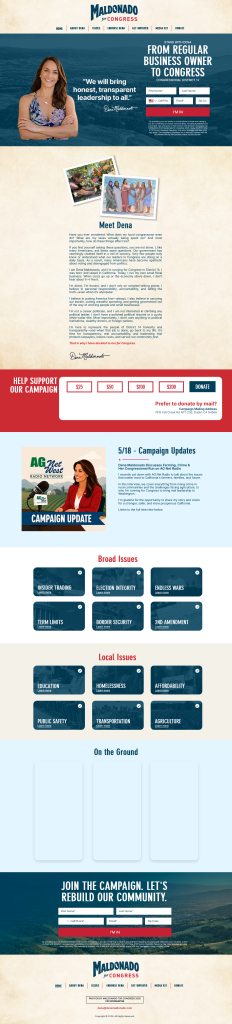
    On June 25, screenshots show a working campaign website that solicited donations, listed Republican endorsements, and promoted her “honest leadership” brand. By August 9, the site was down, and it was still down as of August 11, 2026. We can’t say whether it was removed because the campaign ended or for another reason, but a campaign that built its image on transparency has left voters with a blank page and no explanation.

    The campaign manager

    Her campaign flyer lists Jamison Olivieri as Campaign Manager. A marketing and brand strategist with that name advertises on his own website that he has managed $5 million in ad spending, generated 2.1 billion impressions, and run more than 75 marketing campaigns. We don’t know whether this is the same person, and we have no evidence about what role, if any, he played in the mailer. We are asking.

    The federal complaint

    Wendy Huang filed a complaint with the Federal Election Commission (MUR 8508) and sent party leadership a 27-page letter with 250 questions. Her allegation is that Maldonado was a “ghost candidate,” placed on the ballot to split the Republican vote. As of this writing, Maldonado has not publicly responded to the allegation.

    Where the money is

    The FEC filings for Maldonado’s committee (C00942136) show $0 raised or spent for 2025–2026. That may reflect a reporting delay, but for a candidate whose brand was showing voters the truth, an empty ledger is a problem.

    The outside spending

    FEC records show an outside group, For Our Values PAC, spent $86,447 on direct mail in May supporting Democrat Melissa Hernandez in the same race. On August 6, a mailer paid for by the same PAC featured Maldonado, a Republican candidate, endorsing Hernandez and criticizing the other Democrat. We don’t know whether Maldonado or her campaign coordinated with the PAC, and the record doesn’t say.

    Questions for the campaign

    • Who authorized the August 6 mailer?
    • Did Maldonado or her campaign manager coordinate with For Our Values PAC?
    • Why is the website still down?
    • Were the California Republican Party endorsements valid for the special election?
    • Where are the campaign finance records?

    Maldonado ran on the promise that she would be the cure for back-room politics. The record so far shows a disappearing website, missing finances, and a mailer in which she urged Republicans to elect a Democrat. She can answer these questions at any time. A flyer from her campaign is attached below.

    Next: The Official Republican Endorsement Behind Dena Maldonado →

    Disclosure: Republican Forum has endorsed Wendy Huang in the CA-14 race. Republican Forum is independent of all campaigns, with no coordination with, funding from, or direction from any campaign.
  • The Vote Split in CA-14: What the June 2 Numbers Show

    CA-14 investigation: The June Primaries | Chapter 11 of 11
    New to this story? Start with Part 1: The Stolen Seat, or see the CA-14 Special Report hub.
    ← Previously: Why Did the California GOP Defy Local Voters in CA-14?
    After Rep.

    The Vote Split in CA-14: What the June 2 Numbers Show

    California’s 14th Congressional District covers much of Alameda County and is home to Lawrence Livermore National Laboratory, so who represents it matters to national security and advanced research. That is a reason to look carefully at how the June 2 primary was decided. The numbers are not in dispute.

    The math

    With all 289 precincts reporting, 154,242 votes were cast:

    • Aisha Wahab (D): 59,052 votes (38.29%), first place.
    • Melissa Hernandez (D): 26,479 votes (17.17%), second place, and the second spot in the runoff.
    • Wendy Huang (R): 20,295 votes (13.16%), third place.
    • Dena Maldonado (R): 18,732 votes (12.14%).

    Huang missed advancing by 6,184 votes. Maldonado, the Republican endorsed by the state and county parties, received 18,732, about three times that margin. Had a single Republican candidate received the combined Republican vote, that candidate would have finished well ahead of Hernandez.

    What that does and doesn’t mean

    This is arithmetic, not proof. We can’t know how Maldonado’s voters would have voted had she not been on the ballot, and many may have chosen another candidate or no one. The questions we have raised about Maldonado’s campaign finances, endorsements, and mailers are before the FEC as MUR 8508 and remain unanswered. The vote totals are a reason to take those questions seriously, and nothing more.

    That is the latest chapter. Return to the CA-14 Special Report hub.

    That is the latest chapter. Return to the CA-14 Special Report hub.

    Disclosure: Republican Forum has endorsed Wendy Huang in the CA-14 race. Republican Forum is independent of all campaigns, with no coordination with, funding from, or direction from any campaign.
  • The CA-14 Vote Split and the June 16 Special Primary (Archive)

    Republican Forum endorsement. This is editorial opinion, not news reporting. Republican Forum is independent of all campaigns.

    Archived: written June 2026, between the June 2 primary and the June 16 special primary and kept for the record. The June 16 special primary has passed. Aisha Wahab and Melissa Hernandez advanced to the August 18 special runoff.

    The CA-14 Vote Split and the June 16 Special Primary

    Wendy Huang finished 6,184 votes short of the November runoff in the June 2 primary. Dena Maldonado, the candidate endorsed by the California and Alameda County Republican Parties, received 18,732 votes. We argued then, and argue here, that the split of the Republican vote cost the district its Republican option for November, and that voters had one more chance on June 16 to change the outcome of the special primary.

    What the numbers show

    The June 2 results below come from the Alameda County Registrar of Voters, posted June 12, 2026. The second chart is a hypothetical: it asks what the result would have been if the votes cast for Huang and Maldonado had gone to a single Republican candidate.

    CA-14 Primary Election Results

    Hypothetical Scenario: If Dena Maldonado Did Not Run

    Consolidating the Unified Republican Vote Under Wendy Huang

    The hypothetical is arithmetic, not a prediction. It assumes every Maldonado voter would have chosen Huang, which no one can know, and it doesn’t show whether voters who chose Maldonado did so by mistake or deliberately. We have raised questions about the Maldonado campaign’s finances and endorsements (see the CA-14 Special Report), and those are before the FEC as MUR 8508. The vote totals are a reason to take those questions seriously.

    Our endorsement

    We endorsed Wendy Huang for the June 16 special primary. She holds the endorsements of the Howard Jarvis Taxpayers Association, Reform California, the Republican National Hispanic Assembly of San Diego, Moms for Liberty, and others. On June 16, the special primary produced a different outcome: Aisha Wahab and Melissa Hernandez advanced, and no Republican reached the runoff. See Where Things Stand.

  • Why Did the California GOP Defy Local Voters in CA-14?

    CA-14 investigation: The June Primaries | Chapter 10 of 11
    New to this story? Start with Part 1: The Stolen Seat, or see the CA-14 Special Report hub.
    ← Previously: The Paper Trail Doesn’t Lie: Ghost Candidates and CA-14 Election Integrity
    A Republican Forum election-integrity investigation defining ghost candidates and applying the term to the CA-14 special primary.

    The sudden vacancy in California’s 14th Congressional District following the resignation of Representative Eric Swalwell in April 2026 triggered a compressed, highly competitive electoral scramble. As eleven candidates stepped forward to contest both the June 2 regular primary and the upcoming June 16 special election primary, a stark divergence emerged within the region’s minority party structure.

    While institutional leadership at the California Republican Party, led during the 2026 election cycle by Chairwoman Corrin Rankin, moved swiftly to grant its official endorsement to Dena Maldonado—who self-identifies as a business owner and florist—grassroots voters in the district delivered a different verdict at the ballot box. In the June 2 primary election, real estate investor and elected county party insider Wendy Huang outpaced the state party-endorsed Maldonado by more than 1,500 votes.

    This reporting examines the underlying data, public disclosures, and institutional processes behind the party’s endorsement framework, highlighting a significant structural disconnect between state party decision-makers, local leadership under Alameda County Republican Party Chairwoman Jeanne Solnordal, and the regional electorate.

    What We Know

    A review of public records, California Secretary of State filings, and Federal Election Commission (FEC) data establishes a clear baseline of facts regarding the qualifications, resources, and electoral performance of both candidates.

    • Electoral Performance: In the June 2, 2026 state primary election, Wendy Huang secured third place overall with 20,295 votes (13.16% of the total vote share). Dena Maldonado finished fifth, capturing 18,732 votes (12.14%). Huang outpolled the state-endorsed candidate by a margin of 1,563 votes.
    • Party Leadership Mandate: State election data confirms that Huang possesses a ten-year continuous history as a registered Republican in Alameda County (2016–2026). During this window, Republican voters directly elected her to represent them on the Alameda County Republican Central Committee—the local governing body currently led by Chairwoman Jeanne Solnordal—granting her an explicit public mandate. Maldonado has no documented record of election to county or state party governance structures.
    • Campaign Finance Discrepancies: According to campaign finance summaries filed with the FEC, Huang raised $33,673 and expended $25,943 to fund her voter outreach infrastructure. Conversely, official FEC tracking lists Maldonado’s campaign with $0 in total contributions and $0 in total expenditures, indicating a lack of formal financial infrastructure for a federal campaign.
    • Professional Backgrounds: Huang is a UC Davis graduate and a retired high-tech executive who spent a decade coordinating operations with Silicon Valley leadership before transitioning to real estate investment. Maldonado self-identifies as an East Bay florist and local small business owner who entered the political arena directly following the April vacancy.

    Candidate Comparison Profile

    Metric / IdentifierWendy HuangDena Maldonado
    June 2, 2026 Primary Results20,295 votes (13.16%)18,732 votes (12.14%)
    Party Governance Track RecordElected Member, Alameda County Central CommitteeNo recorded party leadership roles
    Professional BackgroundRetired High-Tech Executive; Real Estate InvestorSelf-identifies as a Florist; Small Business Owner
    Campaign Finances (FEC Filings)$33,673 Raised / $25,943 Expended$0 Raised / $0 Expended
    Primary Institutional EndorsementRegional Grassroots / Local Voter GuidesCalifornia Republican Party

    The Endorsement Gap

    Pursuant to California Elections Code Section 13302(b), qualified political parties are permitted to submit a single endorsed candidate for voter-nominated offices to be printed directly within the official Voter Information Guide. Under the leadership of Chairwoman Corrin Rankin, this state-level privilege was extended exclusively to Maldonado, granting her direct, state-subsidized visibility to hundreds of thousands of households in the 14th District.

    However, an exhaustive search of public announcements, local endorsements, and regional media tracking reveals a pronounced “endorsement gap” surrounding the party’s chosen nominee. Maldonado’s campaign lacks publicly visible endorsements from:

    • Elected municipal or county officials within the East Bay.
    • Former Republican congressional or state legislative candidates.
    • Regional business organizations or local chambers of commerce.
    • Established civic groups or prominent individual conservative figures within Alameda County.

    Maldonado’s public endorsement portfolio consists almost entirely of the top-down state party designation. In contrast, Huang’s campaign generated independent momentum via local grassroots voting blocks and specialized regional voter guides, building an alternative coalition that effectively bypassed the official state party apparatus to secure a higher percentage of the actual vote.

    What We Don’t Know

    Despite extensive reporting, critical operational details regarding the party’s internal endorsement mechanisms and local structural dynamics remain hidden from public view.

    • The Vetting Mechanism: The specific evaluation criteria, scoring matrices, and internal debate transcripts utilized by the California Republican Party’s endorsement committee under Corrin Rankin have not been disclosed. It remains unknown whether the committee conducted formal candidate interviews or evaluated the professional resumes of all registered Republican candidates in the race.
    • The Funding Inconsistency: It is unclear how Maldonado maintained a competitive congressional campaign apparatus, participated in media briefings, and secured ballot placements while reporting $0 in financial contributions and expenditures to federal regulators. Whether local party resources or independent expenditure committees offset standard operational costs remains an open question.
    • Internal Party Friction: The exact circumstances surrounding Huang’s public declaration that she was forced to “fight back publicly when party insiders tried to remove me from a seat voters gave me” remain verified. The roles played, if any, by state party leadership or the local Alameda County Republican Party executive committee under Jeanne Solnordal remain undisclosed.
    • The “Ghost Candidacy” Allegations: The combination of an unexpected candidacy, $0 in reported operational capital, and a top-down endorsement has fueled widespread concern among segments of the local electorate that Maldonado may have functioned as a “ghost candidate” deployed primarily to siphon votes away from an established local figure like Huang. At present, no direct evidence or documented proof of intentional voter manipulation has been validated in a court of law. Political analysts note, however, that if any coordinated institutional effort to manufacture a candidate for the purpose of vote dilution were ever legally proven, it would raise severe questions regarding the potential civil and criminal liability of the party leadership responsible, including Rankin and Solnordal.

    Questions Party Leaders Have Not Answered

    Because institutional leaders have declined to provide public explanations for these discrepancies, the burden of transparency now falls on the electorate. With the June 16 special election primary approaching, district voters and rank-and-file party members are strongly encouraged to directly contact state and local party headquarters by phone to demand the clarity necessary for an informed vote.

    Rank-and-file voters seeking accountability are proposed and encouraged to call California Republican Party Chairwoman Corrin Rankin at 916-448-9496 and Alameda County Republican Party Chairwoman Jeanne Solnordal at 510-368-8880 (or the administrative line at 510-683-3414) to ask the following critical questions:

    Script for State Chairwoman Corrin Rankin

    Phone: 916-448-9496

    “Hello, my name is [Your Name], and I am a California voter calling to demand full transparency regarding the CA-14 endorsement of Dena Maldonado. I have a few specific questions:

    • First: Why did the state committee endorse a candidate with no experience and zero campaign capital over an active, elected member of the local Central Committee?
    • Second: Why were the committee’s internal minutes, voting records, and rationale hidden from voters before the Voter Information Guide was printed?
    • Third: How do you respond to growing public concern that this was a ‘ghost candidacy’ meant to dilute the grassroots vote? If future investigations prove any ballot manipulation, what steps will you take to ensure legal accountability?
    • Did the committee actually review the tech and executive qualifications of the candidates to ensure they fit our highly educated, tech-driven district?
    • Finally: I formally request that all records, emails, and documents related to this process be safely preserved and kept completely unaltered. Thank you.”

    Script for County Chairwoman Jeanne Solnordal

    Phone: 510-368-8880 (Admin Line: 510-683-3414)

    “Hello, my name is [Your Name], and I am a California voter calling to demand full transparency regarding the CA-14 endorsement of Dena Maldonado. I have a few specific questions:

    • First: How does the county party justify aligning with the state’s endorsement of Maldonado, when the June 2nd primary results clearly showed that local voters preferred Huang?
    • Second: How do you respond to growing public concern that this was a ‘ghost candidacy’ meant to dilute the grassroots vote? If future investigations prove any ballot manipulation, what steps will you take to ensure legal accountability?
    • Third: Did your committee actually review the tech and executive qualifications of the candidates to ensure they fit our highly educated, tech-driven district?
    • Finally: I formally request that all records, emails, and documents related to this process be safely preserved and kept completely unaltered. Thank you.”

    Why the Decision Matters

    The operational decisions of political party organizations carry profound consequences for democratic accountability, particularly within California’s 14th Congressional District. The district encompasses a highly educated, tech-literate electorate anchored by East Bay innovation corridors, corporate technology infrastructure, and academic research institutions.

    In a district where voters across the political spectrum demand highly detailed data, substantive policy proposals, and transparent professional credentials, the presentation of a congressional candidate backed by zero reported campaign funding and an opaque vetting process risks undermining institutional credibility.

    Furthermore, when party organizations prioritize top-down insider endorsements over demonstrated grassroots support and established local governance track records, it creates a structural disconnect. This friction can depress voter enthusiasm, alienate the local volunteer base, and ultimately weaken the party’s viability in open, voter-nominated primary systems. The data from June 2 suggests that while party elites hold the power to dictate ballot labels, they cannot always dictate the choices of the voters themselves.

    Next: The Vote Split in CA-14: What the June 2 Numbers Show →

    Disclosure: Republican Forum has endorsed Wendy Huang in the CA-14 race. Republican Forum is independent of all campaigns, with no coordination with, funding from, or direction from any campaign.
  • The Paper Trail Doesn’t Lie: Ghost Candidates and CA-14 Election Integrity

    CA-14 investigation: The June Primaries | Chapter 9 of 11
    New to this story? Start with Part 1: The Stolen Seat, or see the CA-14 Special Report hub.
    ← Previously: The Cardboard Campaign: Dena Maldonado’s Signs Are Not Grassroots
    Eight days before the June 16 special primary, this investigative report argues Dena Maldonado’s campaign signs are not grassroots but a warning sign.

    And Neither Should Your Ballot

    Republican Forum · Investigative Series · CA-14 Election Integrity By Republican Forum Investigative Desk · June 2026

    CA-14 Special Primary · June 16, 2026 · Voters: Read This Before Polls Close

    There is a specific word for what happens when a candidate appears on a ballot with no genuine intent to win — existing only to draw votes and tilt an election for someone else’s benefit. That word is fraud. And when it occurs in a federal congressional race, it is not merely a political complaint to lodge with a party official. It is a matter for the Federal Bureau of Investigation and the United States Department of Justice.

    Over the past several weeks, Republican Forum has published a five-part investigative series into the candidacy of Dena Maldonado, a Republican who appears on the ballot twice in California’s 14th Congressional District — once in the June 2 regular primary, and again in the June 16 special primary to fill the seat vacated by former Rep. Eric Swalwell. The evidence assembled across that series does not tell a story of a campaign that simply ran poorly. It tells an undeniable story of a coordinated effort where Dena Maldonado was advanced as a ghost candidate specifically to siphon votes away from Wendy Huang and protect establishment interests.

    Every voter who read that series and found themselves asking what can I actually do about this? now has a clear answer.

    “A ghost candidate is not defeated at the ballot box. It is defeated in the record — in the complaints filed, the tips submitted, and the paper trails investigators can follow.”


    The Law: This Is Not a Political Dispute. It Is a Federal Matter.

    Ghost candidate schemes are not automatically illegal. Running a low-energy campaign, declining interviews, or even being an unserious candidate does not, by itself, constitute a crime. What crosses the legal line — and what transformed Florida’s 2020 ghost candidate scheme from a political embarrassment into a felony prosecution — is the financial and organizational infrastructure behind the campaign.

    When operatives secretly fund a sham candidacy, when campaign finance disclosures are falsified, when coordination is concealed, when voters are systematically deceived about who is sponsoring a candidate’s ballot appearance — that is election fraud under federal law. And in a federal congressional race, jurisdiction rests squarely with the FBI and the DOJ’s Election Crimes Branch.

    Florida Precedent · Case on Record

    In 2020, former Florida state senator Frank Artiles paid Alexis Rodriguez $44,000 to file as an independent candidate in Florida’s Senate District 37 — sharing a surname with the Democratic incumbent to siphon votes. Rodriguez drew enough ballots to flip the race by 32 votes.
    Rodriguez pleaded guilty to campaign finance crimes in August 2021. He received three years probation and agreed to cooperate with prosecutors. Artiles was subsequently convicted of three felonies — excessive campaign contributions, conspiracy, and false swearing — carrying potential sentences of up to five years each. He was sentenced to 60 days in jail.
    The scheme that generated those convictions looked, at every step, like a minor-league down-ballot race that few people were watching. Voters who noticed and reported it are the reason anyone is in prison today.


    The Evidence: Facts the FEC Filing, Court Records, and Voter Registration Data Confirm

    Our investigative series documented a pattern of facts that, taken individually, might be explained away. Taken together, they paint a picture that warrants serious federal scrutiny. Here is the complete documented case, consolidated for the first time in a single place.

    • Evidence 01 · Roots in the District By the public record she moved to Alameda County in 2025, the year she launched this campaign, and her campaign website provides no verifiable community ties to the district’s voters. Maldonado was registered as a Republican in San Diego County from 2016 through 2025. She re-registered in Alameda County in 2025, the same year she launched her CA-14 campaign. Her FEC filing lists a Dublin, CA address, but Dublin is the city she moved to — not a community she has years of history serving. Her website names no neighbors, no local organizations, no civic groups, and no experiences rooted in the Fremont, Hayward, Union City, or Tri-Valley communities she wants to represent.
      Source: California voter registration records · FEC Committee Filing C00942136 · Maldonado campaign website
    • Evidence 02 · Voter Registration History She was registered as a Republican in San Diego County from 2016 through 2025 — and re-registered in Alameda County in 2025, the same year she announced her CA-14 campaign. Her campaign contact phone number carries a 619 area code: San Diego. This is not a candidate who grew up in, lived in, or built professional roots in the communities of this district. She relocated specifically when a seat became available.
      Source: California voter registration records · FEC filing · campaign contact information
    • Evidence 03 · Party Endorsement Concealment & Isolation Both the California Republican Party and the Alameda County Republican Party formally endorsed her — and she hid both endorsements from voters. Her photo appears on the CAGOP’s statewide endorsements page. The ACRP placed her in their voter guide with a checkmark. Her campaign website — built around the promise of “honest, transparent leadership” — contains no mention of the word “Republican,” “GOP,” “CAGOP,” or either party organization. Accepting institutional endorsements while concealing them from every voter who visits your site is deception by omission.
      Furthermore, aside from these official institutional county and state GOP party line rubber-stamps, absolutely no other endorsements exist for Maldonado’s campaign from any elected officials, community leaders, or fellow candidates. Real campaigns build coalitions; ghost campaigns rely strictly on an artificial vacuum created by party bosses.
      This total political isolation stands in stark contrast to Wendy Huang, the authentic grassroots choice in this race. Huang’s official campaign records reveal a massive wall of legitimate, hard-earned endorsements from trusted conservative organizations, taxpayer advocates, and sitting legislators, including:
    • The Howard Jarvis Taxpayers Association (HJTA)
    • Republican National Hispanic Assembly
    • The California Rifle & Pistol Association (CRPA)
    • Carl DeMaio and Reform California
    • San Ysidro School Board Trustee Kenia Peraza
    • Moms For Liberty
    • Silicon Valley Chinese Association Foundation

    Analysis Note: We now see exactly why this strategy was deployed. By completely scrubbing party branding from her public website and operating without a single public endorsement from real-world peers, Maldonado avoided mainstream voter scrutiny, skipped candidate debates, and dodged press questions that a real candidate faces. Meanwhile, the institutional party leadership quietly used their internal voter guides to position Dena as a ghost candidate to siphon votes away from Wendy Huang, successfully pocketing 18,732 straight-ticket votes from unsuspecting voters on June 2.
    Source: California Republican Party endorsements page · ACRP voter guide · Wendy Huang for Congress Official Endorsements Record · Public endorsement tracking databases · Maldonado campaign website review

    • Evidence 04 · Unverifiable Business Identity Her entire working-class campaign persona rests on a business that cannot be independently verified. Maldonado describes herself as the owner of “my own small floral business” — the biographical anchor of her entire candidacy. Her website provides no business name, no address, no license number, no Yelp listing, and no Google business profile.
      Source: Maldonado campaign website · California business license database search · FEC filing occupation field
    • Evidence 05 · FEC Filing Irregularities Her four-page FEC Form 1 contains multiple inconsistencies that suggest a document filed without review. Her name appears as “Dena maldonado” on the committee name line and “Maldonado, dena, Marie” on the candidate information page. She listed herself as both the campaign’s Custodian of Records and its Treasurer — the person legally responsible for FEC compliance.
      Source: FEC Committee filing C00942136, filed March 5, 2026
    • Evidence 06 · Campaign Materials & Total Biographical Absence Physical campaign signs appearing under her name in Alameda County are handmade from cardboard and spray paint, carrying slogans including “MAGA,” “JESUS SAVES,” and — most revealingly — “ELECT DENA A MOM THAT’S ALL!”
      This generic “mom” branding exposes a glaring structural flaw in her campaign persona: Maldonado’s official campaign website never says anything about a husband, kids, or school. She provides absolutely zero family details, zero parental background, and no educational history whatsoever to the voters. The fact that her street-side cardboard signs aggressively advertise her as a “mom,” while her actual official platform remains completely silent on a husband, children, or basic biographical roots, further confirms that these signs are outsourced props rather than the footprint of a real candidate. Props, not politics.
      Source: Republican Forum field documentation · Photographic record · District boundary mapping · Maldonado campaign website review

    The Hard Numbers: June 2 Regular Primary Results

    We no longer have to speculate about the mathematical impact of this candidacy. The data from the June 2 regular primary is officially in. With 100.00% of the 289 precincts reporting from vote centers, the raw math exposes exactly how a fractured vote guarantees the desired establishment outcome.

    CA-14 Primary Vote Breakdown (Vote for One Only)

    Contest CandidateVotesPercentage
    Aisha Wahab59,05238.29%
    Melissa Hernandez26,47917.17%
    Wendy Huang20,29513.16%
    Rakhi Israni Singh19,97212.95%
    Dena Maldonado18,73212.14%
    Victor Aguilar, Jr.3,2602.11%
    Matt Ortega2,6041.69%
    Carin Elam2,1521.40%
    Suzanne Chenault1,6961.10%

    The math tells an undeniable story. Wendy Huang — the grassroots candidate whom the institutional ACRP leadership aggressively worked to sideline — finished in third place with 13.16% of the vote. She missed the critical second-place general election runoff spot by just 6,184 votes (a margin of 4.01% behind Melissa Hernandez).

    Where did the votes necessary to mount a real challenge go? They went straight to Dena Maldonado, who successfully locked up 18,732 votes (12.14%) despite having no local footprint, an unverified business, and a total absence of a transparent personal background on her website. Maldonado functioned precisely as a ghost candidate to siphon votes away from Wendy Huang, dividing the conservative and independent electorate so that an unvetted, establishment-preferred alternative could slide into the runoff.


    The Institution: Institutional Complicity and Retaliation

    A ghost candidate scheme does not require a lone operative. It requires institutional architecture — a party infrastructure designed to provide instant, unquestioned ballot credibility to prevent voters from asking obvious questions. The sheer scale of this deception makes it undeniably obvious that the Alameda County GOP and the California GOP are entirely complicit in this election fraud.

    How could professional, veteran party operations claim ignorance when vetting a candidate for a federal congressional seat? Consider what they chose to overlook:

    • The Educational Void: Alameda County is structurally recognized as one of the most highly educated counties in the United States. Yet, both the local and state party apparatus rubber-stamped a candidate whose platform features a total lack of verifiable educational credentials.
    • The Biographical Vacuum: Party officials ignored the fact that Maldonado has absolutely no family, no kids, and no school connections to local voters, completely detaching her from the reality of CA-14 families.
    • The Sudden Relocation: The party machine turned a blind eye to her rapid, calculated relocation from San Diego County to Alameda County, executed right as this federal seat opened up.
    • Zero Infrastructure: They endorsed a candidate running for the United States House of Representatives who possesses no known campaign funding and not a single external endorsement from any living elected official, community leader, or peer candidate.

    How could they not know? They knew. They simply chose to weaponize her ballot line.

    This corruption is entirely consistent with the Alameda County Republican Party’s documented track record. On March 5, 2024, 4,049 registered Republicans in Assembly District 20 elected Wendy Huang and five colleagues to the Alameda County Republican Central Committee. Those six seats were never filled. On December 30, 2024, a bylaw was quietly inserted into the ACRP’s governing documents declaring those members “automatically removed.”

    Alameda County Superior Court Case No. 24CV060851 contains what a Superior Court judge described as “compelling evidence of retaliation” against those members. The court imposed $6,550 in sanctions against Chairwoman Jeanne Solnordal for conduct during those proceedings. That same party organization chose to endorse Dena Maldonado for Congress. Federal investigators must examine what this organization is trying to shield from public scrutiny by fabricatng a blank-slate candidate to intentionally eliminate Wendy Huang.


    Act Now: Contact the FBI and DOJ — Here Is Exactly How

    Every complaint filed with a federal agency becomes part of a permanent record. The following contacts are the appropriate channels for federal election fraud concerns. Please reference the FEC Committee ID for Maldonado’s campaign: C00942136.

    Your Two Required Contacts

    Submit to both. They are separate agencies with separate jurisdictions.

    • Department of Justice · Election Crimes Branch
    • Email: election.crimes@usdoj.gov
    • Subject Line: Formal Concern — Potential Ghost Candidate Operation, CA Congressional District 14, June 2026 Primaries
    • Federal Bureau of Investigation · Public Tip Line
    • Portal: tips.fbi.gov
    • Note: Submit as a separate tip. Reference “CA-14 congressional race” and FEC ID C00942136.
    • Federal Election Commission · Complaint Division
    • Portal: fec.gov/legal-resources/enforcement/complaints-process
    • Note: File a formal MUR (Matter Under Review) for suspected campaign finance violations.

    What to Include in Your Submission

    1. Your Standing: Your name, city, and whether you are a registered voter in CA-14 or Alameda County.
    2. The Targets: FEC Committee ID C00942136 and candidate Dena Maldonado, noting her dual appearance in the June 2 regular primary and June 16 special primary.
    3. The Core Complaint: Explicitly outline the institutional complicity of the county and state GOP in running a ghost candidate with no educational credentials, no family ties, and no local footprint, utilizing the official June 2 regular primary results (12.14% vote split) to prove the intentional siphoning of votes away from Wendy Huang.
    4. Institutional Context: Reference Alameda County Superior Court Case No. 24CV060851 to highlight the judicial findings of retaliation against party members by the endorsing committee.

    The Stakes: Why This Race, Why Now

    Congressional District 14 is not a sideshow. With a razor-thin majority in the House of Representatives, every open congressional seat in America carries outsized consequence.

    In Florida’s Senate District 37, a ghost candidate drew 6,000 votes to flip a seat by a margin of 32, resulting in a felony conviction. In CA-14, the ghost candidate tactic successfully extracted over 18,000 votes on June 2, fragmenting the field and keeping Wendy Huang off the November ballot.

    However, the June 16 special primary is still pending. The window to create a federal record — to ensure that investigators have the documentation they need to look into a coordinated scheme — is open right now. One email to election.crimes@usdoj.gov and one tip at tips.fbi.gov takes five minutes and creates a permanent paper trail.

    Democracy is not defended by silence. It is defended by citizens who notice — and say so.


    How to Use This Template:

    1. Copy the text below into your email client or the description box on the FBI tip portal.
    2. Fill in the bracketed information (e.g., [Your Name]) to personalize your submission.
    3. Send separate submissions to both the DOJ and the FBI using the contact channels listed below.

    Submission Routing Information

    • To (Department of Justice): election.crimes@usdoj.gov
    • Web Portal (FBI Tip Line): tips.fbi.gov (Select “Public Corruption” or “Election Crimes” if prompted)
    • Subject Line: Formal Concern — Coordinated Ghost Candidate Fraud Operation, CA Congressional District 14, June 2026 Primaries

    Email / Tip Body Template

    To the Federal Bureau of Investigation and the Department of Justice Election Crimes Branch,

    RE: Request for Investigation into Election Fraud and Coordinated Ghost Candidacy

    • Candidate Name: Dena Maldonado
    • Jurisdiction: California’s 14th Congressional District (Alameda County)
    • FEC Committee ID: C00942136
    • Relevant Elections: June 2, 2026 Regular Primary & June 16, 2026 Special Primary

    I am writing as a concerned citizen and voter to formally request an immediate federal investigation into what public records indicate is a coordinated, fraudulent “ghost candidate” scheme designed to deceive voters and manipulate the outcome of a federal election.

    The evidence strongly demonstrates that Dena Maldonado is an artificial candidate manufactured and deployed with the sole purpose of siphoning votes away from authentic grassroots candidate Wendy Huang. Furthermore, the facts suggest that leadership within the Alameda County Republican Party (ACRP) and the California Republican Party (CAGOP) are actively complicit in this election fraud.

    Federal investigators are urged to examine the following documented anomalies:

    1. Clear Evidence of an Artificial Campaign & Institutional Complicity

    A legitimate vetting process by political parties would have immediately flagged Maldonado as an unqualified, non-viable candidate. Instead, both the state and local party organizations issued formal, exclusive endorsements, turning a blind eye to flagrant warning signs:

    • Total Educational and Professional Void: Alameda County is structurally recognized as one of the most highly educated counties in the United States. Despite this, both party apparatuses rubber-stamped a federal congressional candidate whose platform and filings feature a complete lack of verifiable educational or professional credentials.
    • Complete Biographical Absence: Maldonado’s street-side campaign signs aggressively brand her as “A MOM THAT’S ALL!” However, her official campaign website completely omits any mention of a husband, kids, parental background, or local school connections to the voters.
    • Calculated Relocation: Voter registration data confirms Maldonado had zero roots in the district, having lived and registered as a Republican in San Diego County from 2016 through 2025. She rapidly relocated to Alameda County in 2025 solely to establish a address for this ballot line, while still maintaining a San Diego (619) campaign contact phone number.
    • No Independent Funding or Peer Coalition: Maldonado’s FEC filings show no professional campaign infrastructure, no known traditional funding, and an absolute absence of endorsements from any living elected official, community leader, or fellow candidate.

    2. Contrast with Grassroots Candidate Coalition

    While Maldonado operates in a complete peer endorsement vacuum, the grassroots candidate she was deployed to undermine, Wendy Huang, built a robust, verified coalition. Huang earned the official endorsements of the Howard Jarvis Taxpayers Association (HJTA), Republican national Hispanic Assembly, the California Rifle & Pistol Association (CRPA). The institutional party bosses ignored this legitimate support to manufacture Maldonado’s candidacy.

    3. Proven Spoiler Effect: The June 2 Primary Math

    The certified results from the June 2 regular primary (100% of precincts reporting) mathematically prove the real-world execution of this fraud. Maldonado successfully extracted 18,732 votes (12.14%) despite running a completely invisible campaign with handmade cardboard props. These siphoned votes successfully blocked Wendy Huang (who finished in 3rd place with 13.16%) from securing the 2nd-place general election runoff spot, missing the cutoff by a margin of just 6,184 votes.

    4. History of Institutional Bad Faith and Retaliation

    The institutional backing of this ghost candidacy aligns with a documented pattern of corruption by the endorsing committee’s leadership. In Alameda County Superior Court Case No. 24CV060851, a Superior Court judge explicitly found “compelling evidence of retaliation” by ACRP Chairwoman Jeanne Solnordal against voter-elected party members (including Wendy Huang), resulting in $6,550 in judicial sanctions.

    Conclusion & Request for Action

    This operation closely mirrors the financial and organizational voter deception that resulted in multiple felony convictions in Florida’s 2020 Senate District 37 ghost candidate prosecution. Because this fraud has been perpetrated within a federal congressional race, and with the June 16 special primary actively closing, I request that federal authorities subpoena the communication records, internal coordination logs, and financial backing linking Dena Maldonado’s committee to the leadership of the Alameda County Republican Party and California Republican Party.

    Thank you for your time, vigilance, and commitment to preserving the integrity of our elections. I am fully willing to be contacted for follow-up documentation.

    Sincerely,

    [Your Name]
    [Your City, State, and Zip Code]
    [Your Phone Number]
    [Your Email Address]

    Next: Why Did the California GOP Defy Local Voters in CA-14? →

    Disclosure: Republican Forum has endorsed Wendy Huang in the CA-14 race. Republican Forum is independent of all campaigns, with no coordination with, funding from, or direction from any campaign.
  • Archive: This Is the Moment, Four Days to the CA-14 Special Primary

    Republican Forum endorsement. This is editorial opinion, not news reporting. Republican Forum is independent of all campaigns.

    Archived: written four days before the June 16 special primary and kept for the record. The June 16 special primary has passed. Aisha Wahab and Melissa Hernandez advanced to the August 18 special runoff.

    This Is the Moment: Four Days to the CA-14 Special Primary

    Four days remain to do something that rarely happens in American politics: cast a vote that scares the people in power. Our endorsement goes to Wendy Huang.

    The bill she wrote and carried to a congressional office

    Wendy Huang, a grassroots candidate from the East Bay, stood outside the office of a sitting member of Congress holding a fully drafted piece of federal legislation she wrote herself, and asked that it be acknowledged. The EASJA Act of 2026 would create an independent commission with subpoena power and a forensic panel, and require full, unredacted disclosure of covered federal records connected to the Jeffrey Epstein network. She didn’t announce it as a talking point. She wrote it, printed it, and walked it in.

    Why it matters

    Over decades, through Democratic and Republican majorities alike, no one powerful connected to the Epstein network has faced a real day of accountability, and the circumstances of his death in federal custody have never been coherently explained. That is not a partisan complaint. The flight logs and client lists don’t sort by party registration, and a divided public is one that never looks up long enough to ask the question.

    We think every other candidate on the ballot has had months to say one honest sentence about it, and we haven’t seen them do it. That is part of why we are endorsing Wendy Huang.

    This is bigger than one race

    If you believe no one is above the law, and that the American people are owed the truth about who was involved, then you already agree with what the EASJA Act is trying to do, whatever party you belong to. A vote on June 16 sends a message that this accountability can no longer be deferred. Vote Wendy Huang.

  • The Cardboard Campaign: Dena Maldonado’s Signs Are Not Grassroots

    CA-14 investigation: The June Primaries | Chapter 8 of 11
    New to this story? Start with Part 1: The Stolen Seat, or see the CA-14 Special Report hub.
    ← Previously: Take Action Now: Five Sample Emails to Send Before the June Primaries
    Five sample emails voters can personalize and send about the questions raised in Republican Forum’s CA-14 series. Verify claims first.

    An investigative report by Republican Forum, June 2026. Archived: written eight days before the June 16 special primary.

    Dena Maldonado’s Handmade Signs Raise Questions About Her Campaign

    Eight days before the June 16 special primary for the seat vacated by Eric Swalwell, campaign signs appearing under Dena Maldonado’s name tell us something about how her campaign is being run. This report describes what we observed and what we are asking.

    What we observed

    • The signs are handmade. They are cardboard and spray paint, not the printed signs a political vendor supplies.
    • The messages are unusual for a congressional campaign. Slogans we documented include “MAGA,” “JESUS SAVES,” and “ELECT DENA A MOM THAT’S ALL!” None states a platform or a policy.
    • The placement is puzzling. We saw them in areas we could not confirm are in the district’s core population centers. We have not mapped them and we welcome corrections.

    Handmade signs aren’t disqualifying. Many sincere grassroots candidates use them, and supporters sometimes make their own. But they sit oddly beside a candidate who holds the official endorsement of the California Republican Party and the Alameda County Republican Party.

    Why this matters

    In California’s top-two system, the special primary is one round: the top two finishers advance, and everyone else is out. In the June 2 regular primary, Wendy Huang finished third, 6,184 votes behind second place, while Maldonado finished fifth with about 12 percent. In a race that close, any votes that go to a candidate who isn’t competing seriously can change who advances.

    That is a description of arithmetic, not a finding about intent. We have argued in this series that Maldonado’s candidacy may have been a “ghost candidacy,” and Wendy Huang has filed a complaint to that effect. Handmade signs are a data point, not proof.

    Whose decision was the endorsement?

    The Alameda County Republican Party, whose chairwoman was sanctioned $6,550 by an Alameda County Superior Court judge for discovery obstruction and whose removal of six voter-elected members the court found troubling, endorsed Maldonado. That choice deserves a public accounting.

    Our questions

    To the California Republican Party: Did you review Maldonado’s campaign operations before the endorsement? If so, what did the review conclude? If not, why not?

    To the Alameda County Republican Party and Chairwoman Jeanne Solnordal: On what basis was Maldonado judged a credible standard-bearer in a race of this consequence? Who made that decision, and under what process?

    To Dena Maldonado: Where is your campaign infrastructure? Where are your policy positions and fundraising? Where are your signs, and why are they not clearly in the communities where CA-14 voters live? Who asked you to run?

    Republican Forum is an independent conservative publication covering California politics. Tips, documents, and responses from campaigns or party officials can be sent to the address on our Contact page.

    Next: The Paper Trail Doesn’t Lie: Ghost Candidates and CA-14 Election Integrity →

    Disclosure: Republican Forum has endorsed Wendy Huang in the CA-14 race. Republican Forum is independent of all campaigns, with no coordination with, funding from, or direction from any campaign.
  • What a Real Candidate Looks Like: Wendy Huang vs. the Ghost Candidate

    Republican Forum endorsement. This is editorial opinion, not news reporting. Republican Forum is independent of all campaigns.

    Wendy Huang and the Ghost Candidate Contrast

    Dena Maldonado claims transparency. Wendy Huang demonstrates it. The difference is not subtle.


    The nine-point comparison table at the end of this article makes the contrast impossible to dismiss — but the evidence behind it is worth reading in full first.

    Maldonado’s defenders cannot claim that running as a Republican in CA-14 structurally requires hiding your party affiliation. Wendy Huang — a retired tech CEO, immigrant, mother, elected member of the Alameda County Republican Central Committee, and former CAGOP Delegate running in the same June 16, 2026 special primary — proves it does not.

    Like Maldonado, Huang is a Republican candidate in the same race with CAGOP backing. Like Maldonado, she faces an electorate that includes independents, skeptics, and voters who don’t reliably pull a party lever. Everything Maldonado hides, Huang discloses. That is what makes the contrast definitive.

    The similarities between them end at party registration. Everything else is the difference between a genuine candidate and a phantom.


    Two Republican Candidates. One Real Campaign.

    The argument throughout this series has not been that Maldonado’s opacity is somehow explained by the pressures of running as a Republican in a competitive Tri-Valley district. That argument would fail — because Wendy Huang is running the same kind of race and doing the opposite of everything Maldonado does.

    Both candidates are Republicans. Both are seeking votes in CA-14. Both face an electorate that includes independents, skeptics, and voters who don’t reliably pull a party lever. If the strategic case for hiding your Republican affiliation were sound, Huang would have every reason to do what Maldonado does.

    She doesn’t. And that choice is worth examining in detail.


    The Transparency Checklist

    Below is a side-by-side comparison based entirely on publicly available campaign materials — Maldonado’s at denamaldonado.com and Huang’s at voteforwendy.com. The Huang data is drawn from her WordPress site export (voteforwendy.com, exported June 1, 2026), which documents twelve published posts dating from May 14 through May 28, 2026.

    Party Affiliation

    Maldonado: No mention of the Republican Party, the GOP, the CAGOP, or any party affiliation anywhere on her campaign website.

    Huang: Identifies herself openly and repeatedly as a Republican candidate. In a post directed specifically at independent voters, she writes without equivocation: “I am an elected member of the Alameda County Republican Central Committee and a former CAGOP Delegate. I carry a party label.” She goes further — she acknowledges the political complexity of that label and makes the affirmative case for why independent and even Democratic voters should consider supporting her anyway. That is the behavior of a candidate who trusts voters with the truth.

    Residency and Community Connection

    Maldonado: Campaign mailing address in Dublin, a city split between congressional districts. No named address, neighborhood, school, church, or community organization within the district. No explanation of how long she has lived there or what connects her to the district’s communities.

    Huang: Names specific communities she seeks to represent — Fremont, Hayward, Pleasanton, Livermore, and Union City — throughout her posts. In her First 100 Days piece, she commits to holding post-Congress public town halls in each of those cities by name. She describes watching the I-580 traffic from her own car. These are not abstract references; they are the markers of a candidate embedded in the communities she wants to represent.

    Huang’s campaign is based in Alameda County, and this is not a disqualifying disconnect — it is an alignment. CA-14’s special election district includes portions of Alameda County, specifically the Tri-Valley and southern Alameda communities of Fremont, Hayward, Pleasanton, Livermore, and Union City. Her address places her within the district she is seeking to represent, which is the opposite of Maldonado’s situation.

    Business and Professional Identity

    Maldonado: Describes herself as running “my own small floral business.” Provides no business name, location, years of operation, employees, or any verifiable detail.

    Huang: Identifies herself specifically as a “retired tech CEO” and “retired Silicon Valley tech executive.” Her professional identity is the foundation of her signature policy proposal — a Cabinet-level Department of Technology — and she explains the connection explicitly: “As a tech executive, I spent my career understanding systems: how they fail, why they fail, and what it actually takes to fix them.” Her biography is a causal chain, not a credential list. Voters can evaluate the claim because the claim is specific.

    Policy Platform

    Maldonado: Identical template on every issues page — short paragraph, four vague bullet points. No named legislation. No specific regulations. No dollar figures. No position on healthcare, Social Security, wildfire preparedness, water rights, or trade.

    Huang: Has published a drafted bill — the Department of Technology Establishment and Democratic Accountability Act — with a public framework at www.department.technology. She has published a companion K-12 bill proposal (the K-12 AI Access and Student Safety Act) with specific statutory targets: modernizing COPPA and FERPA, establishing federal AI certification standards, and creating a competitive grant program. She has named specific dollar figures (the $537 million HSR closed-session settlement, the $750 million minimum from SB 1031). She has named specific legislation she supports or opposes (AB 1608). She commits to specific timelines: legislation on Day One, hearings in days 31–60, a bipartisan caucus by day 90, public town halls by day 100.

    This is what a policy platform looks like. Maldonado’s platform is the absence of one in a costume.

    Personal Biography

    Maldonado: No family mentioned. No named personal relationships. No community organizations. Nothing that anchors her in any specific place.

    Huang: Her biography is woven through everything she publishes. She came to the United States from Taiwan at thirteen years old. She has two sons in college. She describes watching her community from the driver’s seat of a car on I-580. She references her political organizing history — fighting vaccine mandates at California community colleges, pushing back mask mandates in Alameda County — as a lived record, not a resume line. She is a specific person doing specific things in a specific place.

    Transparency About Endorsements and Party Infrastructure

    Maldonado: Both the CAGOP and Alameda County Republican Party have formally endorsed her. Neither endorsement appears anywhere on her campaign materials.

    Huang: Discloses her party roles openly. Acknowledges she has party backing and explains what that means and doesn’t mean. In her post to independent voters, she neither hides her Republican affiliation nor pretends it is irrelevant — she addresses it directly, explains her record of cross-partisan action, and asks voters to make an informed choice based on full information. That is the opposite of cloaking.

    Campaign Timeline and Infrastructure

    Maldonado: Domain registered February 3, 2026 — months before the election. Website built quickly, consistent with a campaign stood up for electoral purposes.

    Huang: Site export records show published posts beginning May 14, 2026 — but the site content reflects months of substantive policy development. A drafted bill, a companion framework website (department.technology), a documented record of local political activity, and a twelve-post body of campaign writing all indicate a candidate who has been building toward this run, not one who was placed on a ballot.


    The Electoral Harm Is Measurable

    Here is why the Huang comparison is more than rhetorical. In CA-14’s special primary, this is a top-two race — every vote cast for any candidate is a vote not cast for another. Huang’s own campaign writing addresses this math directly and transparently.

    In her post to independent voters (published May 15, 2026), Huang lays out the district’s registration numbers plainly: Democrats hold 57.7% of registered voters, Republicans 12%, and No Party Preference voters nearly 25% — approximately 241,000 people. She explains that in a split field, a ghost candidate drawing even a fraction of those votes could determine whether any Republican advances to the August runoff.

    The point is not that Huang makes this argument (she does, as a genuine candidate making a genuine strategic case). The point is that she is correct on the arithmetic — and that every vote Maldonado draws from that same cross-partisan pool is a vote that does not go to Huang or any other genuine candidate.

    Ghost candidates do not need to draw large numbers of votes to affect an outcome. They need only draw enough — from the right slice of the electorate, at the right margin. In a race where Huang calculates that the NPP coalition is “not a footnote — it is a deciding factor,” even a few thousand votes peeled away by a nonpartisan-presenting phantom could determine whether a real candidate advances.

    That is real electoral harm. It is not theoretical. It is arithmetic.


    What the Contrast Proves

    The existence of Wendy Huang’s campaign dismantles the most charitable defense of Maldonado’s opacity — that running as a Republican in this district structurally requires hiding your affiliation.

    It does not. Huang proves it does not.

    A candidate can be a Republican, carry a CAGOP affiliation, base her campaign in Alameda County, and still identify openly, campaign transparently, name her community connections, publish detailed policy with specific legislation attached, explain her biography with verifiable specifics, and ask independent voters to support her on the merits of a real argument.

    That is what Huang does. That is what every genuine candidate does.

    Maldonado’s campaign does none of it — not because it is strategically impossible, but because the campaign was apparently not designed for that purpose.


    A Note on Fairness

    This article is not an endorsement of Wendy Huang or any candidate in the CA-14 special primary. Our interest here is not in which candidate wins — it is in whether the candidates on the ballot are genuine.

    Huang’s positions, her record, her policy proposals, and her fitness for office are for voters to evaluate. She may win. She may lose. Those outcomes belong to the voters of District 14.

    What is not for voters alone to decide is whether they have been given accurate information about who is actually running against them. That is a question of electoral integrity, and it is the question this series has been asking from the beginning.

    Wendy Huang answers it — by existing, by being specific, by being transparent — in a way Dena Maldonado simply does not.


    Summary: The Ghost Candidate Contrast in One Table

    CriterionWendy Huang (voteforwendy.com)Dena Maldonado (denamaldonado.com)
    Party affiliation disclosed✅ Openly Republican, CAGOP Delegate❌ No party mentioned anywhere
    Party endorsements displayed✅ Acknowledges party role throughout❌ Both CAGOP and Alameda GOP endorsements hidden
    Named community connections in district✅ Fremont, Hayward, Pleasanton, Livermore, Union City❌ None — no named District 14 location
    Verifiable professional identity✅ Retired tech Exectutive, Silicon Valley career❌ “Small floral business” — no name, location, or detail
    Specific legislation named✅ Drafted DoT Act, K-12 AI Access Act, named bills❌ No legislation named on any issues page
    Personal biography with named details✅ Immigrated from Taiwan, two sons, specific organizing history❌ No family, no organizations, no personal anchors
    Policy positions on district-specific issues✅ HSR, AB 1608, transit funding, housing supply❌ No position on healthcare, water rights, wildfire, trade
    Campaign depth vs. ballot-placement pattern✅ 12 substantive posts, drafted legislation, policy framework❌ Template website, domain registered 4 months before election
    Residency alignment with district✅ Alameda County communities within CA-14 special election scope❌ Dublin (split between districts); no stated tie to the district

    Sources: Wendy Huang campaign website (voteforwendy.com), WordPress export of voteforwendy.com dated June 1, 2026; Dena Maldonado campaign website (denamaldonado.com); FEC filing #C00942136; California Republican Party endorsements (cagop.org); Alameda County Republican Party voter guide (alamedagop.org). This article draws exclusively on publicly available campaign materials. No legal conclusions are expressed. The appropriate authorities — the FEC and DOJ — are the proper bodies to determine whether violations of federal law have occurred.

  • Take Action Now: Five Sample Emails to Send Before the June Primaries

    Archive note: this action page was written ahead of the June 2 and June 16, 2026 primaries and is kept for the record.

    CA-14 investigation: The June Primaries | Chapter 7 of 11
    New to this story? Start with Part 1: The Stolen Seat, or see the CA-14 Special Report hub.
    ← Previously: The Maldonado Campaign: What the Public Record Shows and What It Doesn’t
    What the public record shows about the Maldonado campaign in CA-14, what it doesn’t, and why the ghost-candidate claim remains an allegation.

    Sample Emails to Send Before June 2nd and June 16th

    The evidence has been laid out. Now it is time for voters to demand answers from the people and institutions who can act. Here are ready-to-use email templates you can personalize and send today.


    The evidence has been documented across four articles. Now it is time to act — before the June 16th special primary closes.

    Below are five ready-to-personalize email templates, one for each key audience. Read them, add your own details where indicated in brackets, and send them today. Every email sent is a permanent record. Every complaint filed creates a paper trail that investigators can act on. Every journalist who receives a credible tip is another set of eyes on a race that deserves scrutiny.

    Do not wait. Send these today.


    A Note on Personalizing These Templates

    These templates are starting points. The more personal and specific your email, the more weight it carries. Consider adding:

    • Your connection to the district — do you live, work, or have family in CA-14?
    • Your political affiliation — this concern crosses party lines; Republican, Democratic, and independent voters all have an interest in ballot integrity
    • Any additional evidence you have found — voter registration records, business license searches, local knowledge about the candidate
    • Your willingness to be contacted — investigators and journalists are more likely to follow up if you offer to speak further

    A form email carries weight. A personalized email carries more.


    Email 1:

    To the Department of Justice — Election Crimes Branch

    Send to: election.crimes@usdoj.gov
    CC: tips.fbi.gov (submit separately as a tip)
    Subject: Formal Concern — Potential Ghost Candidate Operation, CA Congressional District 14, June 2026 Primaries (June 2 and June 16)


    Dear Election Crimes Branch,

    I am writing to bring to your attention a pattern of evidence that raises serious concerns about a potential ghost candidate operation in California’s Congressional District 14. The candidate in question — Dena Maldonado — appears on the ballot in two upcoming elections: the June 2, 2026 regular California primary and the June 16, 2026 CA-14 special primary to fill the seat vacated by Rep. Eric Michael Swalwell. The urgency of this concern is heightened by the fact that this candidate may be drawing votes across two separate elections within a two-week period.

    Her FEC committee ID is C00942136. Her campaign website is denamaldonado.com.

    I am writing as a concerned voter [and/or resident of Congressional District 14 / California] because I believe the following documented facts, taken together, are consistent with a coordinated effort to deceive voters about the true nature and sponsorship of this candidacy:

    1. Ties to the district. Her official campaign mailing address is Fall Creek Rd, APT, Dublin, CA 94568. Dublin is split between congressional districts, and we have not determined whether the address was inside CD-14. Her website contains no address, community tie, or verifiable connection to the district she seeks to represent.

    2. Concealed party affiliation. The California Republican Party (CAGOP) has officially endorsed her and lists her on their public endorsements page. The Alameda County Republican Party lists her in their official voter guide with a formal endorsement. Her own campaign website contains no mention of the Republican Party, the GOP, or any party affiliation. Voters in District 14 are given no information about her party identity.

    3. Unverifiable biographical claims. She describes herself as a small business owner running “my own small floral business” but provides no business name, address, employee count, years of operation, or any verifiable detail about the business or its location relative to District 14.

    4. Coordination concerns. The pattern of a candidate accepting formal party endorsements while deliberately concealing them from voters raises questions about whether undisclosed coordination has occurred between her campaign and the endorsing Republican Party organizations that has not been properly reported to the FEC.

    5. Hallmarks of prior ghost candidate operations. The combination of out-of-district residency, party cloaking, vague biography, and hollow policy platform mirrors patterns documented in ghost candidate operations that have previously resulted in federal criminal charges, most notably the 2020 Florida state senate ghost candidate scheme.

    I respectfully request that the Election Crimes Branch review this matter and determine whether a formal investigation is warranted. I am happy to provide any additional documentation or publicly available evidence to support that review.

    The June 2 primary is immediately upon us, and the June 16 special primary follows two weeks later. I urge the fastest possible attention to this concern.

    Respectfully,

    [Your Full Name] [Your City, State] [Your Email Address] [Your Phone Number — optional]


    Email 2:

    To the Federal Election Commission

    Send to: complaints@fec.gov
    Subject: Formal Voter Concern — Potential Campaign Finance Non-Disclosure, Dena Maldonado for Congress, FEC #C00942136 — Two Elections: June 2 and June 16


    Dear Federal Election Commission,

    I am writing to file a formal concern regarding the congressional campaign of Dena Maldonado, candidate for California’s Congressional District 14. Ms. Maldonado appears on the ballot in both the June 2, 2026 regular California primary and the June 16, 2026 CA-14 special primary. Her FEC committee ID is C00942136.

    I am a concerned voter [and/or resident of California / District 14] raising the following specific questions about potential campaign finance disclosure violations:

    Potential undisclosed in-kind contributions and coordination:

    The California Republican Party (CAGOP) and the Alameda County Republican Party have both formally endorsed Ms. Maldonado. Party endorsements typically involve the provision of voter lists, volunteer networks, donor referrals, and organizational infrastructure — all of which may constitute in-kind contributions subject to FEC reporting requirements.

    Ms. Maldonado’s campaign website contains no mention of either endorsement or any Republican Party affiliation. This concealment raises the question of whether coordination between her campaign and the endorsing party organizations has been fully and accurately disclosed in her FEC filings.

    Specific requests for FEC review:

    1. Whether all in-kind contributions, coordinated expenditures, or party support received from the CAGOP or the Alameda County Republican Party have been properly disclosed in her campaign finance reports
    1. Whether any coordination between her campaign and other political committees or operations — including any that may have encouraged or recruited her to run — has been properly reported
    1. Whether her FEC filings accurately and completely reflect all sources of financial and organizational support for her campaign
    1. Whether her campaign mailing address in Dublin raises any questions about the accuracy of her candidate registration filings

    Ms. Maldonado’s campaign website is denamaldonado.com. Her contact email listed publicly is dena@denamaldonado.com.

    I respectfully request that the FEC review her filings for completeness and accuracy, and take appropriate action if discrepancies are found.

    The June 2 primary is immediately upon us; the June 16 special primary follows two weeks later. Both elections are affected by these concerns.

    Respectfully,

    [Your Full Name] [Your City, State] [Your Email Address]


    Email 3:

    To Local and State Media

    Send to: [Your local newspaper’s news tip email — examples below]

    • Modesto Bee: newstips@modbee.com
    • Fresno Bee: newstips@fresnobee.com
    • Stockton Record: newsroom@recordnet.com
    • San Francisco Chronicle: newstips@sfchronicle.com
    • Los Angeles Times: tips@latimes.com
    • CalMatters: tips@calmatters.org
    • Sacramento Bee: newstips@sacbee.com

    Subject: News Tip — Potential Ghost Candidate in CA-14 Congressional Race, Two Primaries: June 2 and June 16


    Dear Editors / News Desk,

    I am a voter [and/or resident of Congressional District 14 / California] writing to bring a time-sensitive story to your attention. This story matters across two upcoming elections: the June 2, 2026 regular California primary and the June 16, 2026 CA-14 special primary.

    There are serious and documented questions about whether Dena Maldonado — a candidate for California’s Congressional District 14 — may be a “ghost candidate”: a person placed on the ballot not to genuinely compete, but to draw votes and affect the outcome of the race for another candidate’s benefit. With Maldonado appearing on two separate CA-14 ballots within two weeks, the potential electoral impact is doubled.

    Here is a summary of the publicly documented evidence:

    Residency: Her official campaign mailing address (Fall Creek Rd, APT, Dublin, CA 94568) is in a city split between congressional districts. Her website contains no verifiable community ties to the district.

    Party cloaking: The CAGOP and the Alameda County Republican Party have both formally endorsed her — their endorsements are publicly visible on their own websites. Her campaign website contains no mention of the Republican Party or either endorsement. She runs as an implicit independent while accepting full party backing.

    Unverifiable identity: She claims to own a small floral business but provides no name, address, or any verifiable detail about it. Her biography contains no named family members, community organizations, or personal details that can be independently confirmed.

    Hollow platform: Every issues page on her website follows an identical format of vague bullet points. No legislation is named. Major policy areas affecting District 14 — healthcare, Social Security, wildfire, water rights, tariffs — are entirely absent.

    FEC filing: Her committee ID is C00942136. Her domain was registered February 3, 2026 — months before the primary.

    This pattern mirrors documented ghost candidate operations, most notably the 2020 Florida scheme that resulted in federal criminal charges.

    With the primary two days away, I believe District 14 voters deserve reporting on these questions before they cast their ballots. I am happy to share additional documentation and sources.

    Thank you for your consideration.

    [Your Full Name] [Your City, State] [Your Email Address] [Your Phone Number — optional]


    Email 4:

    To the California Republican Party (CAGOP)

    Send to: info@cagop.org
    Subject: Formal Voter Question — Endorsed Candidate Dena Maldonado Hides CAGOP Endorsement from Voters


    Dear California Republican Party,

    I am writing as a concerned voter to ask the CAGOP to publicly address a significant transparency concern regarding your endorsed candidate for Congressional District 14, Dena Maldonado.

    Your organization has formally endorsed Ms. Maldonado. Her name and photograph appear on your official endorsements page at cagop.org. I understand that this endorsement reflects the California Republican Party’s formal judgment that she is the preferred Republican candidate for this seat.

    However, Ms. Maldonado’s campaign website — denamaldonado.com — contains no mention of the Republican Party, the GOP, your endorsement, or any party affiliation whatsoever. A voter visiting her website would have no way of knowing she is the CAGOP’s endorsed candidate.

    I am asking the CAGOP to publicly answer the following questions:

    1. Are you aware that your endorsed candidate for CA-14 has no mention of the Republican Party or your endorsement on her campaign website?
    1. Does the CAGOP have any standards requiring endorsed candidates to publicly disclose their party affiliation and your endorsement on their campaign materials?
    1. Has the CAGOP encouraged, requested, or demanded that Ms. Maldonado add your endorsement and her Republican affiliation to her website and campaign materials?
    1. Does the CAGOP consider it acceptable for an endorsed candidate to conceal that endorsement from voters in her district?
    1. What resources — financial, organizational, or logistical — is the CAGOP providing to Ms. Maldonado’s campaign, and are those resources properly disclosed in her FEC filings?

    California voters deserve to know when a congressional candidate has received your party’s official endorsement. I respectfully ask the CAGOP to address these questions publicly before the June 2nd primary — and before the June 16th CA-14 special primary two weeks later. Both elections are affected.

    Respectfully,

    [Your Full Name] [Your City, State] [Your Email Address]


    Email 5:

    To the Alameda County Republican Party

    Send to: chairman@alamedagop.org
    Subject: Formal Voter Question — Your Endorsed Candidate Dena Maldonado Conceals Your Endorsement from Voters


    Dear Alameda County Republican Party,

    I am writing to ask the Alameda County Republican Party to publicly address a serious transparency concern regarding your endorsed candidate for Congressional District 14, Dena Maldonado.

    Your organization has formally endorsed Ms. Maldonado and listed her in your official voter guide with a checkmark of approval alongside your other endorsed candidates. I understand this represents your organization’s formal direction to Alameda County Republicans to support her in the June 2nd primary.

    I have reviewed Ms. Maldonado’s campaign website — denamaldonado.com — in full. It contains no mention of the Republican Party, the GOP, or your endorsement. A voter in District 14 visiting her website would have no way of knowing she is your endorsed candidate or that she has any Republican Party affiliation.

    Additionally, I note that her campaign mailing address is in Dublin, a city split between congressional districts, and that her website contains no verifiable connection to the communities she would represent.

    I am asking your organization to publicly answer the following questions:

    1. Have you reviewed Ms. Maldonado’s campaign website and observed that it contains no mention of your endorsement or the Republican Party?
    1. Did your endorsement process include any requirement that she publicly disclose her party affiliation and your endorsement to voters?
    1. Have you asked her to correct this omission before the June 2nd primary?
    1. Are you comfortable directing Alameda County Republican voters to support a candidate who will not tell District 14 voters she is a Republican?
    1. Did residency within Congressional District 14 factor into your endorsement decision?

    Republican voters in your county and voters in District 14 both deserve honest answers to these questions. I respectfully request a public response before June 2nd — and note that these questions remain equally pressing for the June 16th CA-14 special primary, in which Ms. Maldonado is also a candidate.

    Respectfully,

    [Your Full Name] [Your City, State] [Your Email Address]


    How to File Tips Directly Online

    If you prefer to submit concerns digitally rather than by email:

    FEC Online Complaint Form: https://www.fec.gov/contact-us/

    FBI Election Crime Tip (routes to DOJ): https://tips.fbi.gov Select “Civil Rights” → “Election/Voting Crimes”

    California Secretary of State — Election Fraud Reporting: https://www.sos.ca.gov/elections/reporting-problems-elections

    California Fair Political Practices Commission: https://www.fppc.ca.gov/the-law/filing-a-complaint.html


    Why This Matters With Two Elections Ahead

    There are two CA-14 primaries in quick succession: June 2nd (regular primary) and June 16th (special primary). That means:

    A complaint filed today creates a permanent record that investigators can act on across both elections and after them. Ghost candidate prosecutions in Florida happened months after the elections in question. The FEC routinely investigates campaigns after election day.

    A media tip sent today could produce a story that informs voters before either primary closes — June 2nd ballots are still being cast, and June 16th voters have two more weeks to receive this information.

    A direct email to the CAGOP or Alameda County GOP creates public accountability pressure that may prompt a response or statement before either election. The fact that the same candidate appears on two ballots in two weeks makes the stakes of their silence higher, not lower.

    Nothing you do today is wasted. Every action taken is a piece of a record that serves democratic accountability across both primaries and beyond.

    The voters of Congressional District 14 deserve better than a phantom on their ballot — on either date. Make your voice heard.


    Sources: denamaldonado.com, FEC filing #C00942136 (fec.gov), cagop.org, alamedagop.org, ICANN WHOIS data. FEC complaints: fec.gov/contact-us/. FBI election tips: tips.fbi.gov. CA Secretary of State: sos.ca.gov. CA FPPC: fppc.ca.gov.

    The email templates in this post are provided as civic tools for concerned voters. They reflect publicly available evidence and documented facts. Readers are encouraged to verify all claims independently before sending and to add their own observations and knowledge.

    Next: The Cardboard Campaign: Dena Maldonado’s Signs Are Not Grassroots →

    Disclosure: Republican Forum has endorsed Wendy Huang in the CA-14 race. Republican Forum is independent of all campaigns, with no coordination with, funding from, or direction from any campaign.
  • The Maldonado Campaign: What the Public Record Shows and What It Doesn’t

    CA-14 investigation: The June Primaries | Chapter 6 of 11
    New to this story? Start with Part 1: The Stolen Seat, or see the CA-14 Special Report hub.
    ← Previously: The Republican Parties That Endorsed Dena Maldonado Owe Voters an Explanation
    Republican Forum argues the parties that endorsed Dena Maldonado owe CA-14 voters an explanation, and lists who to contact.

    The Maldonado Campaign: What the Public Record Shows and What It Doesn’t

    Update, June 1, 2026: Dena Maldonado appears on two upcoming CA-14 ballots. See the series hub for the full context.

    A “ghost candidate” is a person placed on a ballot not to win and serve but to draw votes and affect the outcome for someone else’s benefit. The term became familiar after a 2020 Florida state senate race in which unknown candidates with no campaigns were secretly recruited and funded to siphon votes. This post asks whether any of that is true in California’s 14th District. It sets out what the public record shows and what it doesn’t, and it reaches no legal conclusion.

    What the public record shows

    • Her party endorsements are public, but her website did not mention them. The California Republican Party and the Alameda County Republican Party both endorsed her, and both documented it on their sites. As of late May, her own campaign website did not mention the Republican Party or either endorsement. (Later materials did.)
    • Her ties to the district are unexplained. CA-14 lies in Alameda County. Her campaign’s official mailing address is an apartment on Fall Creek Rd in Dublin, a city split between congressional districts. We have not determined whether the address was inside the district, and a candidate is not legally required to live in the district she seeks to represent. Her website doesn’t describe a neighborhood, school, congregation, or organization connecting her to the district.
    • Her business claim is hard to verify. She describes a small floral business, with no business name, address, or license number published.
    • Her platform is general. The issue pages we reviewed consist of a short paragraph and four bullet points each, with no named legislation, dollar figures, or specific proposals, and no mention of several district-specific issues such as wildfire preparedness or federal research funding.
    • Her federal filings show no activity. FEC records for her committee (C00942136) reported no receipts or disbursements.
    • The endorsing parties haven’t explained. Neither has publicly addressed why their endorsement didn’t appear on her site.

    What the record does not show

    None of these facts establishes that Maldonado was recruited or funded to split the vote, or that anyone coordinated her candidacy with another campaign. Many first-time candidates run thin websites, vague platforms, and low-budget campaigns. A domain registered in February, or handmade signs, are ordinary for a candidate with limited resources. The claim that her campaign is a ghost operation is an allegation, and it is the subject of a complaint Wendy Huang has filed with the FEC (MUR 8508). We report it as an allegation.

    Why the questions matter

    California’s top-two primary means every vote for one candidate is a vote not cast for another. In the June 2 primary, the arithmetic showed what a split can do: Huang finished 6,184 votes short of the runoff while Maldonado received 18,732. That arithmetic raises a reason to ask who benefited from her candidacy. It doesn’t answer the question, and we don’t claim it does.

    What voters can do

    • Look up her committee’s FEC filing (C00942136) at fec.gov and read the reports for yourself.
    • Ask the California Republican Party (info@cagop.org) and the Alameda County Republican Party (chairman@alamedagop.org) whether they asked their endorsed candidate to show the endorsement.
    • Anyone can file a complaint with the FEC at fec.gov/contact-us/, or contact their county elections office with questions about candidate eligibility.

    Sources: Dena Maldonado campaign website; FEC filing C00942136; California Republican Party endorsements page; Alameda County Republican Party voter guide. This post raises questions that warrant investigation. It does not constitute legal findings. The FEC and other authorities decide whether any violation occurred.

    Next: Take Action Now: Five Sample Emails to Send Before the June Primaries →

    Disclosure: Republican Forum has endorsed Wendy Huang in the CA-14 race. Republican Forum is independent of all campaigns, with no coordination with, funding from, or direction from any campaign.
  • The Endorsements Dena Maldonado Doesn’t Want You to See

    Note: this post describes her website as it appeared in late May. Later campaign materials did display the endorsement, so the open question is when and why it was shown.

    Dena Maldonado Doesn’t Want You to See

    Update — June 1, 2026: Dena Maldonado is a candidate in both the June 2, 2026 regular California primary and the June 16, 2026 CA-14 special primary. The endorsement concealment documented here is relevant to both elections. District 14 voters have two ballots — and two chances to demand answers.

    When a political party endorses a candidate, it is supposed to be good news. Dena Maldonado has received official endorsements from the California Republican Party (CAGOP) and the Alameda County Republican Party. Her photo appears on the CAGOP’s statewide endorsements page. The Alameda County GOP voter guide lists her for Congressional District 14 with a checkmark next to her name. And yet her campaign website — which has pages dedicated to issues, a media kit, an endorsement submission form, and a candidate biography — mentions none of it. Not one word.

    Three Possible Explanations — None of Them Reassuring

    1. She Is Deliberately Hiding Her Party Affiliation from Voters in District 14

    By scrubbing any mention of the Republican Party from her website, Maldonado may be pursuing a deliberate strategy of party cloaking — presenting herself as an independent outsider (“I don’t owe anything to political institutions”) while quietly relying on the full backing of the Republican Party apparatus. This is fundamentally deceptive.

    2. She Believes Her Base in Alameda County Won’t Support a GOP-Endorsed Candidate

    Her campaign mailing address is in Dublin, in the heart of Alameda County — one of the most reliably Democratic counties in California. If Maldonado has a donor base, a volunteer network, or personal supporters in Alameda County, openly advertising her GOP endorsements could alienate them. Hiding the endorsements may be a calculated choice to maintain appeal across political lines.

    3. She Privately Disagrees with the Parties Endorsing Her

    A more charitable interpretation is that Maldonado is genuinely trying to run as an independent voice and is uncomfortable with the party labels being attached to her. If this is true, the honest response is to say so publicly. Instead, she simply omits the information, which is still a form of deception by silence.

    Questions Maldonado Should Answer Publicly

    • Do you accept and welcome the endorsements of the CAGOP and the Alameda County Republican Party?
    • If yes, why do neither endorsement appear anywhere on your campaign website?
    • If you consider yourself a Republican candidate, why does your website not say so?

    Disclosure: Republican Forum has endorsed Wendy Huang in the CA-14 race. Republican Forum is independent of all campaigns, with no coordination with, funding from, or direction from any campaign.
  • Honest and Transparent? What Dena Maldonado Says vs. What Her Record Shows

    CA-14 investigation: The June Primaries | Chapter 3 of 11
    New to this story? Start with Part 1: The Stolen Seat, or see the CA-14 Special Report hub.
    ← Previously: The Mystery Campaign: Zero Dollars Raised, Zero Spent
    Dena Maldonado reported raising and spending nothing in her congressional run. Republican Forum asks what a candidacy with no visible campaign means.

    So Why Is Dena Maldonado Hiding So Much?

    A closer look at what California’s District 14 congressional candidate says versus what her record actually shows.


    Update — June 1, 2026: Dena Maldonado appears on two upcoming CA-14 ballots — see our full series hub for the complete two-election context.


    The California Republican Party has officially endorsed Dena Maldonado for Congressional District 14. Her photo is on their statewide endorsements page. The Alameda County Republican Party has placed her in their voter guide with a checkmark. These are not small things — they are the most significant institutional backing a first-time congressional candidate can receive.

    Search her campaign website and you will find none of it. Not the word “Republican.” Not “GOP.” Not “CAGOP.” The endorsements from two party organizations are mentioned nowhere on a site that promises voters “honest, transparent leadership.”

    That is the central contradiction of Dena Maldonado’s campaign — and it is the thread that runs through everything else documented below.


    She’s a Republican. She Just Won’t Tell You.

    The California Republican Party (CAGOP) has officially endorsed her. Her photo appears on their statewide endorsements page alongside every other GOP-backed candidate in California. The Alameda County Republican Party has placed her on their voter guide with a checkmark, recommending her to their members for District 14.

    Yet search her entire website — every page, every issue, every paragraph — and you will not find the word “Republican.” You will not find “GOP.” You will not find “CAGOP.” The endorsements from the state and county Republican Parties are mentioned nowhere.

    Her own biography declares she is “direct” and “honest,” that she doesn’t rely on “scripted talking points,” and that she doesn’t “owe anything to political institutions” — while accepting the endorsement of two Republican Party institutions and concealing that fact from every voter who visits her site. For a candidate whose core brand is transparency, the contradiction is not subtle.


    Her Ties to the District Aren’t Explained

    Her public FEC campaign mailing address is listed as an apartment on Fall Creek Rd, Dublin, CA 94568. Dublin is divided between districts: under the lines used in the special election, only part of the city was in CD-14, and the November lines add the rest. We have not determined whether this address was inside the district, and a candidate isn’t legally required to live in the district she seeks to represent.

    Dublin is in Alameda County. Congressional District 14 is not. CA-14 covers a swath of communities with very different economic realities, agricultural concerns, and day-to-day challenges than Dublin’s suburban East Bay.


    The “Small Business Owner” Claim Goes Nowhere

    Maldonado describes herself as running “my own small floral business” — and her entire campaign is built around this identity as a working-class entrepreneur who “lives” economic hardship rather than just hearing about it.

    But her website provides no verifiable details:

    • No business name
    • No business location
    • No mention of employees
    • No years in operation
    • No indication it operates in or near District 14

    This matters because the business owner identity is central to her credibility on economic issues like affordability, small business regulation, and taxation. Voters cannot verify a claim that offers them nothing to verify.


    Her Policy Pages Are Built to Sound Substantive Without Being Substantive

    Every single issues page on her website follows an identical format: a short paragraph describing a problem, followed by four bullet points expressing general support for vague solutions. Not one page names a specific bill she would support, a regulation she would repeal, a spending line she would cut, or a dollar figure attached to any proposal.

    On housing affordability: she supports “reducing unnecessary regulations.” Which ones?

    On homelessness: she supports “auditing homelessness spending.” What specific programs? What outcomes would trigger reform?

    On agriculture: she supports “improving management of federal water infrastructure.” What does that mean in practice?

    More strikingly, her website contains no position at all on healthcare, Social Security, the federal deficit, climate change, wildfire preparedness, veterans’ benefits, or trade and tariffs — issues that directly affect District 14 constituents every single day.

    This is not a policy platform. It is the appearance of one.


    Little Personal or Community Background

    Most congressional candidates — whatever their politics — tell voters something personal: a spouse, children, how long they’ve lived in the community, what neighborhood they grew up in, what church or civic organization they belong to. These details matter not because they’re requirements, but because they help voters assess whether a candidate genuinely belongs to the community they want to represent.

    Maldonado’s website offers little of this: nothing on how long she has lived near the district, no community or civic organizations, and only professional campaign photographs. That is not a disqualifier, but it leaves voters with little to judge her local ties by.

    Most candidates use biographical detail to establish district ties — school boards, civic groups, years lived in the community — because those details help voters assess whether someone genuinely belongs to the place they want to represent. Its complete absence here is not a stylistic choice. It is a structural gap. The woman asking to represent the working families of the Tri-Valley has told those families almost nothing about herself.


    What Voters Should Ask Before June 2nd and June 16th

    These are not gotcha questions. They are the baseline inquiries any informed voter should be able to answer before casting a ballot — whether that ballot is in the regular primary on June 2nd or the CA-14 special primary on June 16th:

    1. What party do you belong to, and who has endorsed your campaign?
    2. Where do you actually live, and what is your connection to District 14?
    3. What is your business called, where is it located, and does it operate in the district?
    4. Which specific legislation would you support or oppose in Congress?
    5. Why do your official party endorsements not appear anywhere on your campaign website?

    Demanding answers to these questions is not attacking a candidate. It is what an engaged electorate is supposed to do.

    Dena Maldonado has built her entire campaign around the promise of transparency. The least she can do is be transparent.


    Sources: denamaldonado.com, California Republican Party endorsements (cagop.org), Alameda County Republican Party voter guide (alamedagop.org), ICANN domain registration lookup, FEC campaign filing #C00942136. For a contrast with a genuine candidate’s campaign transparency, see our companion analysis of Wendy Huang’s campaign at voteforwendy.com.

    Next: The Endorsements Dena Maldonado Doesn’t Want You to See →

    Disclosure: Republican Forum has endorsed Wendy Huang in the CA-14 race. Republican Forum is independent of all campaigns, with no coordination with, funding from, or direction from any campaign.
  • Archive: What Happens If a Ghost Candidacy Is Proven in CA-14?

    Republican Forum endorsement. This is editorial opinion, not news reporting. Republican Forum is independent of all campaigns.

    Archived: written four days before the June 16 special primary and kept for the record. The primary has passed. See Where Things Stand.

    What Happens If a Ghost Candidacy Is Proven in CA-14?

    Elections can be distorted through careful design and not only through loud failures. In California’s 14th District, with the seat open after a high-profile vacancy, we have asked whether a candidate on the ballot was a real contender or a placeholder. This post describes what the consequences would be if that were ever established. It does not claim it has been.

    The Florida precedent

    In 2020, in Florida Senate District 37, a candidate who shared the Democratic incumbent’s surname and never campaigned drew 6,382 votes in a race decided by 32. A consultant, Frank Artiles, was later convicted on three felony counts: excessive contributions, conspiracy, and false swearing. The case shows what investigators look for: payments, false filings, and concealed coordination. A candidate on a ballot with no campaign is not, by itself, a crime.

    What would follow here

    • An FEC finding. The complaint in MUR 8508 would have to find reason to believe a violation occurred and then follow an enforcement process that can take years.
    • Scrutiny of party endorsements. If funds or coordination were shown, the California and Alameda County Republican Parties would face questions about how they handled the endorsement.
    • Pressure for internal accountability. Party members who have already called for transparency, including those removed by the Alameda County party, would have standing to ask for a leadership review.

    None of that happens on speculation. It happens if evidence is established and the proper authorities act on it. We have documented the questions and the record, and we have said what we don’t know.

    Our endorsement

    Voters did not have to wait for any inquiry. We endorsed Wendy Huang, who holds the endorsements of taxpayer, reform, and parents’ organizations and has a published platform, and encouraged voters to choose a candidate with a visible campaign.

  • When the Party Becomes the Threat: A Florida Case and the Alameda Dispute

    CA-14 investigation: The Alameda Dispute | Chapter 6 of 6
    New to this story? Start with Part 1: The Stolen Seat, or see the CA-14 Special Report hub.
    ← Previously: The Machine vs. The Voter: Investigative Report on the Alameda County Republican Party
    This synthesized investigative report draws on court records, federal filings, and independent reporting.

    Special Investigation: Republican Forum · Investigative Series · California’s 14th Congressional District · 2026

    From a Florida race flipped by 32 votes to an Alameda County purge backed by court records — two stories of party machinery operating against the voters it was built to serve. One ended in a felony conviction. The other is still unfolding.

    The Cases at a Glance

    • Case One · Florida · 2020: The Ghost Candidate in Senate Districts 9 & 37. Features Republican operatives, dark money, a 32-vote flip, and a felony conviction.
    • Case Two · California · 2024–2026: The Purged Voters in Alameda County & CA-14. Features 6 voter-elected members removed, $6,550 in court sanctions, and an unexplained CAGOP endorsement.

    Democracy does not always fail loudly. Sometimes it fails on a spreadsheet — a dark money transfer routed through a nonprofit nobody has heard of. Sometimes it fails in an official letter — signed on the same day a bylaw is quietly inserted into a party’s governing documents. Sometimes it fails by 32 votes, after a man who never campaigned and shared the incumbent’s surname drew 6,000 ballots from voters who thought they were choosing something else entirely.

    These are not hypothetical threats. They are documented facts, confirmed in courtrooms in Florida and California by sworn testimony, judicial findings, and — in Florida — a felony conviction. What connects them is not party affiliation. Republicans ran the Florida scheme. Republicans ran the California purge. What connects them is something more fundamental: party machinery deciding that its own institutional survival matters more than the voters it was built to serve.

    Understanding both cases — how they worked, what they cost, and what they have in common — is essential reading for any voter who believes their ballot should mean what it says.

    Case One: Florida 2020 — The Ghost That Flipped a Senate Seat

    Florida’s Senate District 37 covers the upscale Miami-Dade communities of Coral Gables, Key Biscayne, Palmetto Bay, and Pinecrest. In 2020, it was held by incumbent Democratic Sen. Jose Javier Rodriguez — a progressive who had won the seat in 2016. His Republican challenger was Ileana Garcia, founder of Latinas for Trump.

    The race was expected to be close. For operatives in the business of flipping competitive state Senate seats, “close” is an opportunity.

    Enter Frank Artiles: a former Republican state senator from Miami-Dade who had resigned from the legislature in 2017 after a racist tirade against Black colleagues in a Tallahassee bar. By 2020, he had reinvented himself as a political consultant with a lucrative contract working on Republican Senate races. He had a plan. And it required a ghost.

    The Mechanics of the Scheme

    Artiles recruited Alexis Pedro Rodriguez — a friend, an auto parts dealer, a former Republican — to file as an independent candidate in District 37. The candidate was chosen with precision: he shared the same surname as the Democratic incumbent. Name confusion was not a side effect of the scheme. It was the engine.

    Artiles personally flew to Tallahassee to file Alex Rodriguez’s qualifying paperwork, paying the $2,000 filing fee himself — already twice the legal limit for a campaign contribution. Alex Rodriguez received $44,708 in total. He never held a rally. He never debated. He never gave an interview willingly. When a television reporter found him after the election, he lied about his own identity at the door.

    While Rodriguez did nothing, the operation around him spent over half a million dollars. Dark money groups — operating through PACs chaired by young women with no known political experience, funded through a nonprofit called Grow United connected to the Alabama-based consulting firm Matrix LLC — blanketed the district with mailers. The mailers portrayed Rodriguez as a progressive, left-leaning alternative, tailored specifically to Democratic-leaning voters. They went out in October 2020, weeks before election day, to households most likely to be confused by them.

    The Money Trail · Florida District 37

    Grow United, a dark money nonprofit, funneled $550,000 to two political committees — “The Truth” and “Our Florida” — both chaired by recruited political newcomers with no traceable party background. Data Targeting, the firm that employed Artiles, wired $100,000 from a tax-exempt group it controlled to Florida Stronger, a dark money group controlled by Artiles. Artiles billed Data Targeting for his plane ticket to Tallahassee on the same day he personally filed Alex Rodriguez’s qualifying paperwork. The identical architecture — same PAC structure, same mailer vendor, same messaging strategy — was deployed in two additional Florida Senate races in 2020, targeting Democratic voters in each.

    The scheme worked. Alex Rodriguez drew 6,382 votes. Jose Javier Rodriguez lost his seat to Ileana Garcia by 32 votes. A recount confirmed the margin. Prosecutors said there was no evidence Garcia knew anything about the plot. The operation had done its job cleanly enough that the winner was kept at arm’s length from the mechanics.

    “There was no question that this had an impact on a race that was ultimately decided by 32 votes out of nearly a quarter million cast.” — Sen. Jose Javier Rodriguez, after losing his seat

    The Reckoning

    The scheme began unraveling almost immediately. Investigative reporters at the Orlando Sentinel and Miami Herald followed the money. The Miami-Dade State Attorney’s office opened a public corruption investigation. In March 2021, Artiles was arrested. Alex Rodriguez pleaded guilty and agreed to testify.

    Timeline of Events

    • November 2020 (The Election): Ileana Garcia defeats Jose Javier Rodriguez by 32 votes. Alex Rodriguez, who never campaigned and shared the incumbent’s surname, drew 6,382 votes.
    • March 2021 (Artiles Arrested): Frank Artiles is charged with felony election crimes. Alex Rodriguez, his co-conspirator, pleads guilty in August and agrees to cooperate with prosecutors.
    • May 2022 (Seminole County Charges): Seminole County GOP Chairman Ben Paris, consultant Eric Foglesong, and ghost candidate Jestine Iannotti — who moved to Sweden after the election — are indicted in the District 9 scheme.
    • September 2024 (Artiles Convicted): A jury deliberates seven hours and convicts Artiles on three felony counts: excessive contributions, conspiracy, and false swearing. Miami-Dade State Attorney Katherine Fernandez Rundle declares the jury found Artiles “not only the mastermind of the ghost candidate scandal but violated Florida’s campaign finance and election laws in order to do it.”
    • November 2024 (Sentenced): Artiles receives five years probation and 60 days in jail. His attorneys file an appeal arguing the campaign finance statute was unconstitutionally vague. Ileana Garcia’s four-year term has already ended.

    The conviction came. The seat did not return. That sequence — scheme succeeds, reckoning follows years later — is the most important lesson the Florida case teaches about how ballot manipulation actually works in practice.

    Case Two: California 2024–2026 — When the Party Purges Its Own Voters

    The Florida scheme was a covert operation run by insiders against an opposing party. What has unfolded in Alameda County, California is something different in its form but recognizable in its logic: a party apparatus deciding, openly, that the voters who elected its own members do not actually get to be represented by them.

    On March 5, 2024 — Super Tuesday — 4,049 registered Republicans in Alameda County’s Assembly District 20 went to the polls and cast lawful votes for their party’s central committee. They elected Wendy Huang and five other candidates to seats on the Alameda County Republican Central Committee.

    None of those six voter-elected members ever occupied their seats.

    The Purge

    Before a single one could be sworn in, Alameda County Republican Party (ACRP) Chairwoman Jeanne Solnordal signed official letters declaring all six “automatically removed.” No hearing. No appeal. No procedure recognized in the party’s own bylaws as a valid basis for removal. The bylaw cited in the removal letters had been quietly inserted into the party’s governing documents on December 30, 2024 — the same day the letters were signed and sent.

    This is not an allegation. It is a documented fact, confirmed across multiple proceedings in Alameda County Superior Court Case No. 24CV060851 — a case that has produced sworn testimony, cross-examination, discovery battles, judicial sanctions, and a judge who described the conduct as potentially criminal.

    Court Record · Case No. 24CV060851 · Alameda County

    Under oath, multiple witnesses testified that Chairwoman Solnordal said she wanted to “punch Wendy [Huang] in the face” — not once, but between eight and twelve times between February and July 2023. Solnordal denied it under oath. The presiding judge stated from the bench that the conduct described “would in no way be a legitimate way of removing somebody, and would be a criminal offense,” and that Huang’s fear was “quite understandable.” When the court issued subpoenas for party records, Solnordal’s attorneys claimed she was too ill to respond — citing a serious medical condition. Photographic evidence submitted to the court showed she had traveled to and attended out-of-state political meetings during the same period. The court imposed $6,550 in monetary sanctions against Solnordal personally, finding her conduct “frivolous and disingenuous, and possibly for the purpose of delay.” On December 30, 2024, while proceedings were ongoing, Solnordal signed letters removing Huang and Jennifer Kavouniaris from the party specifically for having participated in those court proceedings. The court characterized this as “strong evidence of retaliation” for constitutionally protected activity.

    The Endorsement Nobody Can Explain

    Into this environment — a party chair under court-ordered sanctions, six voter-elected members blocked from their seats, and a congressional race of national significance opening in the district — the California Republican Party (CAGOP) issued its formal endorsement in the CA-14 Republican primary to Dena Maldonado.

    The CAGOP organized no public debate between the candidates before endorsing. It has not publicly disclosed the criteria for its decision, the process by which deliberation occurred, the identity of the decision-makers involved, or whether its organizational resources — staff time, donor lists, communications infrastructure — were made equally available to both candidates.

    The candidate it passed over, Wendy Huang, holds endorsements from the Howard Jarvis Taxpayers Association, the California Rifle and Pistol Association (Grade A), Moms for Liberty, the Republican National Hispanic Assembly of San Diego, and Carl DeMaio of Reform California. By every measurable standard of grassroots conservative credibility, she is the candidate Republican voters and organizations chose.

    The candidate the party apparatus chose has no publicly listed CRPA rating, no HJTA endorsement, no Moms for Liberty endorsement, and a campaign website that — as of May 2026 — contains no AI policy, no technology policy, no China or Taiwan policy, no defense policy, and no Indo-Pacific strategy for representing a district at the geographic heart of Silicon Valley. Her business filings — three companies claimed on official candidate documents — surfaced only one verifiable state registration. The other two showed no DBA filings in the county where she operates.

    “Who benefits from a Republican party apparatus that does not debate, does not organize, endorses without explanation, and suppresses its own voter-elected members?” — Republican Forum

    The Pattern That Connects Them

    These two cases are separated by geography, party target, and degree of documented criminality. In Florida, operatives paid a fake candidate to deceive Democratic voters and steal a seat for Republicans. In California, a Republican party apparatus purged voter-elected Republican members, sanctioned their own chair for lying to a judge, and issued an unexplained endorsement that bypassed the candidate their own grassroots organizations had chosen.

    What they share is the same foundational contempt: the belief that insiders — whether operatives, consultants, or chairpersons — have the right to override the voters who are supposed to be the point of the exercise.

    By the Numbers:

    • 32: Votes separating FL-SD37 winner from loser
    • $550K: Dark money spent on FL ghost candidate mailers
    • 6: Voter-elected CA committee members purged
    • 116K: Registered Alameda County Republicans with 951 Facebook followers reached by their own party
    • 0: Public debates held by CAGOP before endorsing in one of America’s most-watched congressional races

    The Florida scheme worked through misdirection — voters deceived about who a candidate was. The California pattern works through suppression — voters whose actual choices were simply declared void by the people those voters had the power to remove. The tactics differ. The result is the same: the voters’ will is redirected into an outcome the voters did not choose.

    The Playbook: Side by Side

    TacticFlorida 2020 Ghost CandidateCalifornia 2024-26 Alameda / CA-14
    Concealment of financing$550K routed through dark money nonprofits, PACs chaired by political newcomers with no traceable origin.CAGOP endorsement process conducted without public disclosure of criteria, process, or resource deployment.
    Candidate with no real campaignAlex Rodriguez never held a rally, never debated, lied about his own identity to reporters after the election.CAGOP-endorsed candidate filed with blank public phone number on official state declaration forms; no tech, AI, or China policy on website.
    Voter misdirectionGhost candidate deliberately shared surname with Democratic incumbent; mailers framed him as a progressive to confuse Democratic voters.Party apparatus bypassed grassroots-endorsed candidate without debate, explanation, or transparent deliberation.
    Suppression of accountabilityGhost candidate fled to Sweden after the election; operatives hid financial trails through multiple dark money layers.Chairwoman cited illness to avoid discovery subpoenas while attending out-of-state political events; court imposed $6,550 sanctions for “frivolous and disingenuous” conduct.
    Retaliation against those who fought backGhost candidate lied to reporters; Artiles claimed trial was “a colossal waste of time”; attempted appeal of conviction.Huang and Kavouniaris formally removed from the party specifically for participating in court proceedings; court found this “strong evidence of retaliation” for constitutionally protected activity.
    OutcomeDemocratic incumbent lost by 32 votes. Republican challenger won. Artiles convicted on three felony counts, sentenced to probation and 60 days jail. Seat was not restored.Six voter-elected members never seated. CAGOP endorsed without debate. Wendy Huang — the candidate with every major grassroots conservative endorsement — was passed over. Investigation ongoing.

    What Voters Should Watch For

    The Florida case took nearly four years from election to conviction. The California case is unresolved. In both, the harm to voters was immediate; the accountability came later — if at all. The question facing every voter in a competitive district is not whether to wait for the subpoenas. It is whether to recognize the warning signs before the ballot is cast.

    Red Flags: What Institutional Manipulation Looks Like Before the Indictments

    • A candidate who files for office but runs no visible campaign — no public events, no debates, no accessible contact information on official filings.
    • A candidate promoted by organizations whose funding sources cannot be traced to disclosed donors.
    • A party organization that endorses in one of the country’s most-watched races without holding a single public debate and without disclosing its process.
    • A party leadership that hides its own bylaws, operates below one percent reach of its own registered voter base, and has been sanctioned by a court for discovery misconduct.
    • An organization that uses its official authority to punish members who exercise their constitutional right to petition the courts.
    • A shared building address between nominally opposing political organizations — not evidence of wrongdoing, but relevant context when paired with decisions that consistently harm the organization’s own candidates.

    In Florida, none of these red flags were illegal on their own. It was the payments, the false filings, and the concealment of coordination that made the scheme criminal. The lesson is not that every ghost campaign is a crime. It is that every ghost campaign is worth examining — because the ones that are crimes look, from the outside, exactly like the ones that aren’t.

    Why This Matters Beyond the Ballot

    The CAGOP is headquartered on the fourth floor of a Sacramento building whose second floor houses the California Labor Federation — the primary institutional engine of the Democratic supermajority that has dominated California politics for a generation. The two organizations share an address, a lobby, and an elevator. Structural proximity is not, by itself, evidence of coordination. But when a party organization consistently produces outcomes that predictably harm its own candidates — no debates, no outreach, no organizing, an endorsement process opaque to its own members — the question regulators are entitled to ask is a simple one: is this organization functioning as advertised, or as something else entirely?

    In Alameda County, 116,589 registered Republicans exist, in theory, as the constituency the ACRP was built to serve. The party’s official Facebook page has 951 followers — a reach rate of less than one percent of its own registered voter base. In the first six months of 2026, the San Diego County Democratic Party scheduled 175 public organizing events. The CAGOP held a candidate training session after the filing deadline had already closed.

    In Florida, a dark money nonprofit spent half a million dollars to flip a Senate seat by 32 votes. The money was there. The organization was there. The intent was there. What was missing was transparency — and what transparency’s absence permitted was an election result that the voters of District 37 did not choose.

    Democracy does not only fail loudly. It fails in the gap between what voters decide and what institutions deliver. The Florida conviction closed one chapter of that story. The California chapter is still being written — and the voters of CA-14 are the ones holding the pen.

    Sources & Court Record

    • Alameda County Superior Court Case No. 24CV060851 — Huang v. Solnordal et al., Judge Hon. Elizabeth Riles
    • Floodlight News — “Former Florida senator convicted in ghost candidates scandal” · September 2024
    • Floodlight News — “Florida GOP operative admits role in ghost candidate scheme” · April 2024
    • Miami Herald — Investigative reporting on ghost candidate scheme, 2021–2024
    • Orlando Sentinel — Original investigative reporting on Seminole County scheme, 2021–2022
    • CBS Miami — Trial coverage and sentencing, September–November 2024
    • NBC News — “Former Florida state senator charged with three criminal counts” · March 2021
    • CNN — “A dark money mystery in Florida state senate race” · November 2020
    • Governing.com — “Amid Election Fraud Crackdown, DeSantis Ignores Ghost Candidates” · December 2021
    • Republican Forum — CA-14 investigative series, Parts 1–5, January–May 2026 · republican.forum/
    • California Secretary of State — Certified candidate filings, CA-14 Special Primary 2026
    • iVoterGuide — Dena Maldonado candidate profile, CA-14 Special Primary CD14 2026

    All factual claims are drawn from publicly available court records, official filings, and the sources listed above.

    This article does not constitute the practice of law. Placing a ghost candidate on the ballot is not illegal; coordination, payment, and false filings are the conduct that resulted in criminal charges in Florida.

    That is the latest chapter. Return to the CA-14 Special Report hub.

    Disclosure: Republican Forum has endorsed Wendy Huang in the CA-14 race. Republican Forum is independent of all campaigns, with no coordination with, funding from, or direction from any campaign.

  • The Mystery Campaign: Zero Dollars Raised, Zero Spent

    CA-14 investigation: The June Primaries | Chapter 2 of 11
    New to this story? Start with Part 1: The Stolen Seat, or see the CA-14 Special Report hub.
    ← Previously: Who Is Dena Maldonado, and Why Is the Alameda GOP Vouching for Her?
    Who is Dena Maldonado, and why is the Alameda County Republican Party vouching for her? Republican Forum asks the questions voters should.

    The Mystery Campaign: Zero Dollars Raised, Zero Spent

    Dena Maldonado has filed to run for Congress in California’s 14th District. Federal Election Commission records show her committee is registered, but they list no reported receipts and no reported disbursements: not a dollar raised, not a dollar spent. That alone isn’t proof of anything. It is a question voters are entitled to ask.

    What a campaign normally looks like

    Every campaign leaves a footprint: signs, door-knocking, a website, small contributions from people who believe in the candidate. Candidates aren’t legally required to spend money, but running for one of 435 seats in the House is a public request for voters’ trust, and a candidate who asks for it takes on an obligation to be visible and verifiable.

    Why it matters

    If a name occupies a ballot line without a real effort to win, voters who assume the race is competitive can be misled, and votes can be diverted from candidates who are running seriously. Whether that is what is happening here is what we are trying to determine. The pattern of a registered committee with no financial activity and little public presence is the kind of pattern election-law investigators are trained to look at, and the questions are for her and for the authorities, not conclusions for us.

    What the law says, in general terms

    Federal and California law regulate campaign-finance reporting and prohibit certain fraudulent conduct in connection with elections. Filing false or materially incomplete disclosures can be a violation, and so can failing to report contributions or expenditures. We are not asserting that any violation has occurred. Whether any provision applies is a question for the FEC and other authorities.

    Questions for the campaign

    • How does the campaign intend to reach voters without spending money?
    • Who supports the campaign, and who, if anyone, is funding it?
    • Is any third party coordinating with or benefiting from the candidacy?
    • What is the campaign’s plan for winning the seat?

    There may be legitimate answers. Funding may be imminent, or a strategy may be forming that the filings don’t yet reflect. If Maldonado is running a real campaign, she can show it in an afternoon. We will report her answers when we receive them.

    Next: Honest and Transparent? What Dena Maldonado Says vs. What Her Record Shows →

    Disclosure: Republican Forum has endorsed Wendy Huang in the CA-14 race. Republican Forum is independent of all campaigns, with no coordination with, funding from, or direction from any campaign.
  • The Machine vs. The Voter: Investigative Report on the Alameda County Republican Party

    CA-14 investigation: The Alameda Dispute | Chapter 5 of 6
    New to this story? Start with Part 1: The Stolen Seat, or see the CA-14 Special Report hub.
    ← Previously: Our Report Is Final. Now It’s Your Turn.
    Republican Forum releases its full investigative report on the Alameda County Republican Party and the CA-14 race on Memorial Day 2026.

    How the Alameda County Republican Party Betrayed Its Own

    An investigative report synthesized from court records, federal filings, and independent reporting


    The Stolen Seats

    On March 5, 2024 — Super Tuesday — 4,049 registered Republicans in Alameda County’s Assembly District 20 went to the polls and made a lawful democratic choice. They elected Wendy Huang, Tom Wong, Jennifer Kavouniaris, Joe Grcar, John Guerrero, and Alison Hayden to seats on the Alameda County Republican Central Committee. The votes were cast. The results were certified. The seats were theirs.

    None of them ever occupied those seats.

    Before a single one of them could be sworn in, leadership of the Alameda County Republican Party (ACRP) declared all six “automatically removed” — no hearing, no appeal, no procedure recognized in the party’s own bylaws as a valid basis for removal. A bylaw wielded as the instrument of the purge had been quietly inserted into the party’s governing documents on December 30, 2024 — the same day the removal letters were signed and sent.

    Six voter-elected members. One small group of insiders. Zero accountability.

    This is not a political dispute. It is a documented fact, confirmed across multiple court proceedings, sworn testimony, and judicial findings in Alameda County Superior Court Case No. 24CV060851. The case record is public. What it reveals is a portrait of institutional capture — a political party machine that has turned its back on 116,589 registered Republican voters while collecting their donations, suppressing their representatives, and running the organization as a personal instrument for the benefit of its insiders.

    The story of what happened in Alameda County matters far beyond county lines. With the resignation of Representative Eric Swalwell in April 2026 — amid allegations of sexual assault, a Manhattan District Attorney criminal investigation, and a House Ethics Committee probe — California’s 14th Congressional District became one of the most watched open seats in America. Republicans held a 217-to-213 majority in the House, with multiple vacancies. CA-14 was a genuine pickup opportunity in a majority measured in single digits.

    It was also the district where Wendy Huang — the candidate at the center of the ACRP’s purge — was running for Congress. And both the ACRP and the California Republican Party chose, in that environment, to obstruct her.


    A Pattern of Threats, Lies, and Judicial Findings

    The Threats

    Long before the purge letters arrived, Wendy Huang had already experienced firsthand what happens when you challenge the established order of a political machine.

    In January 2024, she filed four petitions for civil harassment restraining orders against senior officers of the Alameda County Republican Party — Chairwoman Jeanne Solnordal, former Chairman David Chan, Ethics Committee Chairman David Lam, and member Keith Koo. The petitions alleged a documented pattern of threatening behavior.

    What emerged in court was extraordinary. Witness Thomas Wong testified under oath that Chairwoman Solnordal had repeatedly expressed a desire to physically assault Huang:

    “She said, ‘I want to punch Wendy in the face. She makes me so mad, I want to punch her in the face.’ How many times did she say this? Probably less than a dozen times. It was quite a few times. If I had to put a number on it, it will be up to a dozen times.” — Case No. 24CV060851, November 7, 2024 Transcript

    The judge addressed Solnordal directly on this testimony from the bench:

    “Statements like ‘I want to punch her in the face’ — which in no way would be a legitimate way of removing somebody, and would be a criminal offense — when we start to blur those lines then we have where we are today with Ms. Huang concerned that, in fact, her life is in danger, which is quite understandable.”

    The threats did not stop at Solnordal. Multiple witnesses testified under oath that member Keith Koo and then-Chairman David Chan were overheard discussing having Huang strangled. Thomas Wong testified to what he personally witnessed:

    “What I heard was that Mr. Koo said to David Chan that, ‘We need to get rid of Wendy.’ ‘I feel like strangling her.’ And then Chan’s response was, ‘Don’t do that. Hire somebody.’ And then they both chuckled — malicious laughter, like a villain who laughs.” — Case No. 24CV060851, September 26, 2024 Transcript

    When David Chan was asked directly, under oath, whether he had discussed strangling Wendy Huang, his attorney advised him to invoke the Fifth Amendment right against self-incrimination. He did so — twice.

    A senior officer of the Alameda County Republican Party. In a civil harassment case brought by a voter-elected member. Taking the Fifth.

    The Lies the Court Called Out

    The insider network’s response to scrutiny was not transparency. It was dishonesty — and the court noticed.

    Keith Koo testified under oath that he was not present at an October 18, 2023 ACRP meeting at which key decisions affecting Huang’s membership were made. He stated: “I was definitely not present.” Three independent witnesses — Cindy Rocha, Dr. Luis Reynoso, and Thomas Wong — all testified he was there, described what he was wearing, and recalled him giving a speech that night.

    The judge did not mince words:

    “I’m extremely concerned about what I believe may be a baldfaced lie to the court with regard to whether or not he was present. I find the evidence that he was present fairly compelling… I’m trying to weigh what I consider to be, frankly, perjury to the court.” — Case No. 24CV060851, January 9, 2025 Transcript

    The Sanctions

    When the court issued a subpoena for ACRP meeting records and videos, Solnordal refused to comply. Her attorneys represented to the court that a serious, life-threatening illness prevented her from responding. Photographic evidence submitted to the court showed she had been traveling and attending out-of-state political events during the same period.

    The court imposed $6,550 in monetary sanctions against Solnordal personally, finding her conduct “frivolous and disingenuous, and possibly for the purpose of delay.”

    The Retaliation

    After more than a year of proceedings — after a judge described their conduct as potentially criminal, after sanctions, after a Fifth Amendment invocation, after findings of likely perjury — ACRP leadership still believed they were untouchable.

    On December 30, 2024, Solnordal sent Wendy Huang a letter congratulating her on her re-election to the Central Committee for the 2025–2026 term. And then stripped that election away, using a bylaw inserted the same day. The stated rationale: Huang had filed civil harassment restraining orders against party leadership in January 2024. That act — constitutionally protected petitioning of the courts — was now grounds for automatic removal and forfeiture of voting rights until 2029.

    A separate letter removed Jennifer Kavouniaris for attending court hearings and preparing a written declaration. Showing up to court. Signing a declaration. Both grounds for removal from an elected seat.

    The judge stated plainly upon reviewing the letters:

    “I’m also concerned that there is strong evidence that there is retaliation going on, and this letter is very compelling evidence of retaliation… I would be very disturbed by the later information that Ms. Wendy Huang had been removed from her seat because of her petition.”

    A sitting judge. On the record. Describing the removal of a voter-elected official as retaliation for exercising a First Amendment right. That is not a campaign talking point. That is a judicial finding in a public court record.


    The Conflict of Interest: A Party Machine Run for Personal Benefit

    The Chairwoman’s Husband

    The conduct documented in the court record does not exist in isolation. It is part of a pattern of self-dealing that extends to the ACRP’s most basic function: issuing endorsements.

    The ACRP’s official website, last revised March 8, 2026, lists its official endorsements for the June 2 primary. Among them: “AD-14: Borgar Solnordal.”

    Borgar Solnordal is Jeanne Solnordal’s husband.

    As Chairwoman, Jeanne Solnordal presides over the organization that issues official party endorsements, maintains the county’s Republican donor lists and email infrastructure, controls access to party candidate-facing resources, and hosts campaign events at party headquarters. Through that control, she directed the party’s institutional credibility to her husband’s State Assembly campaign — without any public disclosure of her personal and financial relationship with the endorsed candidate.

    Jeanne and Borgar Solnordal are co-owners of Marsol Management Group, a real estate and property management company in Oakland. They share a home, a business, and a financial interest. They now share, through Jeanne’s institutional control, a party endorsement infrastructure that Borgar is directly benefiting from.

    The questions that demand answers are straightforward: Was there a vote on the AD-14 endorsement? Was the Chairwoman recused during deliberations about her husband’s candidacy? Were other potential Republican candidates given equal access to party resources? Was there any disclosure to the membership or donors?

    The ACRP has answered none of them.

    What makes the endorsement more striking is what Borgar Solnordal’s campaign actually consists of. As of the date of this report, the endorsed Republican candidate for California’s 14th Assembly District has:

    • No campaign website
    • No campaign social media presence of any kind
    • No completed Ballotpedia Candidate Connection survey
    • No disclosable campaign finance activity on file
    • A Ballotpedia profile displaying a generic “SUBMIT PHOTO” silhouette

    His sole public contact point, as listed in the Tri-Valley Republicans 2026 primary guide, is a personal Gmail address.

    The party endorsed him. The party promoted him on its official website. And yet the candidate has not submitted so much as a headshot to the most widely consulted nonpartisan voter resource in the country.

    There are two explanations. Either Borgar Solnordal is not running a real campaign, or the infrastructure of his wife’s party organization is his campaign — with none of the disclosure, accountability, or equal-access requirements that formal campaign finance structures would impose.

    Neither explanation is acceptable for an organization that solicits donations from 116,589 registered Republican voters.

    The Digital Ghost

    The self-dealing visible in the husband endorsement is matched by an organizational dysfunction that runs throughout the ACRP. The party’s official Facebook page — its primary social media presence — had 951 followers as of May 2026. That is a reach rate of less than one percent of its own registered voter base.

    Its official website hides its own bylaws. It publishes no photographs of its leadership. Its Election Integrity Officer, Mark Zulim, uses a personal, encrypted email account instead of an official party address.

    Meanwhile, Republican Forum documented that the San Diego County Democratic Party scheduled more than 175 separate organizing events between January and June 2026. The San Diego County GOP scheduled five. The ratio is 35 to 1. In Alameda County, the pattern is no different.


    The State Party’s Endorsement: A Question No One Has Answered

    While the ACRP’s failures are documented in court records, the California Republican Party’s failures in CA-14 are documented in a different kind of record: the endorsement scoreboard.

    The CAGOP issued its formal endorsement to Dena Maldonado, bypassing Wendy Huang. The decision was made without a single public debate between the candidates.

    Consider what the endorsement record actually shows.

    Wendy Huang holds:

    • The Howard Jarvis Taxpayers Association official PAC endorsement (requiring a signed pledge and rigorous vetting)
    • A Grade “A” rating from the California Rifle and Pistol Association
    • An “AQ” rating from the NRA-PVF
    • Endorsement from Moms for Liberty
    • Endorsement from the Republican National Hispanic Assembly of San Diego — the oldest Hispanic Republican organization in America, RNC-affiliated since 1967
    • Personal endorsement from Carl DeMaio and Reform California
    • Endorsements from elected school board trustee Kenia Peraza and mayoral candidate Kelley Cuehlo

    Dena Maldonado holds:

    • The CAGOP endorsement

    By every measurable grassroots conservative metric — taxpayer protection, gun rights, parental rights, Hispanic Republican community support — Huang is the candidate the base chose. The party chose differently, in private, without explanation.

    The substance of the contrast goes beyond endorsements. Maldonado’s campaign website — reviewed in full as of May 2026 — contains no mention of artificial intelligence, no technology policy, no China policy, no Taiwan policy, and no Indo-Pacific strategy. CA-14 is the geographic heart of Silicon Valley. The former occupant of this seat sat on the House Intelligence Committee. The next representative will vote on defense appropriations, export controls on advanced AI chips, and the legislative framework governing America’s technological competition with China.

    Maldonado’s campaign headline is: “FROM REGULAR BUSINESS OWNER TO CONGRESS.”

    Wendy Huang came to the United States from Taiwan at age 13, speaking no English. She built a career as a Silicon Valley technology executive. She speaks Mandarin. She understands Chinese political psychology, economic strategy, and the institutional character of Chinese markets — not from a policy brief, but from lived experience over a lifetime. She understands what the Taiwan Strait represents not as a geopolitical abstraction but as a personal reality: the homeland her family left, the democracy that has survived and flourished.

    In a district at the epicenter of America’s technological competition with China, Huang’s background is not peripheral biography. It is the central qualification.

    The California Republican Party looked at that contrast and endorsed the florist.

    Republican primary voters deserve to know why — and the party has not explained itself.


    The Only Forum Left: Federal Investigators

    Any instinct to route accountability for the ACRP’s conduct through California state agencies runs into a single devastating counterexample: the California High-Speed Rail project. Authorized by voters in 2008 with a projected cost of $33 billion and a promised 2020 completion date, the project has consumed tens of billions of public dollars, completed zero miles of operational track, and now carries cost projections exceeding $100 billion. For fifteen-plus years, every California state oversight body with nominal jurisdiction watched it unfold — and none acted with sufficient independence to protect the public.

    A regulatory apparatus that cannot account for $100 billion in public funds over fifteen years cannot be trusted to investigate the conduct of a county party organization.

    The evidence in Case No. 24CV060851 — corroborated by certified endorsement records, organizational data, and publicly verifiable financial filings — is more than sufficient to warrant federal inquiry. The specific referrals that would address the documented conduct:

    DOJ Election Crimes Branch — Investigate the purging of six voter-elected Central Committee members; issue grand jury subpoenas for all ACRP records from 2022 to present.

    DOJ Civil Rights Division — Investigate the retaliatory removal of Huang and Kavouniaris for exercising First Amendment rights, under 18 U.S.C. §§ 241 and 242 (conspiracy against rights; deprivation of rights under color of law).

    DOJ Public Integrity Section — Investigate whether Solnordal’s sworn denial constitutes perjury under 18 U.S.C. § 1621, and whether her discovery misconduct constitutes obstruction under 18 U.S.C. § 1512.

    FEC Audit — Forensic accounting of ACRP and CAGOP financial filings (2022–present) to determine whether donor funds were expended in a manner consistent with the purposes for which they were solicited from 116,589 registered Alameda County Republicans.

    FEC Investigation — Examine whether the CAGOP’s CA-14 endorsement process constituted unlawful in-kind contributions under 52 U.S.C. § 30116.

    Congressional Notification — Inform the House Administration, Judiciary, and Oversight Committees of the direct threat this conduct poses to the August 2026 CA-14 special election and House majority control.


    What This Is Really About

    The conduct documented in this report — the purging of voter-elected officials, court-ordered sanctions for discovery abuse, documented retaliation against members exercising constitutional rights, institutional opacity while collecting donor dollars from 116,000 registered voters — is a threat to democratic integrity that transcends party affiliation.

    The voters of Alameda County voted. Their choices were certified. And then a party apparatus with no public accountability and no transparency overruled those results, retaliated against the people who pushed back, and endorsed the Chairwoman’s husband using the same infrastructure that was built on those voters’ donations.

    Republicans stand for the rule of law and election integrity. Those principles have to start at home.

    The American democratic system rests on one foundational premise: political party organizations serve their voters. When those organizations serve only their insiders — suppressing the candidates voters have chosen, collecting donor dollars for purposes that bear no relationship to those donors’ expressed political interests — they have ceased to function as democratic institutions.

    The Department of Justice and the Federal Election Commission are not merely the appropriate forums for this inquiry.

    They are the only ones left.


    All factual claims in this report are drawn from the public record of Alameda County Superior Court Case No. 24CV060851 (Huang v. Solnordal et al., Judge Hon. Elizabeth Riles), certified endorsement records, official FEC and California Secretary of State filings, publicly available organizational data, and independent reporting by Steve Tavares of East Bay Insiders (September 26, 2025). This document does not constitute the practice of law.

    Next: When the Party Becomes the Threat: A Florida Case and the Alameda Dispute →

    Disclosure: Republican Forum has endorsed Wendy Huang in the CA-14 race. Republican Forum is independent of all campaigns, with no coordination with, funding from, or direction from any campaign.
  • Our Report Is Final. Now It’s Your Turn.

    CA-14 investigation: The Alameda Dispute | Chapter 4 of 6
    New to this story? Start with Part 1: The Stolen Seat, or see the CA-14 Special Report hub.
    ← Previously: The Controlled Collapse: Are California’s County Republican Parties Engineered to Lose?
    A long analysis argues that failures across San Diego and Alameda counties form a pattern too consistent to explain by incompetence alone.

    Published: Mon, 25 May 2026 | Republican Forum


    This Memorial Day, as Americans pause to honor the men and women who gave their last full measure defending the United States Constitution, we at Republican Forum are finalizing and releasing our complete investigative report on the Alameda County Republican Party and the CA-14 congressional race.

    We chose this day deliberately.

    The freedoms enshrined in that Constitution — the right to vote, the right to petition the courts, the right to have your elected representatives actually seated — are precisely what our fallen heroes died to protect. They did not die for party machines. They did not die so that a chairwoman could purge six voter-elected members, pay court-ordered sanctions for lying to a judge, and endorse her own husband with party funds. They did not die so that a state party could hand its endorsement to the candidate the grassroots rejected, in private, without debate, without explanation.

    What the Alameda County GOP has done — under the direct supervision and control of Chairwoman Jeanne Solnordal, and, as our reporting shows, left unchecked by the California Republican Party — is a betrayal. Not just of 116,000 registered Republican voters. Not just of the candidates those voters chose. It is a betrayal of every service member, past and present, who swore an oath to defend the democratic principles this conduct has trampled.

    We owe them better than silence.


    That is why we are asking every patriot — Democrat, Republican, Independent, and third-party voter alike — to do one thing today:

    Share this report.

    Send it to your family. Send it to your neighbors. Send it to your precinct contacts. Send it to every candidate on your ballot — every candidate, regardless of party — because election integrity is not a partisan issue. It is an American one. If candidates want your vote, they should know what is happening in their own backyard and be willing to say so publicly.

    Our fallen gave everything. We are asking you to share a link.

    That is not a heavy lift. It is the bare minimum a free citizen can do to honor the people who made that freedom possible.

    The report is out. The record is public. The court documents are real.

    Now it is your turn.


    Republican Forum | republican.forum/ | God · Family · Country

    Next: The Machine vs. The Voter: Investigative Report on the Alameda County Republican Party →

    Disclosure: Republican Forum has endorsed Wendy Huang in the CA-14 race. Republican Forum is independent of all campaigns, with no coordination with, funding from, or direction from any campaign.
  • Who Is Dena Maldonado, and Why Is the Alameda GOP Vouching for Her?

    CA-14 investigation: The June Primaries | Chapter 1 of 11
    New to this story? Start with Part 1: The Stolen Seat, or see the CA-14 Special Report hub.


    Who Is Dena Maldonado — And Why Is the Alameda GOP Vouching for Her?

    The Alameda County Republican Party is supposed to be fighting for survival in one of the most hostile political environments in America.

    That fight requires discipline, credibility, and candidates who are genuinely rooted in the communities they seek to represent.

    So why is party leadership backing a congressional candidate who, according to public records, moved to Alameda County only in 2025, the same year she launched her campaign?

    That is the question local Republicans should be asking — and aren’t.


    A Republican Who Moved to Alameda County

    Public voter registration records tell a straightforward story.

    Dena Maldonado was registered as a Republican in San Diego County from 2016 through 2025. She re-registered in Alameda County in 2025 — the same year she launched her congressional campaign in CA-14.

    Her FEC filing, submitted in March 2026, lists a Dublin, California address. But her campaign contact phone number carries a 619 area code — San Diego.

    That isn’t a minor detail. By the public record, this is a candidate who moved to the county around the time she launched her campaign, in a district where she has no demonstrated history of living, working, or advocating.

    Republicans in Alameda County spend years building credibility in one of the toughest political environments in the state. They knock doors, attend community meetings, and fight uphill battles in neighborhoods where the GOP is an afterthought. They deserve a candidate who has been in those fights alongside them — not one who moved in when an open seat became available.

    A congressional candidate is not legally required to live in the district she seeks to represent, so this is a political question, not a legal one. But the carpetbagger label exists for a reason. Voters notice, opponents exploit it, and in a district dominated by Democrats with deep local roots, handing them that ammunition is a strategic error.


    The FEC Filing Problem

    Set aside the carpetbagger issue for a moment. The campaign’s own federal paperwork raises additional questions.

    Maldonado’s FEC Form 1, filed March 5, 2026, contains inconsistent capitalization of her name across multiple pages — “Dena maldonado” on the committee name line, “Maldonado, dena, Marie” on the candidate information page — as well as a lowercase street address (“fall creek”) repeated across several fields.

    Individually, these are minor data entry errors. Collectively, on a four-page document, they suggest a filing completed without review or a second set of eyes.

    More substantively, Maldonado lists herself as both the campaign’s Custodian of Records and its Treasurer — the person legally responsible for FEC compliance. Serious congressional campaigns separate these functions and bring in experienced compliance professionals. FEC reporting errors carry real legal and financial consequences.

    This is not a disqualifying offense. Many first-time candidates file their own paperwork. But it is a visible indicator of a campaign operating without infrastructure — and in a congressional race, infrastructure matters.


    The Qualification Question

    Maldonado’s campaign website describes her as a small business owner running a floral operation. Her campaign materials emphasize authenticity, transparency, and outsider status.

    Those qualities are not without value. But CA-14 is a district grappling with housing costs, public safety challenges, a post-Swalwell political vacuum, and a crowded Democratic primary producing experienced, well-funded opponents.

    The Republican nominee will face intense scrutiny on policy, funding, and credibility. Voters and journalists will ask hard questions about legislative priorities, budget positions, and federal governance. What is Maldonado’s demonstrated preparation for that level of scrutiny?

    That is a fair question — not a personal attack. It is the basic threshold any congressional candidate should be able to clear.


    What Alameda GOP Leadership Owes Its Voters

    Republicans in the Bay Area operate at a structural disadvantage that requires them to be smarter, better prepared, and more strategically disciplined than their opponents — not less.

    Every underprepared candidate, every avoidable credibility problem, every line of attack handed to Democrats reinforces a narrative the GOP cannot afford: that the local party is not serious about winning.

    Alameda GOP leadership may have internal reasons for backing Maldonado. But the party owes its grassroots a transparent answer to a simple question:

    Of all the candidates who could have carried the Republican banner in CA-14, why this one?

    Because from the outside, the answer is not obvious.

    And in competitive politics, that gap between what leadership sees and what voters see has a way of becoming very expensive on Election Day.


    Voter Concern Checklist: Questions Alameda Republicans Should Be Asking

    Candidate Roots & Residency

    • When did the candidate establish residency in CA-14?
    • What community ties, relationships, or track record does she have in the district?
    • Why does her campaign still carry a San Diego area code phone number?

    Campaign Professionalism

    • Why do FEC filings contain repeated formatting and capitalization errors across multiple pages?
    • Why is the candidate serving as her own campaign treasurer rather than engaging experienced compliance professionals?
    • Does the campaign have the infrastructure required for congressional-level scrutiny?

    Candidate Qualifications

    • What relevant governing, legislative, or executive experience does the candidate bring?
    • What is her demonstrated policy depth on economics, housing, immigration, or federal governance?
    • Is the campaign prepared for the demands of a contested Bay Area congressional race?

    Electability

    • What evidence exists that this campaign can compete against a well-funded Democrat in one of the toughest districts in California?
    • How does the party plan to address the carpetbagger narrative opponents will inevitably raise?
    • What is the long-term strategic logic behind this endorsement?

    Party Leadership Accountability

    • What vetting process preceded the endorsement?
    • What alternatives were considered?
    • Is Alameda GOP leadership building toward a competitive future — or managing a comfortable decline?

    Republican voters in Alameda County deserve straight answers. They have earned the right to demand them.

    Next: The Mystery Campaign: Zero Dollars Raised, Zero Spent →

    Disclosure: Republican Forum has endorsed Wendy Huang in the CA-14 race. Republican Forum is independent of all campaigns, with no coordination with, funding from, or direction from any campaign.

  • The Authenticity Choice: Why Aisha Wahab and Wendy Huang Are CA-14’s Clear Options

    Republican Forum endorsement. This is editorial opinion, not news reporting. Republican Forum is independent of all campaigns.

    The Authenticity Choice: Why Aisha Wahab and Wendy Huang Are CA-14’s Clear Options

    This Memorial Day weekend, with the June 2 primary and June 16 special primary ahead, voters deserve more than polished marketing. They deserve to know where candidates stand and to trust that what they say matches what they have done.

    Whether you lean left or right, real representation requires candidates who don’t hide who they are. By that standard, we think Aisha Wahab and Wendy Huang give voters the clearest choices on the ballot. You can agree or disagree with their policies, but both have been direct about what they believe.

    For liberal voters: Aisha Wahab

    As a State Senator, Aisha Wahab has a public record of progressive legislation and positions that matches her campaign rhetoric. Whether she is working on civil rights, community safety, or protections for working families, voters know what they are getting: a consistent, openly progressive philosophy.

    For conservative voters: Wendy Huang

    Wendy Huang has lived in the East Bay for decades, built a career as a high-tech executive, and raised two college-aged sons in the district. Her platform is specific:

    • Taxpayer defense. She is endorsed by the Howard Jarvis Taxpayers Association (HJTA PAC) and Carl DeMaio’s Reform California.
    • Local wallets. Her priority is defending Proposition 13 and cutting the hidden regulatory fees that drive up the cost of living.
    • Foreign policy grounded in cost. She opposes expensive overseas conflicts that fuel domestic inflation and favors diplomacy.

    The verdict

    In California’s top-two primary, voters can’t afford to split their support among campaigns that haven’t shown voters who they are. If you are a Democratic voter, go ahead and vote for Aisha Wahab. If you are a Republican, vote for Wendy Huang. It’s not complicated.

  • Representation Over Special Interests: Why Wendy Huang Is Our Choice in CA-14

    Republican Forum endorsement. This is editorial opinion, not news reporting. Republican Forum is independent of all campaigns.

    Representation Over Special Interests: Why Wendy Huang Is Our Choice in CA-14

    This Memorial Day weekend, as we honor those who gave their lives for the principle of self-government, voters in California’s 14th Congressional District have a responsibility that comes with that principle: to choose a representative who answers to the people who elect them. Representative democracy depends on it.

    What that standard looks like

    • A transparent campaign. Voters should be able to find a candidate’s positions, contact information, and funding.
    • Independence from outside interests. Wendy Huang runs on the endorsement of taxpayer watchdogs, the Howard Jarvis Taxpayers Association (HJTA PAC) and Reform California, not on special-interest funding.
    • A focus on local costs. Her priorities are defending Proposition 13, cutting hidden government fees, and bringing down the cost of living for East Bay families.
    • Diplomacy before escalation. As a retired tech executive, she favors diplomacy over open-ended overseas conflicts that raise inflation and energy prices at home.

    The case

    Wendy Huang came to this country at 13 speaking no English and built a career in technology. She has lived and raised her family in the East Bay for decades. She has done the work of earning endorsements from organizations that require written commitments, and she has said plainly where she stands. Voters who want a representative who answers to them, not to donors or national factions, have a clear choice.

    Vote on June 2 and June 16

    We urge CA-14 voters to support Wendy Huang in both primaries. Representation should stay in the hands of the people it serves.

  • Stop Splitting the Vote: The Case for Wendy Huang in CA-14

    Republican Forum endorsement. This is editorial opinion, not news reporting. Republican Forum is independent of all campaigns.

    Stop Splitting the Vote: The Case for Wendy Huang in CA-14

    California’s 14th Congressional District faces two primaries, June 2 and June 16. If conservative, independent, and reform-minded voters want to break the hold of East Bay establishment politics, they have to be strategic. In California’s top-two system, only two candidates advance, and a divided vote can lock out the district’s conservative voice entirely. Our endorsement goes to Wendy Huang.

    Local roots and a record of work

    Wendy Huang came to this country at 13 speaking no English and worked her way up to a career as a high-tech executive. She has lived in the East Bay for decades and raised her two sons here. The inflation hitting East Bay families, from groceries to utility bills to tuition, is an everyday concern for her, not an abstract statistic.

    Endorsements

    • Howard Jarvis Taxpayers Association (HJTA PAC), which endorsed her after she signed the pledge to defend Proposition 13.
    • Reform California and Carl DeMaio.
    • Republican National Hispanic Assembly of San Diego, which endorsed her on May 5, 2026.
    • Moms for Liberty, on parental rights.
    • A grade of “A” from the California Rifle and Pistol Association.

    Where she stands

    • Defending Proposition 13 and cutting hidden government fees that raise the cost of living
    • Diplomacy over open-ended overseas conflicts, including proposals such as a virtual U.S.-Iran embassy, to ease inflation and energy prices
    • Full transparency on the Epstein files

    The other Republican candidates

    According to state candidate filings, Jack Wu listed no campaign website or phone number, Dena Maldonado left her campaign phone number blank on her declaration forms, and Tom Wong has not shown the fundraising or grassroots network a Bay Area federal race requires. We raise these points because voters deserve to know what a campaign looks like before they spend their vote on it, not because of who these candidates are. Our reporting on the Maldonado campaign appears in the CA-14 Special Report.

    The verdict

    Every vote for a candidate without visible infrastructure or a path to the general election makes it more likely the district’s conservative voice will be shut out. Wendy Huang has the endorsements, the record, and the campaign to compete. Vote Wendy Huang on June 2 and June 16.

  • Part 4: The Alameda GOP Chairwoman Endorses Her Own Husband

    ← Previously in this series:
    Part 3: The Vote That the Party Refused to Honor

    Alameda County Republican Party Chairwoman — Sanctioned by a Judge, Retaliator of Elected Members — Is Now Endorsing Her Own Husband for State Assembly

    Sources: Alameda County Republican Party official endorsement page (alamedagop.org, rev. 03/08/2026) · Tri-Valley Republicans Primary Guide 2026 · Wikipedia: 2026 California State Assembly Election · Ballotpedia · Alameda County Superior Court Case No. 24CV060851


    Jeanne Solnordal — the ACRP Chairwoman who was personally sanctioned $6,550 by a court for willful discovery obstruction, whose removal of voter-elected members a judge called “compelling evidence of retaliation,” and whose conduct was described from the bench as something that “would be a criminal offense” — is now using the full weight of her party’s endorsement apparatus to back a candidate for the California State Assembly.

    That candidate is Borgar Solnordal. Her husband. Running for California Assembly District 14.

    How a Party Chairwoman Becomes Her Husband’s Most Powerful Campaign Asset

    As Chairwoman of the Alameda County Republican Party, Solnordal presides over the organization that issues official party endorsements, maintains the county’s Republican donor lists and email infrastructure, controls access to the party’s candidate-facing resources, and — as this publication has previously documented — hosts campaign events at party headquarters with her personal contact information as the point of entry.

    The ACRP’s own website, last revised March 8, 2026, lists its official endorsements for the June 2 primary. Right there on the list, alongside statewide candidates: “AD-14: Borgar Solnordal.”

    The Tri-Valley Republicans’ 2026 primary guide confirms it: “Borgar Solnordal — R — Sunday School Teacher — Endorsed by ACRP, RC, and HB.” The endorsement from Jeanne’s organization is listed first.

    Borgar Solnordal is running against incumbent Democratic Assemblywoman Buffy Wicks — one of the most entrenched legislators in the East Bay, who has held an Assembly seat since 2018 and represents Berkeley, Piedmont, Richmond, San Pablo, and El Cerrito. This is not a race anyone expects Borgar to win. AD-14 is not a competitive district. It is, however, a race that now carries the official imprimatur of the Alameda County Republican Party — an organization whose Chairwoman is also the candidate’s wife.

    This Is Exactly the Behavior Republican Voters Should Be Furious About

    Let’s call this what it is: a textbook conflict of interest. When the head of an organization uses that organization’s resources — its endorsement authority, its donor lists, its official communications channels, its institutional credibility — to benefit a family member’s personal political ambitions, that is not leadership. That is self-dealing.

    Jeanne and Borgar Solnordal are both owners of Marsol Management Group, a real estate and property management company operating in Oakland and the surrounding Bay Area. They share a home, a business, a financial interest — and now, through Jeanne’s control of the ACRP, they share a party endorsement infrastructure that Borgar is directly benefiting from.

    The question Republican donors in Alameda County should be demanding an answer to: at what point did the ACRP’s endorsement process for AD-14 include any meaningful deliberation not controlled by the candidate’s own wife? Was there a vote? Were other potential Republican candidates in AD-14 given the same access to party resources? Was there any disclosure to the membership or donors that the Chairwoman had a direct personal and financial relationship with the endorsed candidate?

    The ACRP has not answered these questions. Based on its track record in the CA-14 congressional race — where the party endorsed Dena Maldonado without a single public debate and without identifying the decision-makers — there is every reason to believe the answer to most of them is no.

    One More Thing: He Has No Campaign — and Ballotpedia Proves It

    Most candidates running for the California State Assembly — even in deeply uncompetitive districts — have at minimum a campaign website, a Facebook page, a Twitter/X account, or an Instagram.

    As of the date of this report, Borgar Solnordal has none of them.

    There is no campaign website. No campaign Facebook page. No campaign Twitter/X account. No campaign Instagram. The only public contact point for the Republican candidate for California’s 14th Assembly District — as listed in the Tri-Valley Republicans 2026 primary guide — is a personal Gmail address: bsolnordal@gmail.com.

    His Ballotpedia profile tells the same story: no candidate photo (a generic “SUBMIT PHOTO” placeholder silhouette), no completed Candidate Connection survey, one endorsement from a fringe social media group, and no disclosable campaign finance activity on file.

    Compare this to the resources that the Alameda County Republican Party — an organization with 116,589 registered Republicans, a donor base, an email infrastructure, and a full endorsement apparatus — has formally extended to this candidate. The party endorsed him. The party promoted him on its official website. The party’s chairwoman — his wife — has her name and phone number on party event invitations listing him as a featured candidate.

    There are two possible explanations. The first is that Borgar Solnordal is simply not running a real campaign — that this is a placeholder candidacy rather than a genuine effort to represent 116,000 Republicans. The second is that the infrastructure of his wife’s party organization {em(“is”)} his campaign, with none of the disclosure, accountability, or equal-access requirements that a formal campaign finance structure would impose.

    Neither explanation reflects well on the Alameda County Republican Party.

    What Needs to Happen — and What You Can Do

    Demand transparency. The ACRP should publicly disclose the process by which Borgar Solnordal received its AD-14 endorsement. Who voted? Who was recused? Was the Chairwoman present during deliberations about her husband’s candidacy?

    Recognize the pattern. The purging of voter-elected committee members. The court-sanctioned discovery obstruction. The retaliatory removal of members who exercised their constitutional rights. And now the use of party endorsement authority to benefit the Chairwoman’s own husband — all of it flows from the same source: a party leadership that has treated the ACRP as a personal instrument rather than a democratic institution.

    Support the federal inquiries. As this publication has previously reported and submitted to the DOJ and FEC, the pattern of conduct at the ACRP — including its endorsement processes, its financial stewardship of donor funds, and its treatment of voter-elected members — warrants formal federal investigation. The husband endorsement is one more data point in a file that is already substantial.

    Vote accordingly. In AD-14, the question has an answer every voter can see with their own eyes: the endorsed candidate is the Chairwoman’s husband. In a functioning democratic institution, that would never have been allowed to happen.

    The voters of Alameda County — all 116,589 registered Republicans among them — deserve better than a party that endorses its own leadership’s family members in secret and calls it a process.


    This report is based on publicly available sources including the Alameda County Republican Party official website (alamedagop.org), the Tri-Valley Republicans 2026 primary guide, Wikipedia’s 2026 California State Assembly election page, Ballotpedia, NBC Bay Area, and Alameda County Superior Court Case No. 24CV060851. This document does not constitute the practice of law.

    The full picture of both the ACRP’s and the CAGOP’s conduct in the CA-14 congressional race is in Part 5: Special Report on CA-14.

    Next in this series →
    Part 5: Special Report on CA-14

    Disclosure: Republican Forum has endorsed Wendy Huang in the CA-14 race. Republican Forum is independent of all campaigns, with no coordination with, funding from, or direction from any campaign.

  • Part 3: The Vote the Party Refused to Honor

    Source: Alameda County Superior Court Case No. 24CV060851 | Special Report: CA-14, May 2026 | Prepared by Republican Forum


    What the Court Record Establishes

    As Parts 1 and 2 of this series documented, the Alameda County Republican Party barred six voter-elected Central Committee members from their seats after the March 2024 primary. The court record in Case No. 24CV060851 is public, the facts are uncontested, and a Superior Court judge has already described the conduct as potentially criminal.

    This piece makes a different argument: this is not just an internal party dispute. It is a matter for federal investigators — and here is the case for why.

    Threats, Sanctions, and a Judge Who Called It Criminal

    On March 5, 2024 — Super Tuesday — 4,049 registered Republicans in Alameda County’s Assembly District 20 went to the polls and cast lawful votes in their party’s primary. They chose Wendy Huang and five other candidates to serve as elected members of the Alameda County Republican Central Committee.

    They won. Their votes were certified. Their seats were theirs.

    Then the Alameda County Republican Party stepped in and took those seats away. All six voter-elected members were barred from taking office — without a hearing, without notice, and without any procedure recognized in the party’s own bylaws as a valid basis for removal.

    When a political party overturns a certified election result and denies voters their chosen representatives, it commits institutional disenfranchisement. This is not an allegation. It is a documented fact confirmed by the court record — a case that produced sworn testimony, cross-examination, discovery battles, and judicial sanctions.

    Court-Ordered Sanctions

    When the court issued subpoenas for party records, Chairwoman Solnordal refused to comply. Her attorneys told the court she was too ill to respond — citing a serious, life-threatening medical condition. Photographic evidence submitted to the court showed that during the same period, Solnordal had traveled to and attended out-of-state political meetings.

    The court imposed $6,550 in monetary sanctions against Solnordal personally and found her conduct to be “frivolous and disingenuous, and possibly for the purpose of delay.”

    Retaliation for Going to Court

    On December 30, 2024 — while proceedings were actively ongoing — Solnordal signed official letters removing Wendy Huang and Jennifer Kavouniaris from the party specifically because they had participated in those court proceedings. The court characterized this as “compelling evidence of retaliation” for constitutionally protected activity.

    The First Amendment right to petition the courts for redress of grievances is not optional. Retaliating against a party member for exercising it — using an organization’s official authority to punish them — is not merely a procedural violation. It is a constitutional one, potentially implicating federal criminal statutes including 18 U.S.C. § 241 (conspiracy against rights) and 18 U.S.C. § 242 (deprivation of rights under color of law).

    116,000 Republicans. 951 Facebook Followers. Where Did the Money Go?

    There are 116,589 registered Republicans in Alameda County. The ACRP’s official Facebook page has 951 followers — a reach rate of less than one percent of its own registered voter base. The comparison to peer organizations is stark: the San Diego County Democratic Party scheduled 175 public organizing events in the first six months of 2026. The CAGOP scheduled a candidate training session after the filing deadline had already closed, ensuring that no candidate who learned of it could act on the information.

    When a political organization solicits contributions from over 116,000 registered voters for the stated purpose of electing Republican candidates — and then systematically fails to deploy those resources for that purpose — the question becomes unavoidable: where did the money go, and who benefited?

    The FEC has statutory authority to audit party committee financial filings and determine whether donor funds were expended in a manner consistent with the purposes for which they were solicited.

    Why California Cannot Investigate Itself

    Any instinct to refer this matter to California state agencies must confront a single, devastating counterexample: the California High-Speed Rail project. Authorized by voters in 2008 with a projected cost of $33 billion and a promised completion date of 2020, the project has consumed tens of billions of public dollars, has not completed a single mile of operational track, and now carries cost projections exceeding $100 billion.

    For fifteen-plus years, every California state oversight body with nominal jurisdiction watched it unfold — and none acted with sufficient independence to protect the public. The only credible forum for the conduct documented here is the federal government.

    What Federal Investigators Should Do Now

    The evidence documented in Case No. 24CV060851 — corroborated by certified endorsement records, organizational data, and publicly verifiable financial filings — is more than sufficient to warrant a serious federal inquiry.

    • DOJ Election Crimes Branch — Investigate the ACRP’s purging of six voter-elected Central Committee members; issue grand jury subpoenas for all ACRP records from 2022 to present.
    • DOJ Civil Rights Division — Investigate the retaliatory removal of Huang and Kavouniaris for exercising First Amendment rights, under 18 U.S.C. §§ 241 and 242.
    • DOJ Public Integrity Section — Investigate whether Solnordal’s sworn denial constitutes perjury under 18 U.S.C. § 1621, and whether her discovery misconduct constitutes obstruction under 18 U.S.C. § 1512.
    • FEC Audit — Forensic accounting of ACRP and CAGOP financial filings (2022–present) to determine whether donor funds were used as solicited.
    • FEC Investigation — Examine whether the CAGOP’s CA-14 endorsement process constituted unlawful in-kind contributions under 52 U.S.C. § 30116.
    • Congressional Notification — Inform the House Administration, Judiciary, and Oversight Committees of the direct threat this conduct poses to the August 2026 CA-14 special election and House majority control.

    This Is Not a Partisan Argument. It’s a Democratic One.

    The voters of Alameda County voted. Their choices were certified. And then a party apparatus with no public accountability and no transparency tore up the results.

    The American democratic system rests on one foundational premise: political party organizations serve their voters. When those organizations instead serve their insiders — suppressing the candidates their voters have chosen, collecting donor dollars for purposes that bear no relationship to those donors’ expressed political interests — they have ceased to function as democratic institutions.

    The Department of Justice and the Federal Election Commission are not merely the appropriate forums for this inquiry. They are the only ones left.


    This report is based on documented facts, court records, and published investigative reporting. All factual assertions are drawn from Alameda County Superior Court Case No. 24CV060851 and Republican Forum’s ongoing CA-14 investigation. This document does not constitute the practice of law.

    The conflict-of-interest story at the heart of the ACRP’s endorsement process is documented in Part 4: Alameda GOP Chairwoman Endorses Her Own Husband.

    Disclosure: Republican Forum has endorsed Wendy Huang in the CA-14 race. Republican Forum is independent of all campaigns, with no coordination with, funding from, or direction from any campaign.

  • Part 5: Special Report on CA-14 and the Alameda County Republican Party

    CA-14 INVESTIGATION · PART 5 OF 5

    This is Part 5 and the final installment of Republican Forum’s CA-14 investigation. Part 1 documented the court record. Part 2 told Wendy Huang’s story. Part 3 made the case for federal investigation. Part 4 examined the Chairwoman’s husband endorsement. This Special Report synthesizes those findings and examines what they reveal about the state of California Republican Party governance—and what is at stake for the conservative movement in the most consequential open congressional seat in America.

    SPECIAL INVESTIGATIVE REPORT · CALIFORNIA’S 14TH CONGRESSIONAL DISTRICT

    Strategic Misstep, Controlled Opposition, or Deliberate Choice?

    California’s Republican Parties in CA-14: A Multi-County Analysis of Party Endorsement, Debate, and Organizational Decisions in One of America’s Most Watched Congressional Races

    Published by Republican Forum · May 2026 · republican.forum

    Sourced in part from investigative reporting by Republican Forum and the public court record of Alameda County Superior Court Case No. 24CV060851.


    Executive Summary

    California’s 14th Congressional District is, at this moment, one of the most consequential open congressional seats in America. The resignation of Representative Eric Swalwell in April 2026, following allegations of sexual assault, a Manhattan District Attorney criminal investigation, and a House Ethics Committee probe, has transformed what was a safe Democratic hold into a nationally watched battleground with direct implications for House majority control.

    Against this backdrop, two Republican party organizations—the California Republican Party (CAGOP) and the Alameda County Republican Party (ACRP)—have each made decisions that demand serious scrutiny from every conservative voter, donor, and political observer in the state.

    The CAGOP issued its formal endorsement in the CA-14 Republican primary to candidate Dena Maldonado—bypassing candidate Wendy Huang, who holds the full endorsement of California’s most credible grassroots conservative organizations—and organized no public debate between its Republican candidates in one of the most nationally significant congressional primaries in the country.

    The ACRP, meanwhile, has been documented by independent investigators and confirmed by multiple court proceedings as an organization that purged six voter-elected Central Committee members, imposed $6,550 in court-ordered sanctions against its own Chair for discovery misconduct, and operates with such profound disconnection from the 116,000 registered Republicans it is supposed to represent that its official Facebook page has fewer than 1,000 followers. As documented in full in Part 4 of this series, its Chairwoman is also using the party endorsement apparatus to back her own husband’s State Assembly campaign.

    The candidate at the center of both failures is Wendy Huang: immigrant, wife, mother of two sons, retired Silicon Valley technology executive, Taiwanese-born American citizen—and Republican candidate for California’s 14th Congressional District. She is the candidate the CAGOP passed over, the candidate the ACRP tried to erase, and the candidate who refused to disappear.

    The Candidate: Who Is Wendy Huang?

    Her full story is documented in Part 2 of this series. What matters here is the endorsement record—because it tells the story of institutional failure more precisely than biography alone.

    Wendy Huang is running for Congress on a platform of Public Safety, Affordability, and Prosperity. She is endorsed by the Howard Jarvis Taxpayers Association, the California Rifle and Pistol Association, Moms for Liberty, the Republican National Hispanic Assembly of San Diego, and Carl DeMaio of Reform California. She is endorsed by Kenia Peraza, an elected school board trustee and Republican candidate for San Diego City Council, and by Kelley Cuehlo, Republican candidate for Mayor of Turlock, California.

    She is a wife, a mother of two sons, and a Christian who campaigns openly on Family, Faith, and Freedom—not as a consultant-approved talking point, but as the actual architecture of her life. She came to America at 13 with no English and no connections and built a career running technology companies in Silicon Valley. She understands artificial intelligence not as a policy brief someone handed her, but as a professional reality she spent decades navigating.

    The Stakes: Why CA-14 Matters to Every Conservative in America

    Eric Swalwell held California’s 14th Congressional District for 13 years. His resignation in April 2026 came in roughly 100 hours—from front-runner in the California gubernatorial race to abandoning his congressional seat in disgrace. The allegations against him included sexual assault, relationships with subordinates in violation of House ethics rules, and conduct serious enough to prompt a criminal investigation by the Manhattan District Attorney’s office. More than two dozen Democratic colleagues withdrew their endorsements. The House Ethics Committee opened a formal probe. Even former Speaker Nancy Pelosi called his resignation the right decision.

    As of his resignation, Republicans held a 217 to 213 majority in the United States House of Representatives, with multiple vacancies. A special election has been scheduled for August 18, 2026, to fill the CA-14 seat. The June 2nd primary will determine the Republican and Democratic nominees. In a House where the majority margin is measured in single digits, a California seat held by a disgraced incumbent represents one of the most realistic opportunities for Republican pickup in the country.

    This is the environment in which both the CAGOP and the ACRP have chosen to either actively obstruct or passively neglect the candidate best positioned to win it.

    Part One: The California Republican Party

    The CAGOP’s Endorsement Without a Debate—and Without Explanation

    The California Republican Party endorsed Dena Maldonado. Dena Maldonado describes herself, in her own words on her own campaign website: “Today, I run my own small floral business.” Her campaign homepage headline reads: “FROM REGULAR BUSINESS OWNER TO CONGRESS.”

    That is not an insult. Those are her words. And in most contexts, the profession of a candidate would be entirely irrelevant. But this is California’s 14th Congressional District—the geographic heart of Silicon Valley, where artificial intelligence, cybersecurity, semiconductor policy, and the digital economy will define the next decade of American competitiveness. In that context, professional background is not irrelevant. It is the central question.

    Dena Maldonado’s campaign website—reviewed in full as of May 2026—contains no mention of artificial intelligence, no mention of technology policy, and no mention of Silicon Valley or the tech economy that employs hundreds of thousands of CA-14 residents. A candidate running to represent the congressional district at the center of the global AI revolution has no AI policy on her campaign website. Not a sentence.

    Her website also contains no information confirming she is a mother, no mention of a spouse or husband, and no mention of faith, church, or Christian values of any kind. For a party whose base is built on Family, Faith, and Freedom—whose most energized voters show up because of parental rights, religious liberty, and a commitment to traditional values—the California Republican Party chose to endorse a candidate whose own campaign website provides zero public information about whether she shares any of those values personally.

    The Endorsement Scoreboard: No Contest

    Wendy Huang Dena Maldonado
    ✓ Howard Jarvis Taxpayers Association (official PAC endorsement) ✕ No HJTA endorsement
    ✓ CRPA Grade “A” ✕ No publicly listed CRPA rating
    ✓ NRA-PVF “AQ” rating ✕ No publicly listed NRA-PVF rating
    ✓ Moms for Liberty ✕ No Moms for Liberty endorsement
    ✓ Republican National Hispanic Assembly of San Diego ✕ No Hispanic Republican organization endorsement
    ✓ Carl DeMaio / Reform California ✕ —
    ✓ Openly Christian. Wife. Mother of two sons. ✕ No mention of faith, spouse, or children on campaign website
    ✓ Retired Silicon Valley tech executive. AI policy. China policy. ✕ No AI policy, tech policy, or China policy on campaign website
    ✕ CAGOP endorsement ✓ CAGOP endorsement

    The California Republican Party looked at that contrast and endorsed the florist. Republican primary voters deserve to know why.

    No Debate. No Public Vetting. No Explanation.

    On May 5, 2026, CNN hosted a full primary debate for the California gubernatorial race—seven candidates, broadcast nationally. The California Republican Party organized no equivalent event for its own candidates in California’s 14th Congressional District—a race that, by any objective measure of national significance, warrants at least as much public scrutiny.

    Republican Forum has documented that between January and June 2026, the San Diego County Democratic Party scheduled over 175 separate organizing events. The San Diego County GOP, in the same period, scheduled five. The ratio is 35 to 1. The pattern is not unique to San Diego. It is systemic.

    The CAGOP is headquartered at 1001 K Street in Sacramento—on the fourth floor of a building whose second floor houses the California Labor Federation, the most powerful union machine in the state. The two organizations—supposedly locked in battle for the soul of California—share the same address, the same lobby, and the same elevator. The California Democratic Party, by contrast, operates from its own standalone building on 9th Street.

    Conservative voters are entitled to ask who benefits from a Republican party apparatus that does not debate, does not organize, does not endorse the grassroots coalition’s candidate, and does not explain itself. The answer is not the voters of CA-14.

    Part Two: The Alameda County Republican Party

    A Ghost Ship Steering Away from 116,000 Voters

    The full legal record of the ACRP’s conduct—the six purged voter-elected members, the $6,550 in court-ordered sanctions against Chair Solnordal, the retaliation letters a judge called “compelling evidence” of unconstitutional conduct, and the husband endorsement this publication broke in Part 4—has been documented across this series. The facts are public, the case number is 24CV060851, and they are not in dispute.

    What deserves analysis here is what those facts, taken together, reveal about how a Republican county party organization can function as an instrument of insider control while nominally serving 116,589 registered voters—and what it reveals that the California Republican Party made its endorsement in this race without addressing any of it.

    The ACRP’s official Facebook page has 951 followers. That is a reach rate of less than one percent of its own registered voter base. Its website hides its own bylaws. It publishes no pictures of its leadership. It operates as an organization that wants your votes and your donations while remaining deliberately faceless and unaccountable.

    An organization that hides its bylaws, purges its duly elected members, sanctions its critics, retaliates against citizens who exercise their constitutional rights, and uses its endorsement infrastructure to benefit the Chairwoman’s own husband is not a political party functioning in the interest of its voters. It is an institution functioning in the interest of its insiders.

    A Pattern Too Consistent to Be Coincidence

    This analysis would be incomplete without acknowledging what Republican Forum has been documenting for years and what the Alameda County court record now confirms: the failure of California’s Republican county parties does not look like random incompetence. It looks like a pattern.

    Republican Forum has documented: zero Spanish-language outreach by the San Diego GOP in one of the most heavily Latino counties in America; zero serious Vietnamese-American outreach despite Vietnamese-Americans being a natural Republican constituency; a 175-to-5 event ratio between Democrats and the San Diego GOP in the first half of 2026; a candidate training class scheduled after the filing deadline had already passed; bylaws that concentrate power in leadership and ban remote access; and no published platform, leaving every candidate to “invent coherence on their own.”

    In Alameda County, the pattern continues: an official Facebook presence reaching fewer than 1% of registered Republicans; no public list of committee members; hidden bylaws; six purged voter-elected members; a chair under court-ordered sanctions for discovery misconduct; and a court record describing retaliation against members who exercised their First Amendment right to petition.

    The question Republican Forum has posed about its own county—“Is it incompetence, or are they effectively working for the Democratic Party?”—must now be asked with equal seriousness about the ACRP and the CAGOP.

    What the Conservative Movement Should Demand

    First, the CAGOP should provide a public, detailed explanation of its endorsement process in this race—what criteria were applied, what vetting was conducted, and why the full grassroots conservative coalition’s endorsements were not treated as relevant evidence of candidate fitness.

    Second, the CAGOP should commit publicly to organizing formal debates between its candidates in any congressional race of comparable national significance in future election cycles. A party that endorses in private and debates nowhere is not serving its voters. It is managing them.

    Third, the ACRP leadership must answer for six purged voter-elected members, $6,550 in court-ordered sanctions, a documented pattern of retaliation, and the use of party endorsement infrastructure to benefit the Chairwoman’s own husband.

    Fourth, and most importantly, Republican primary voters in CA-14 should exercise the one form of authority that no party machine can manage: their vote.

    If You Thought It Couldn’t Get Worse—Consider What Was Left Off the Table

    In the coming years, the relationship between the United States and the People’s Republic of China will define the security, economic, and technological future of this country. Taiwan Strait tensions. Semiconductor supply chain decoupling. Chinese military expansion in the South China Sea. Fentanyl precursor trafficking. TikTok and outside influence operations. Trade policy. Export controls on advanced AI chips. The defense of American allies in the Indo-Pacific.

    These are not abstract foreign policy questions. They are live legislative decisions that the next representative from California’s 14th Congressional District will be asked to make from Day One—in a district that sits in the geographic heart of Silicon Valley, where the semiconductors, the AI companies, and the defense contractors whose fate rests on those decisions are headquartered.

    The former occupant of this seat, Eric Swalwell, sat on the House Intelligence Committee. His replacement will inherit a district with profound national security implications. The voters of CA-14 are not choosing a city council member. They are choosing someone who will vote on defense appropriations, intelligence oversight, export controls, and the rules that govern America’s technological competition with the single most formidable strategic adversary the United States has faced since the Cold War.

    Wendy Huang Is Not Simply an Immigrant From Taiwan. She Is a Strategic Asset.

    Wendy Huang came to the United States from Taiwan at age 13. She is a naturalized American citizen. She has spent her adult life in Silicon Valley—the geographic intersection of American technology leadership and Chinese strategic ambition. She speaks Mandarin. She understands Chinese culture, Chinese political psychology, Chinese economic strategy, and the institutional character of the Chinese economy and markets—not as a briefing document prepared by a staffer, but as lived knowledge accumulated over a lifetime of direct experience.

    She understands what the Taiwan Strait represents not as a geopolitical abstraction but as a personal reality—the homeland her family left, the democracy that has survived and flourished, the twenty-three million people whose economy and American relationships rest on decisions made in the United States Congress.

    In a congressional district that is home to some of America’s most sensitive technology companies—companies whose intellectual property is the primary target of Chinese state-sponsored economic competition, whose supply chains run through Taiwan and South Korea, and whose competitive position against Chinese state-subsidized rivals will be shaped by the laws this Congress writes—the question of who represents CA-14 is not merely a local political question. It is a national security question.

    Wendy Huang’s professional background in Silicon Valley technology executive leadership, her fluency in Mandarin, her deep personal and cultural understanding of China and Chinese methods, and her firsthand knowledge of Taiwan’s political and strategic situation are not peripheral biographical details. They are precisely the qualifications that the voters, the armed forces, and the allies of the United States need in a representative from this district at this moment in history.

    And the CAGOP Endorsed a Florist Instead.

    The California Republican Party passed over a Taiwanese-born American citizen with decades of technology executive experience, Mandarin fluency, a profound personal understanding of China’s strategic economic behavior, an A-rating from the California Rifle and Pistol Association, the endorsement of the Howard Jarvis Taxpayers Association, the endorsement of Moms for Liberty, the endorsement of the Republican National Hispanic Assembly, and a court-verified record of standing up to institutional power when it threatened her constitutional rights.

    And it endorsed a self-described small floral business owner whose campaign website contains no AI policy, no technology policy, no China policy, no Taiwan policy, no defense policy, and no Indo-Pacific strategy.

    Running a small floral business is an honorable way to make a living. It is not a qualifying credential for representing the epicenter of America’s technological competition with China in the United States Congress.

    Closing Statement

    The CAGOP made its choice. The ACRP made its choice. The question before every Republican voter in CA-14 on June 2nd is not merely which candidate the party machine prefers. It is whether the voters of this district—and the country that depends on this seat—will accept a party machine’s private decision as a substitute for the judgment of an informed electorate.

    Wendy Huang earned every endorsement. She fought every machine. She is still standing.

    On June 2nd, the voters of CA-14 get to make their choice. The answer is not a florist. The answer is Wendy Huang.


    Sources and Disclosure

    This analysis was prepared by Republican Forum (republican.forum). All factual claims are drawn from publicly available court records, official candidate filings, certified endorsement listings, verified media reporting, and investigative reporting by Republican Forum.

    Court record: Huang v. Solnordal et al., Case No. 24CV060851, Superior Court of California, County of Alameda, Hayward Hall of Justice. Endorsement sources: hjta.org, crpa.org, momsforliberty.org, rnhasd.com, reformcalifornia.org. Swalwell resignation sources: CalMatters, CNN, Fox News, Ballotpedia, April 2026. Independent reporting: Steve Tavares, East Bay Insiders, September 26, 2025.

    © 2026 Republican Forum | republican.forum | God · Family · Country

    Disclosure: Republican Forum has endorsed Wendy Huang in the CA-14 race. Republican Forum is independent of all campaigns, with no coordination with, funding from, or direction from any campaign.

  • Part 1: The Stolen Seat

    THE STOLEN SEAT

    May 6, 2026

    Did Your Vote for the Alameda County Republican Party Actually Count?


    In March 2024, 4,049 Republicans in Assembly District 20 voted to elect Wendy Huang to the Alameda County Republican Central Committee. She won. And yet today, her seat sits empty.

    Before Huang could even take her place, a small group of party insiders declared her “automatically removed.” No appeal. No hearing. No regard for the voters who put her there.

    This isn’t just an internal dispute. It is a matter of legal record across multiple court proceedings — and the record is damning.

    A Timeline of What the Courts Found

    January 2024 — Restraining orders filed. Huang filed for civil harassment restraining orders against ACRP Chairwoman Jeanne Solnordal, former Chairman David Chan, Ethics Committee Chairman David Lam, and member Keith Koo. The filings alleged a pattern of conduct that included publishing Huang’s personal home address without redaction while redacting other members’ information, and a series of threatening statements made privately by leadership.

    May 8, 2024 — Judge Riles rules on anti-SLAPP motions. Leadership moved to have Huang’s case thrown out as a SLAPP suit — an attempt to characterize her legal action as an abuse of process targeting protected political speech. Judge Riles denied the motions on two critical issues. On the doxxing allegation, the court found that selectively publishing Huang’s personal contact information while redacting others’ was not protected activity. On the threats, court documents set out allegations that Solnordal said she wanted to physically remove Huang and “punch her in the face”; that Chan suggested Koo should “hire somebody to strangle” Huang; and that Koo said he “wanted to get rid of” Huang and strangle her. The judge ruled these allegations described conduct that was “not protected activity” and were “at the very least reckless” — and allowed the case to proceed.

    October 18, 2023 — The disputed meeting. At the center of the broader dispute is an ACRP meeting on October 18, 2023 at which key decisions affecting Huang’s membership appear to have been made. Only the second half of the meeting was recorded, due to a documented WiFi interruption, leaving sworn testimony as the primary evidence of what occurred.

    November 7, 2024 — Court sanctions leadership. A subpoena for meeting records and videos became a legal battle of its own. After reviewing all of leadership’s explanations, Judge Riles imposed $6,550 in monetary sanctions against Chairwoman Solnordal — finding her response to the subpoena “frivolous and disingenuous” and intended “for the purpose of delay.” On the key question of what happened at the October 18, 2023 meeting, the judge characterized leadership’s testimony as a “baldfaced lie” and “frankly, perjury to the court.”

    December 30, 2024 — The purge. Once the court proceedings concluded, leadership issued letters “automatically” removing Huang and former Secretary Jennifer Kavouniaris from their elected seats. The judge described the removal letters as “compelling evidence of retaliation.” Five other voter-elected members — Tom Wong, Jennifer Kavouniaris, Joe Grcar, John Guerrero, and Alison Hayden — were also barred. Six democratic choices by Alameda County voters, all overruled by the same group of insiders.

    Two Cases. The Same Pattern.

    What makes this record so significant is that it spans two separate legal proceedings before the same judge, covering different aspects of the same conduct.

    In the restraining order case, Judge Riles found that allegations of doxxing and threats were serious enough to proceed to trial — ruling that such conduct is not protected political speech. In the sanctions proceeding, she found that leadership had testified falsely about a key meeting and deliberately obstructed the production of records.

    Taken together, the court record describes a leadership group that allegedly threatened an elected member privately, selectively exposed her personal address publicly, lied under oath about a pivotal meeting, ran up court sanctions through bad-faith litigation, and then — once the courtroom was no longer watching — removed her from the seat voters gave her.

    Republicans stand for the rule of law and election integrity. Those principles have to start at home.

    What You Can Do Right Now

    Attend the next meeting. Show up and ask, on the record, why duly elected members are being denied their seats. Leadership should answer to the people who fund and support this party.

    Contact the committee. Email chairman@alamedagop.org. Ask directly: Were voter funds used to pay the $6,550 in court-ordered sanctions? Why is the “litigation” bylaw being used to override the March 2024 primary results?

    Send the accountability letter. Below is a ready-to-send email template grounded in the court’s own findings. Take five minutes and send it.

    Spread the word. Forward this to your precinct contacts. Transparency is only possible when voters stay informed and stay engaged.

    Your vote is your voice. Don’t let it be discarded.


    Email Template: Demand Accountability

    This letter draws on findings from two separate court proceedings before Judge Elizabeth Riles — a May 2024 anti-SLAPP ruling and a November 2024 sanctions order — both involving the same ACRP leadership and the same pattern of conduct. Four steps: (1) Copy the text below. (2) Replace bracketed fields with your information. (3) Address to chairman@alamedagop.org and info@alamedagop.org. (4) Share with fellow Republicans in your precinct.

    To: chairman@alamedagop.org, info@alamedagop.org From: [Your Name] Subject: URGENT: Accountability for Voter Funds and Election Integrity Dear Chair Solnordal and Election Integrity Officer Zulim, I am writing as a registered Republican voter and contributor in Alameda County to demand transparency about how party funds are being used and why the results of the March 2024 primary are not being honored. In that election, 4,049 Republicans in Assembly District 20 chose Wendy Huang as their representative on the County Republican Central Committee. Despite that clear mandate, Mrs. Huang and former Secretary Jennifer Kavouniaris were “automatically removed” by letters dated December 30, 2024. Superior Court Judge Elizabeth Riles subsequently described those removal letters as “compelling evidence of retaliation.” From the May 8, 2024 anti-SLAPP ruling: Judge Riles denied leadership’s motion to dismiss claims related to the alleged publication of Mrs. Huang’s personal home address without redaction, finding this was not protected activity. The judge also denied the motion to dismiss claims based on alleged threatening statements by leadership members — ruling that such statements were “not protected activity” and were “at the very least reckless.” From the November 7, 2024 sanctions hearing: The court imposed $6,550 in monetary sanctions against Chairperson Solnordal for conduct described as “frivolous and disingenuous” and intended “for the purpose of delay.” The judge characterized leadership’s testimony about the October 18, 2023 meeting as a “baldfaced lie” and “frankly, perjury to the court.” I am requesting written responses to the following: 1. Were Alameda GOP funds used to pay the $6,550 in court-ordered sanctions? 2. How much in total has been spent on legal fees across both proceedings? 3. Why is the “litigation” bylaw being used to remove duly elected primary winners? 4. What steps is leadership taking to address the court’s finding of retaliation? Republicans donate to this party to support candidates — not to cover court sanctions arising from conduct a judge found retaliatory. Sincerely, [Your Name] [Your City/Precinct] [Your Contact Information]

    All facts in this post are drawn from the public record of Alameda County Superior Court Case No. 24CV060851, Huang v. Solnordal et al., Judge Hon. Elizabeth Riles, and from independent reporting by Steve Tavares of East Bay Insiders (September 26, 2025). Court documents, declarations, and transcripts are available upon request.

    Disclosure: Republican Forum has endorsed Wendy Huang in the CA-14 race. Republican Forum is independent of all campaigns, with no coordination with, funding from, or direction from any campaign.

  • Part 2: The Fighter Alameda County Needs in Congress (Profile of Wendy Huang)

    Republican Forum endorsement. This is editorial opinion, not news reporting. Republican Forum is independent of all campaigns.

    ← Previously in this series:
    Part 1: The Stolen Seat

    They Threatened Her. They Lied Under Oath. They Purged Six Voter-Elected Members. She Never Backed Down.

    Why Wendy Huang Is the Fighter Alameda County Needs in Congress.


    You elected them. They tried to erase every single one of them.

    That is the story of Wendy Huang — immigrant, wife, mother, retired tech executive, lifelong Union City resident, community advocate, elected Central Committee Member of the Alameda County Republican Party, and now candidate for California’s 14th Congressional District. But it is also the story of five other Alameda County voters whose democratic choices were thrown in a trash can by the same political machine.

    It is a story about what happens when ordinary citizens win fair elections, stand up to powerful insiders, and refuse to be silenced — no matter the cost.

    The Court Record, in Brief

    The full timeline is documented in Part 1 of this series. The essential facts: in the March 2024 primary, 4,049 Alameda County Republicans elected Wendy Huang to the Central Committee. Party leadership subsequently barred her from taking her seat, using a bylaw inserted the same day they sent the removal letter. Along the way, a judge sanctioned ACRP Chairwoman Jeanne Solnordal $6,550 for “frivolous and disingenuous” discovery obstruction, heard sworn testimony that Solnordal had said she wanted to “punch Wendy in the face” up to a dozen times, and described the December 30, 2024 removal letter as “compelling evidence of retaliation” against a constitutionally protected act.

    That is what Wendy Huang walked through before she announced she was running for Congress. Here is who she is.

    Behind Every Court Document Is a Person

    Wendy Huang is a proud immigrant from Taiwan who came to the United States in pursuit of the promise this country makes to those willing to work for it. She arrived at age 13. She spoke no English. She had no political connections, no family wealth, and no institutional backing.

    What she had was the kind of determination that the American story was built on — a mother’s values, an immigrant’s work ethic, and an engineer’s approach to solving problems.

    She built a career in Silicon Valley. She married and raised two sons in Union City, California — the same community she has fought for in every civic role she has taken on. She became a United States citizen and registered as a Republican because she believes in the founding principles of this country: that your effort, your character, and your integrity determine how far you can go.

    She ran for Union City City Council because she believed her neighbors deserved a stronger voice at the local level. She ran for the Republican Central Committee because she believed the party’s voters deserved honest, accountable representation. And now she is running for Congress because she has seen firsthand — in the most personal and documented way possible — what happens when the people holding power stop answering to the people who gave it to them.

    Why Congress. Why Now.

    An immigrant who built a life here. A mother who wants a better community for her children. A tech leader who understands the economy shaping Alameda County’s future. A fighter who has already proven, on the public record, that she will not be bought, managed, or bullied into silence.

    In Congress, she will bring that same documented, uncompromising commitment to the issues that matter to every Alameda County family: the cost of housing, the safety of our neighborhoods, access to opportunity for immigrants and working families, and a government that actually works for the people paying for it — not the insiders running it.

    She is running for U.S. Congress in California’s 14th Congressional District. She is the candidate the establishment doesn’t want. She is the candidate the voters chose. And she is asking for your support — Republican, Democrat, and Independent alike — because the fight she has been waging for Alameda County voters does not end at a party registration card.

    Vote Wendy Huang for Congress — California’s 14th Congressional District.


    The legal case for why these actions warrant federal investigation is documented in Part 3: The Vote That the Party Refused to Honor.